Book sales statistics 2026 · AuthorWings Research
The 12-Copy Myth Is Fading. Other Book Sales Myths Aren’t.
The claim that half of all books sell fewer than 12 copies has gone viral at least four times since 2022. It started as a question asked at a 2022 antitrust trial, with no published source behind it. Sales data puts the real share at 14.7%, and none of the five AI assistants we tested repeated the claim. But 11 of the 19 top Google pages that give book sales figures still repeat other myths as fact, and Google’s AI Overviews cite them.
By the AuthorWings Research Team · Media contact: Dr. Bazla M, Head of Research · Download the data
Part of AuthorWings Research. See all studies.
The short answer
No, most books don’t sell 12 copies. About 15% of new books from the 10 largest US publishers sold fewer than 12 print copies in a year, not 50%. Two in three sold fewer than 1,000. Yet most top Google pages that give a sales figure still use other popular numbers, such as “90% sell under 2,000” and “3,000 copies in a lifetime.” Most of these numbers started from real data but measured something different: old books as well as new ones, one year instead of a lifetime, or one format instead of every format.
Key findings
- 11 of 19Top Google pages that tell readers how many copies books sell repeat a myth as fact.
- 10 of 10Book sales searches where Google’s AI Overview cited a page that repeats a myth.
- 0 of 5AI assistants that repeated the 12-copy myth. Two, Google’s and Microsoft Copilot, confirmed “90% sell fewer than 2,000.”
- 14.7%, not 50%New books from the 10 largest US publishers that sold fewer than 12 print copies in a year.
- 2 in 3Of those new books sold fewer than 1,000 print copies in their first 52 weeks.
- 42%Of the pages Google showed for book sales questions were forum and social posts, not data.
Book sales statistics for 2026 at a glance
- Americans bought 762.4 million print books in 2025 at stores that report to Circana BookScan, up 0.3% from 2024 (Publishers Weekly, Jan 2026).
- The bestselling print book of 2025 was The Let Them Theory by Mel Robbins, with more than 2.8 million copies (Publishers Weekly, Jan 2026).
- Counting ebooks and audiobooks, Americans buy more than 1 billion new books a year (estimate by author Lincoln Michel, Slate, Apr 2024).
- More than 4 million books got ISBNs in the US in 2025, up 32.5%. Of those, 642,242 came from traditional publishers and 3,529,980 were self-published (Bowker via Publishers Weekly, Mar 2026).
- 14.7% of new print books from the 10 largest US publishers sold fewer than 12 copies in a year. 66% sold fewer than 1,000, and under 2% sold 50,000 or more (BookScan, 2022, reported by Jane Friedman).
- About 98% of the books publishers released in 2020 sold fewer than 5,000 copies that year (BookScan, reported by The New York Times, April 2021).
- Fewer than 1% of the 3.2 million titles BookScan tracked in 2021 sold more than 5,000 copies. That count includes old books still in print (The Japan Times, 2022).
- BookScan tracks print sales only and says it covers about 85% of US print retail sales. Ebooks, audiobooks, library sales, and direct sales are not in its counts.
How many copies does the average book sell?
It depends on which books you count, so no single “average” is right. The best public data covers new print books from the 10 largest US publishers. In 2022, the typical one sold somewhere between 12 and 999 print copies in its first year. One in three sold more than 1,000, and one in eight sold more than 5,000.
The average (the mean) is much higher than the typical book, because a few hits sell hundreds of thousands of copies. In that same data, 163 books sold 100,000 copies or more.
You may hear that “the average book sells 200 copies” or “500 copies.” Those figures usually divide all sales by every title on sale, including old books, workbooks, and self-published titles. That tells you little about what any one new book sells. We explain the math below.
How many books are published each year?
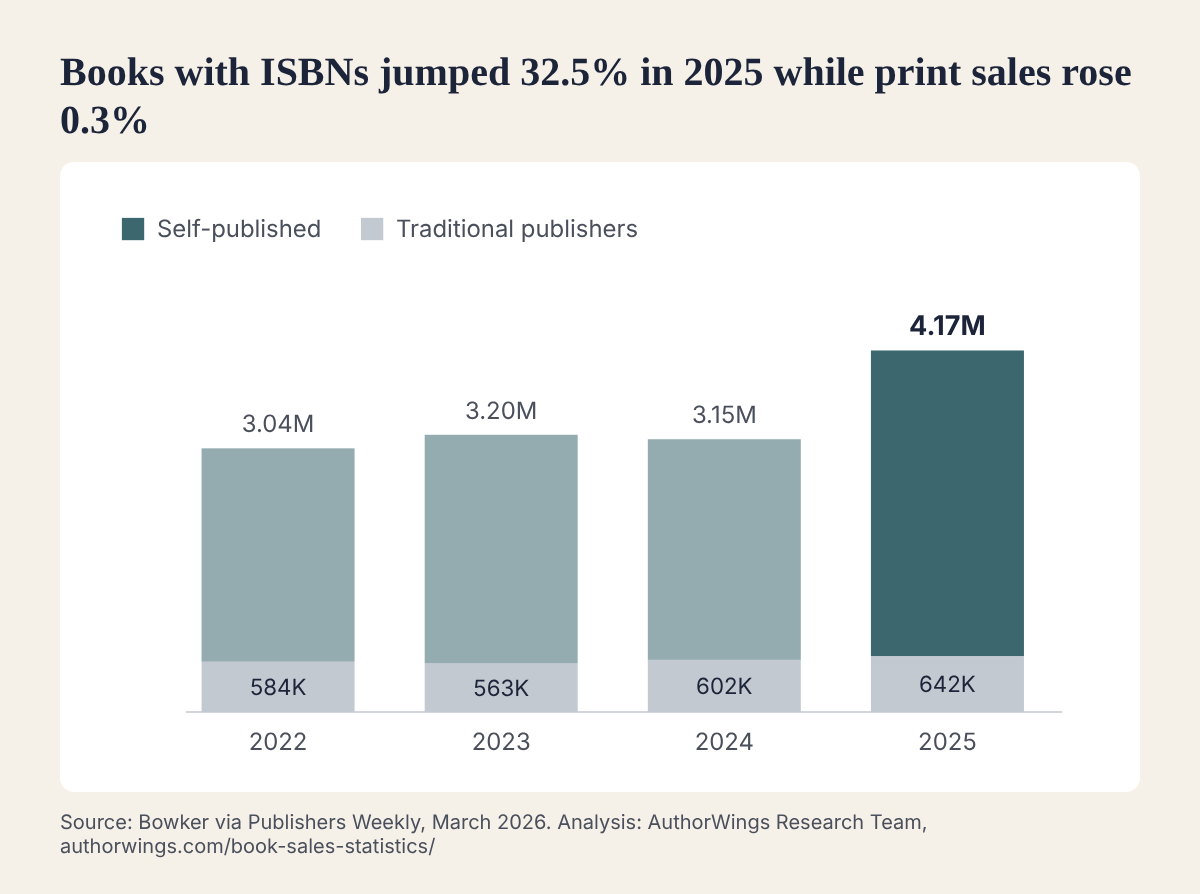
More than 4 million books got ISBNs in the US in 2025, up 32.5% from 2024. Traditional publishers released 642,242 of them, up 6.6%. The other 3,529,980 were self-published, up 38.7% (Bowker via Publishers Weekly).
These are ISBN counts, not unique books. A book released in print, ebook, and audio can carry three ISBNs, so the number of different books is lower.
Why we looked
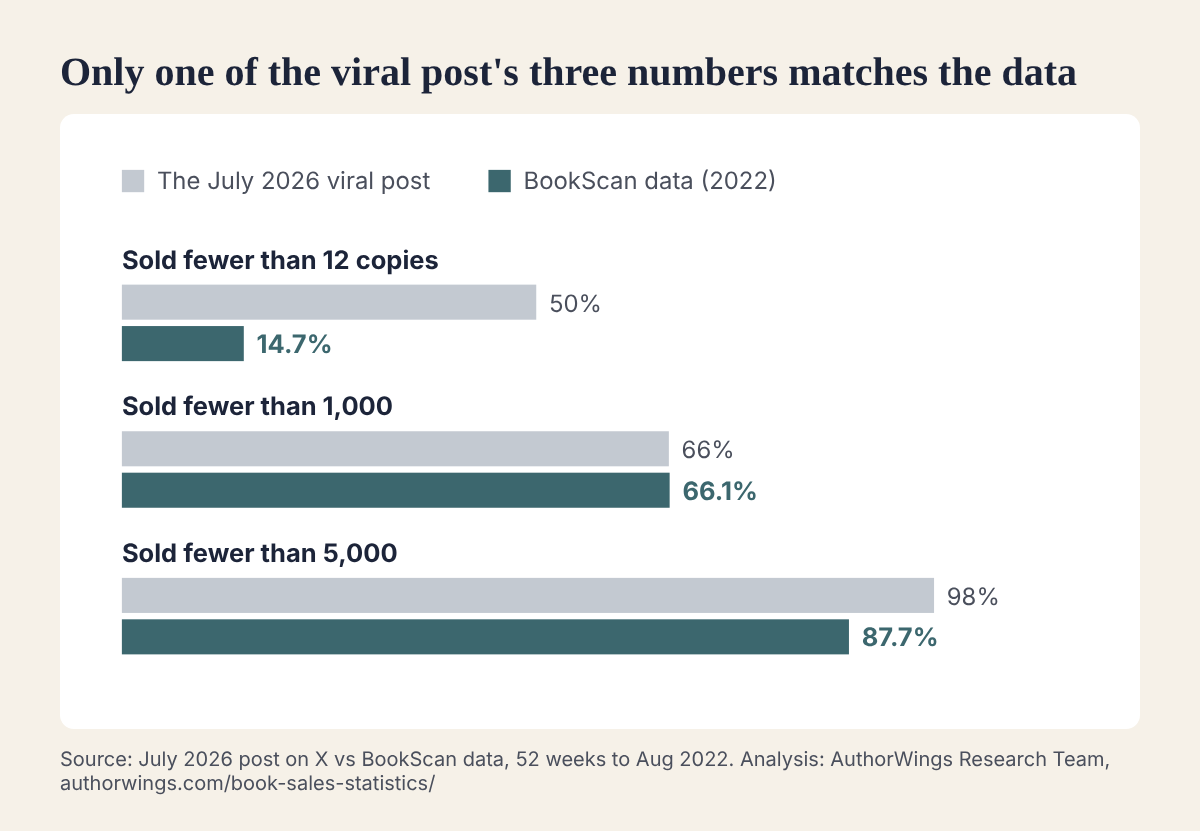
On July 15, 2026, a post on X claimed that 50% of Big Five novels sell fewer than 12 copies. It added that 66% sell fewer than 1,000, and 98% fewer than 5,000. The post spread fast, as the same claim did in 2022, 2023, and 2024. Authors worry about these numbers, so we went looking for where each one started, and where people find them today.
Others got there first, and we credit them. Kristen McLean, lead analyst at BookScan at the time, ran the numbers in 2022. Author Lincoln Michel (Counter Craft), industry analyst Jane Friedman, and Publishers Lunch have each corrected the 12-copy claim. What we add:
- An audit of what Google and five AI assistants tell people about book sales in 2026.
- Eight viral sales statistics in one place, each traced to its first source, with what it actually measured.
- A check of each claim against the BookScan data, and 2025 data on why every “average book sells X” figure keeps falling.
What Google and AI assistants tell people about book sales
The 12-copy myth is fading, but the other book sales myths are still what people find first. We checked the top 10 Google results and the AI Overview sources for 10 book sales searches in the US. The results are Google’s US results as recorded between September 28 and October 23, 2026. We read the pages and asked five AI assistants on November 1, 2026.
Google’s top results
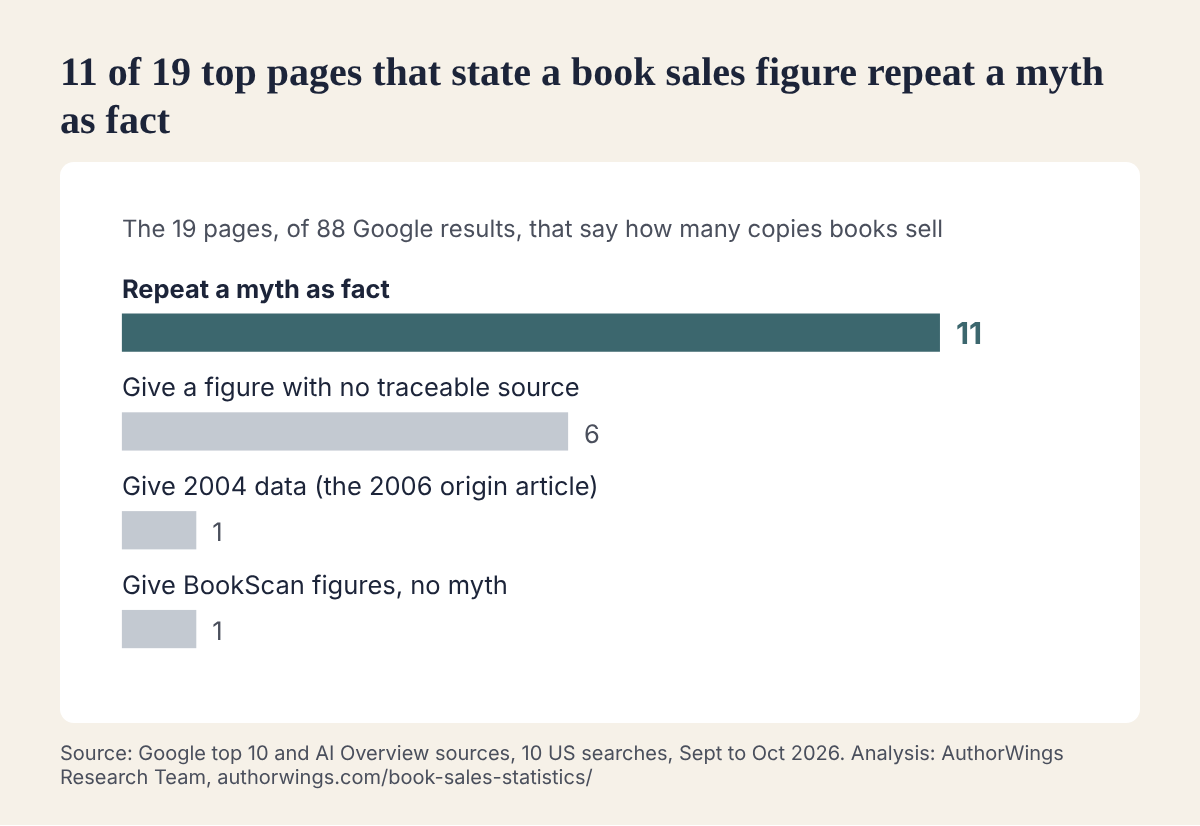
The 10 searches returned 88 unique pages. 37 of them (42%) were Reddit, Facebook, Quora, Instagram, and other forum or social posts. Of the 47 articles we could read, 19 tell readers how many copies books sell.
11 of 19 top pages that state a book sales figure repeat a myth as fact
- Only 5 of those 19 pages give BookScan’s figures, and 4 of the 5 also repeat one of the popular numbers.
- The most repeated myths: “the average book sells under 200 copies a year, or under 300 to 1,000 in a lifetime” (6 pages) and “3,000 copies in a lifetime” (3 pages).
- Google showed an AI Overview for all 10 searches. Every one cited at least one page that repeats a myth. Of the 42 source links in those Overviews, 17 went to those pages.
- The page Google’s AI Overviews cited most, for 6 of the 10 searches, repeats the “3,000 copies in a lifetime” figure without a source.
- For two searches, the AI Overview cited a 2006 Publishers Weekly article that uses 2004 sales data.
Many of these pages quote older or secondhand sources in good faith, and some were written before the 2022 BookScan breakdown came out. The numbers are easy to repeat because they sound plausible and appear in many places.
AI assistants
None of the five assistants repeated the 12-copy myth. Google’s AI answer and Microsoft Copilot both confirmed “90% of books sell fewer than 2,000 copies.”
| Assistant | Repeated the 12-copy myth | Answers with a myth stated as fact | What stood out |
|---|---|---|---|
| ChatGPT | No | 0 of 5 | Gave the BookScan figures and called the 90% claim unproven |
| Claude | No | 0 of 5 | Said the 12-copy and 90% claims don’t match the data; noted thin sources for 3,000 and 250 to 300 |
| Perplexity | No | 1 of 5 | Gave the BookScan breakdown, but used the 250 to 300 first-year estimate |
| Microsoft Copilot | No | 1 of 5 | Said yes to the 90% claim for big-publisher books. Other answers gave figures without a clear source, such as 3,000 to 10,000 first-year sales |
| Google’s AI answer | No | 3 of 5 | Said “yes, this is accurate” to the 90% claim and said only about 2% of new big-publisher books pass 5,000 copies (BookScan: 12.3%) |
We don’t name individual pages or sites. Our aim is to get the numbers right, not to single anyone out. Answers from AI assistants change over time; these are from one day.
The myth tracker: 8 viral book sales statistics, traced
None of the eight describes what a typical new book sells over its life. Each one measured something narrower, older, or different.
| The claim | Where it started | What it measured | What the data says |
|---|---|---|---|
| “Half of all books sell fewer than 12 copies” | A question from DOJ lawyer Mel Schwarz to defense economist Edward Snyder at the Penguin Random House and Simon & Schuster trial, August 2022 | No source was entered as evidence | 14.7% of new print titles from the 10 largest US publishers sold fewer than 12 copies in 52 weeks |
| “90% of books sell fewer than 2,000 copies” | The same trial question, August 2022. Still repeated in 2026 | No documented source | Below 87.7% for new books from the largest publishers, since 87.7% sold under 5,000 |
| “98% of books sell fewer than 5,000 copies” | The New York Times, April 2021, citing BookScan | Books publishers released in 2020, print only, with sales counted only within 2020 | 87.7% for new books from the 10 largest publishers. About 98% only with small presses and self-published books added |
| “Fewer than 1% of books sell more than 5,000 copies” | The New York Times, 2022, citing BookScan | All 3.2 million titles that sold in 2021, including books published decades ago | A count of every book on sale, not of new books |
| “Most books sell fewer than 99 copies” | Chris Anderson, A Bookselling Tail, Publishers Weekly, 2006 | 950,000 of 1.2 million titles that sold at least one copy in 2004, of any age | One year of sales for every title still selling, including very old ones |
| “The average book sells 500 copies” | The same 2006 Publishers Weekly article | The same 2004 count of every title with a sale | A mean across new and old titles in one year |
| “The average book sells 250 copies a year and 3,000 in its lifetime” | Steven Piersanti, 10 Awful Truths About Book Publishing, first published in 2009. Often credited to Publishers Weekly in 2006 | An estimate; versions from 2010 on apply it to US nonfiction books only | A publisher’s estimate, often repeated without the word “nonfiction” |
| “The average book sells less than 300 print copies in its lifetime” | The same Piersanti list, updated April 30, 2026 | US print sales divided by the number of books now published | Divides sales of mostly older books by a title count that is mostly self-published ISBNs |
“Half of all books sell fewer than 12 copies”: a question, not a statistic
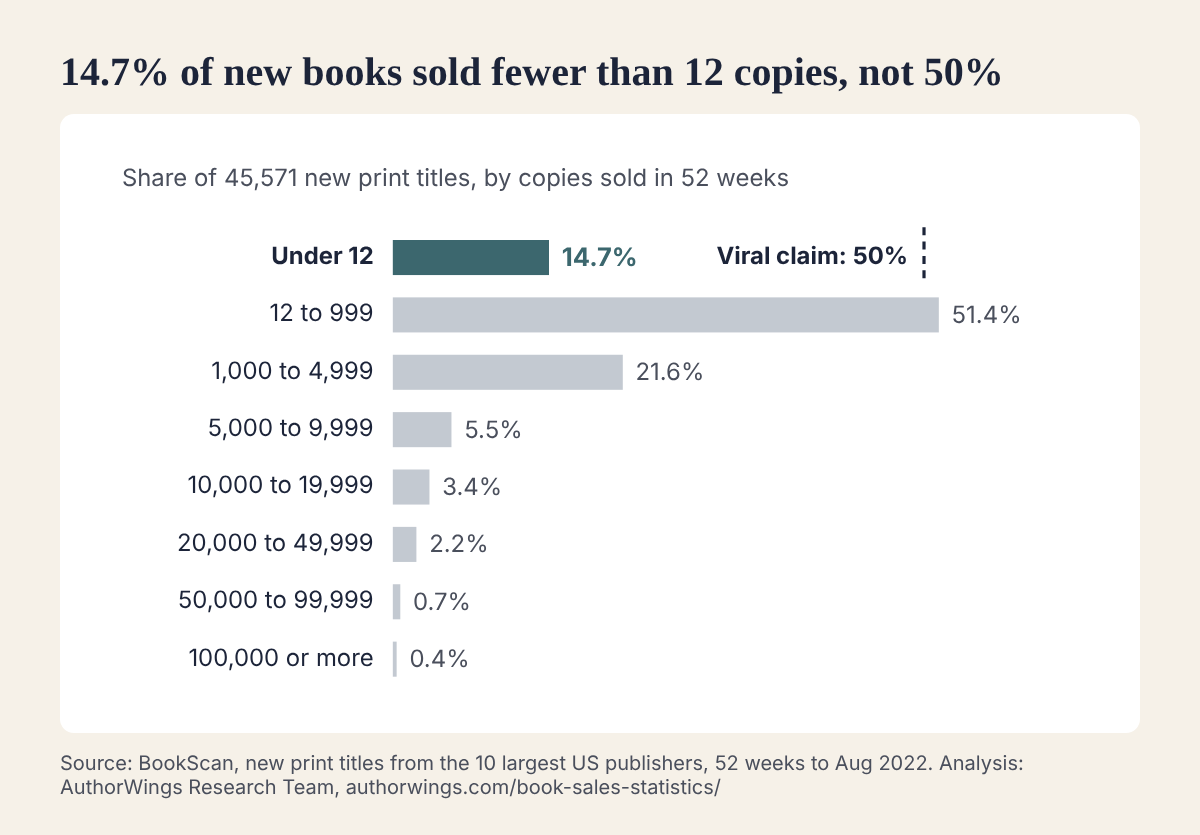
The real share is 14.7%, not 50%. The 12-copy figure started in August 2022, at the trial over Penguin Random House’s plan to buy Simon & Schuster. A government lawyer asked a defense economist whether he’d be surprised that half of about 58,000 trade titles sold fewer than a dozen copies. No source for the number was entered as evidence.
BookScan, which tracks US print sales, then ran the numbers for the 10 largest publishers. Of 45,571 new print titles, 6,701 sold fewer than 12 copies in 52 weeks.
14.7% of new books sold fewer than 12 copies, not 50%
Even 14.7% overstates how many books sell almost nothing. BookScan counts each format separately, so a hardcover, a paperback, and a large-print edition are three “titles.” And a book released two weeks before the cutoff had only two weeks of sales in the count.
“90% of books sell fewer than 2,000 copies”: the data points lower
This figure came from the same trial question in 2022, also without a source. It doesn’t fit BookScan’s own breakdown: 87.7% of new books from the largest publishers sold fewer than 5,000 copies. A smaller share must have sold fewer than 2,000, so the true figure is below 87.7%, not 90%.
“98% of books sell fewer than 5,000 copies”: true for a different group of books
This one has a real source: The New York Times, citing BookScan, in April 2021. But it covered books released in 2020 and counted only sales within that year. For new books from the 10 largest publishers, the 2022 figure is 87.7%. BookScan’s analyst said the share reaches about 98% only when small presses and self-published books are added.
The July 2026 post combined three numbers from different years and different groups of books, then described them all as “Big Five novels.” The data covered 10 publishers and every kind of book, not just novels. Only the middle number, 66%, matches BookScan.
Only one of the viral post’s three numbers matches the data
“Most books sell fewer than 99 copies” and “the average book sells 500”: every book on sale
Both come from a 2006 Publishers Weekly article by Chris Anderson, using 2004 BookScan data. They counted every title that sold even one copy that year, including books published decades earlier. An old classic that sells 10 copies a year counts the same as a new release.
“250 copies a year, 3,000 in a lifetime”: a publisher’s estimate, not a count
The earliest version we found is in Steven Piersanti’s list “10 Awful Truths About Book Publishing,” first published in 2009. It was a publisher’s estimate, not a count of sales, and versions from 2010 on apply it only to average US nonfiction books. Online, it usually appears without the word “nonfiction,” and it is often credited to Publishers Weekly in 2006 by mistake.
Why the “average book” keeps selling less, even when sales don’t fall
The “average book sells X copies” figure falls whenever ISBNs grow faster than sales, even if readers buy just as many books. In 2025, the number of new US books with ISBNs rose 32.5% to 4.17 million. Print sales rose just 0.3%.
Books with ISBNs jumped 32.5% in 2025 while print sales rose 0.3%
Here’s the math behind the newest “average.” Divide 2025’s 762.4 million print sales by 4.17 million new ISBNs and you get 183 copies per book. That number says little about any one book, for three reasons:
- Most of those 762 million sales were older books, not books published in 2025.
- 85% of the new ISBNs were self-published, and many are ebooks that BookScan doesn’t count.
- One book in four formats gets four ISBNs.
The effect is pure arithmetic. If sales stay flat while ISBNs rise by a third, the “average” falls by about a quarter. That’s what happened in 2025: the average per new ISBN fell about 24%, while print sales went up.
For traditional publishers alone, the same division gives about 1,190 print copies per new title. That’s still not a real average, but it shows how much the count of titles changes the answer.
What this means for authors
A new book that sells 1,000 print copies in its first year has outsold two in three new books from the largest publishers. That’s a more useful benchmark than any viral figure, and it counts print only.
How many books does the average new author sell? No public data separates first books from the rest, so any figure for debut authors is a guess. The closest real benchmark is the BookScan breakdown above, which covers every new book from the largest publishers, debut or not.
- Judge your book against books like it, over the same time, in the same formats. A December release and a March release can’t be compared after one calendar year.
- Count every format. BookScan misses ebooks, audiobooks, library sales, and copies you sell at events.
- Be wary of any “average book” number. Ask what was counted, over how long, and in which formats.
The bottom line: how to read any book sales number
The 12-copy myth is fading, but the myths that replaced it are still what people find first. The real numbers are less dramatic and more useful. Here is how a new book’s first-year print sales rank among new books from the 10 largest US publishers.
| First-year print sales | Share of new books that reached it | Roughly |
|---|---|---|
| At least 1,000 copies | 33.9% | 1 in 3 |
| At least 5,000 | 12.3% | 1 in 8 |
| At least 10,000 | 6.7% | 1 in 15 |
| At least 20,000 | 3.3% | 1 in 30 |
| At least 50,000 | 1.1% | About 1 in 100 |
| At least 100,000 | 0.4% | 1 in 280 |
These are print sales at stores BookScan tracks, for the biggest publishers’ books, in 2022. Ebooks, audiobooks, and direct sales add to these totals, so treat the figures as a floor, not a target.
Before you trust or share any book sales figure, ask four questions:
- Which books? New releases, or every title still on sale, old ones included?
- Over how long? One calendar year, the first 52 weeks, or a whole lifetime?
- Which formats? Print only, or ebooks and audiobooks too?
- Where is the data? If no one can point to it, treat the figure with caution.
As they usually spread online, every figure in our tracker leaves at least one of these questions unanswered. For the 12-copy claim, the last question has no answer.
Download the data
Five CSV files with a short guide: the myth tracker, the BookScan sales bands, Bowker title counts, our Google audit totals, and the AI assistant answers. Free to use with credit.
Download the data (ZIP, CSV files)
Charts are free to use too: open “Use this chart on your site” under any chart for the embed code.
Method and limits
AuthorWings offers editing and publishing services to authors. We ran no survey, and no data in this study came from our clients. For each claim, we searched for its earliest published version, read the original where it was public, and recorded what it measured. We recalculated every share from the published BookScan counts (45,571 titles in eight bands) and checked them against the published percentages.
For the Google audit, we recorded the top 10 US results and AI Overview sources for 10 book sales searches. We read every article and scored it against the eight myths; forum and social posts were counted but not scored. We asked ChatGPT, Google’s AI, Microsoft Copilot, Perplexity, and Claude the same five questions on November 1, 2026, all five in one message per assistant. Copilot’s answer to question 5 arrived cut off, so we asked that question again on its own the same day.
Limits
- The BookScan breakdown is one 52-week snapshot, to August 24, 2022, of print sales only. No newer public breakdown exists.
- BookScan counts each format (ISBN) separately and covers about 85% of US print retail. It misses ebooks, audiobooks, libraries, and direct sales.
- No public data shows lifetime sales for a typical book. Every lifetime figure in circulation is an estimate.
- Bowker counts ISBNs, not unique books. One book in several formats is counted several times.
- Google results change daily and vary by location. Ours are US results recorded between September 28 and October 23, 2026. AI answers vary from one chat to the next; we asked each assistant once.
- An earlier version of a claim may exist that we did not find. We list the earliest version we could confirm.
For journalists
Media contact: Dr. Bazla M, Head of Research, AuthorWings · bazla.mukhtar@authorwings.com. Dr. Bazla M is available for interviews.
About AuthorWings: AuthorWings offers editing, design, and publishing services to independent authors. AuthorWings Research publishes free studies on books, reading, and publishing.
“The 12-copy figure was never a statistic. It began as a question in a courtroom, and no source for it was ever shown. The real numbers are sobering enough: two in three new books from the biggest publishers sell fewer than 1,000 print copies in their first year. Authors deserve the real figure, not the scariest one.” Dr. Bazla M, Head of Research, AuthorWings
How to cite: AuthorWings Research Team. “The 12-Copy Myth Is Fading. Other Book Sales Myths Aren’t.” AuthorWings, November 2026. https://authorwings.com/book-sales-statistics/
Sources
- Jane Friedman, Why Book Sales Figures Are So Hard to Interpret (and Complete Sales Figures Nearly Impossible to Find), April 2026. Includes Kristen McLean’s BookScan breakdown.
- Jane Friedman, About That “One Dozen Copies” Statistic: NPD BookScan Helpfully Clarifies, 2022.
- Lincoln Michel, No, Most Books Don’t Sell Only a Dozen Copies, Counter Craft, September 2022.
- Lincoln Michel, That Viral “Most Books Sell < 12 Copies” Claim Again, Counter Craft, September 2023.
- Lincoln Michel, A Post About Book Sales Went Viral. Here’s What It Gets Wrong, Slate, April 2024.
- Michael Cader, That Stat Isn’t A Stat, Publishers Lunch, April 2024.
- The 12-Copy Myth, Comic Crusaders, July 2026 (on the July 2026 viral post).
- Chris Anderson, A Bookselling Tail, Publishers Weekly, 2006.
- Alexandra Alter and Elizabeth A. Harris, “What Snoop Dogg’s Success Says About the Book Industry,” The New York Times, April 2021.
- The Japan Times, June 2022 (on 2021 BookScan titles).
- Steven Piersanti, The 10 Awful Truths about Book Publishing, Berrett-Koehler, updated April 30, 2026.
- Publishers Weekly, Print Book Sales Rose Slightly in 2025, January 2026.
- Publishers Weekly, Book Output Topped 4 Million in 2025, March 2026 (Bowker data).