Home / Guides / Memoir and Autobiography
What Is a Memoir? Definition, Features and Examples
 By AuthorWings editorial team
9 min read
Short answer
A memoir is a true story from the author’s own life, usually told in the first person and focused on one part of that life: a period, a relationship, a place or a turning point. It looks back on what happened and what it meant. Unlike an autobiography, a memoir doesn’t try to cover a whole life.
You might be reading memoirs, studying one for class or wondering whether the book you want to write counts as one. This guide covers what makes a book a memoir, how true it has to be, the main kinds, and how it differs from an autobiography, a novel and an essay. When you’re ready to write your own, see how to write a memoir, step by step. If you’d rather tell your story in interviews and have a professional write it, see our memoir ghostwriting services.
Memoir meaning, and where the word comes from
A memoir is a book-length (or shorter) piece of nonfiction about the writer’s own experience. One Merriam-Webster definition is “a narrative composed from personal experience.” The writer is called a memoirist.
The word comes from French mémoire, from Latin memoria, “memory.” It entered English in the early 1400s meaning a written record or memorandum, and by the 1670s it could mean a person’s written account of their own life. The plural “memoirs” (from the 1650s) has long meant a personal record of events, which is why some whole-life books carry it in their titles.
Memoir is an old form. Around 1059 in Japan, a woman known as Lady Sarashina wrote the Sarashina nikki, covering her life from age 12 into her 50s in prose and poetry. Despite “diary” in its title, she wrote it in her later years, looking back, which is why it reads like a memoir. In Memoir: A History (2009), Ben Yagoda traces the form from Augustine and Julius Caesar to Ulysses S. Grant and recent memoirs, and argues that memoir has become “the central form of the culture.”
Six features of a memoir
Memoirs vary widely, but they usually share these six features.
The six features of a memoir
True
The events happened, told as honestly as memory allows.
First person
Told by the writer as “I,” with a few exceptions.
A narrow window
One period, relationship, place or theme, not a whole life.
A theme
One question or idea ties the chapters together.
Scenes
Key moments shown with detail, action and dialogue.
Reflection
The writer looks back and shows what it meant.
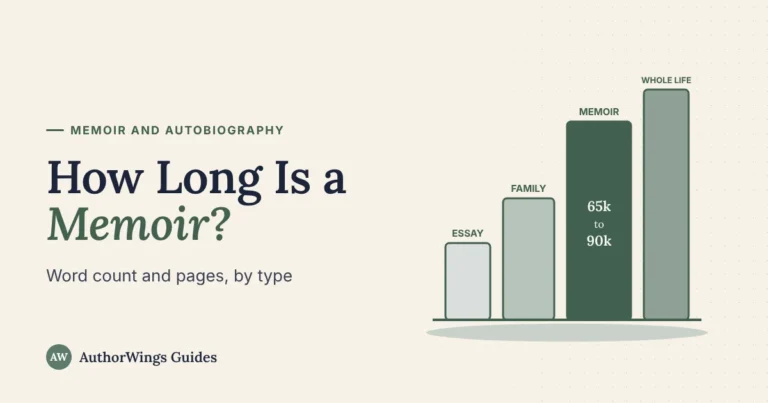
A narrow window doesn’t mean a short book. A published memoir often runs about 65,000 to 90,000 words, and a book printed for the family can be much shorter. See memoir word count by type.
A short example, with the features marked. This passage is invented for this guide:
The summer I was fourteen, my father let me drive the bakery van around the empty church lot every Sunday after the last delivery. “Clutch like you’re stepping on a sleeping cat,” he said, and I stalled it eleven times in a row. He never raised his voice that summer. I didn’t know yet that the bakery was failing, or that he was teaching me to drive because soon he wouldn’t be driving me anywhere. I only knew the van smelled of yeast and diesel, and that he laughed every time the engine died.
- Narrow window: one summer, one ritual.
- Scene: a place, an action, a line of dialogue, a smell.
- Reflection: the adult writer knows what the fourteen-year-old didn’t (“I didn’t know yet…”).
- Theme: a father protecting his child from bad news, which the rest of the book could follow.
Our memoir guide shows how to write in scenes like this one.
How true does a memoir have to be?
A memoir has to be true in its events. Readers, publishers and libraries treat it as nonfiction, so inventing things that didn’t happen breaks the promise the label makes.
Memory isn’t a recording, though, and memoirists work within some common limits:
- Dialogue is rebuilt. Few people remember exact words from years ago. Writers recreate conversations as faithfully as they can.
- Time may be compressed. Several similar visits can become one scene, and dull stretches can be skipped.
- Names and details may change to protect people’s privacy.
- An author’s note says so. Many memoirs open with a short note explaining which names were changed or what was compressed.
What crosses the line is inventing events, people or outcomes. A well-known case is A Million Little Pieces by James Frey, published in 2003 as a memoir of addiction and recovery. In January 2006, reports showed parts were made up, and Frey admitted to fabrications. Later editions carried notes from the publisher and the author, and a settlement approved by a federal judge in 2007 gave refunds to 1,729 readers who had bought it as a memoir.
Writing about real people also carries legal risk, even when every word is true. Our guide to writing about people who are still alive explains what to check before you publish.
Kinds of memoir
Memoirs are usually grouped by subject. One book can fit more than one kind. Here are six common ones, each with one well-known example. For 20 more, see our memoir examples by type.
| Kind | What it’s about | Example |
|---|---|---|
| Coming of age | Growing up, often in a hard or unusual home | The Glass Castle, Jeannette Walls (2005) |
| Family | A parent, a family or a family secret | Angela’s Ashes, Frank McCourt (Pulitzer Prize for Biography, 1997) |
| Grief and illness | Loss, illness or recovery | The Year of Magical Thinking, Joan Didion (National Book Award for Nonfiction, 2005) |
| Travel and adventure | A trip that changes the writer | Wild, Cheryl Strayed (2012), a solo walk of about 1,100 miles of the Pacific Crest Trail |
| Work | A career, trade or field seen from inside | Kitchen Confidential, Anthony Bourdain (2000) |
| Graphic memoir | A memoir told in comics form | Fun Home, Alison Bechdel (2006) |
You don’t need to be famous to write one. Frank McCourt taught in New York City public schools for about 30 years before Angela’s Ashes, his first book.
How a memoir differs from similar books
The difference comes down to whose life it is, how much of it, and whether it’s true.
| Type | Whose life | How much of it | True? | Example |
|---|---|---|---|---|
| Memoir | The writer’s | One part, told for its meaning | Yes | Wild |
| Autobiography | The writer’s | The whole life so far, usually in order | Yes | Life and Times of Frederick Douglass (1881, expanded 1892) |
| Biography | Someone else’s | Usually the whole life | Yes | Steve Jobs, Walter Isaacson (2011) |
| Autobiographical novel | Based on the writer’s | Any | No, it’s fiction | The Bell Jar, Sylvia Plath (1963) |
| Personal essay | The writer’s | One moment or idea, a few pages | Yes | Magazine and newspaper essays |
| Diary or journal | The writer’s | Day by day, written at the time | Yes | The Diary of a Young Girl, Anne Frank (1947) |
One line in that table surprises people: a diary isn’t a memoir. A memoir looks back on events from a distance, while a diary records them as they happen. A diary can become raw material for a memoir later. For the full side-by-side, see memoir vs autobiography vs biography.
If you’re writing about your whole life, our guide to writing a book about your whole life fits better. If your story fits in a few pages, see how to write a short memoir or memoir essay.
Quick check: is your book a memoir?
Quick check
Is your book a memoir?
Your book is most likely
When to get help
You can write a memoir on your own with a clear window, a theme and honest scenes. Help makes sense at two points:
- You want to write it yourself, with feedback. A book coach reads your pages every two weeks and sets your next deadline. Memoir is one of the genres our coaches cover. Book coaching is from $849, or try one session for $399.
- You’d rather tell it than write it. A memoir ghostwriter interviews you, learns how you talk and writes the book in your voice. Memoir ghostwriting is 68¢ a word, from $13,600 for 20,000 words, and takes 8 to 27 weeks. Every word is written by a human writer.
Memoir ghostwriting
Your story, in your voice
Tell your story in recorded interviews. A memoir writer turns them into a book that sounds like you, with your name on the cover.
- 68¢ a word, from $13,600
- Every word written by a human writer
- An NDA signed before we start
Questions about memoirs
Is a memoir fiction or nonfiction?
A memoir is nonfiction. Readers, publishers and libraries expect the events to have happened, even though the writer rebuilds dialogue from memory and may change names or compress time. A book that openly invents events is fiction, such as an autobiographical novel. One that invents events while claiming to be true misleads readers, and publishers have faced lawsuits when a memoir turned out to be partly invented.
Does a memoir have to be in chronological order?
No. Many memoirs move back and forth in time. Wild follows Cheryl Strayed’s hike in order but cuts back to the events that led her to it, including her mother’s death. What matters is that the order serves the theme, and that the reader can always tell when they are.
Can a memoir be written in third person?
Yes, though it’s rare. A famous example is The Education of Henry Adams, privately printed in 1907, in which Adams writes about himself as “he.” It won the Pulitzer Prize for Biography in 1919. Memoirs usually use “I,” because readers expect to hear the writer’s own voice, and third person can make the book feel distant.
What is a memoirist?
A memoirist is a person who writes a memoir. You don’t need to be a professional writer or a public figure to be one. Many memoirists are ordinary people writing about one part of their life, and some tell their story to a ghostwriter, who writes it in their voice with their name on the cover.
AuthorWings editorial team
The AuthorWings editorial team writes and updates our guides for first-time authors. Every post is read and edited by a person on our team before it is published.