Home / Guides / Memoir and Autobiography
Memoir vs Autobiography vs Biography: The Differences
 By AuthorWings editorial team
10 min read
Short answer
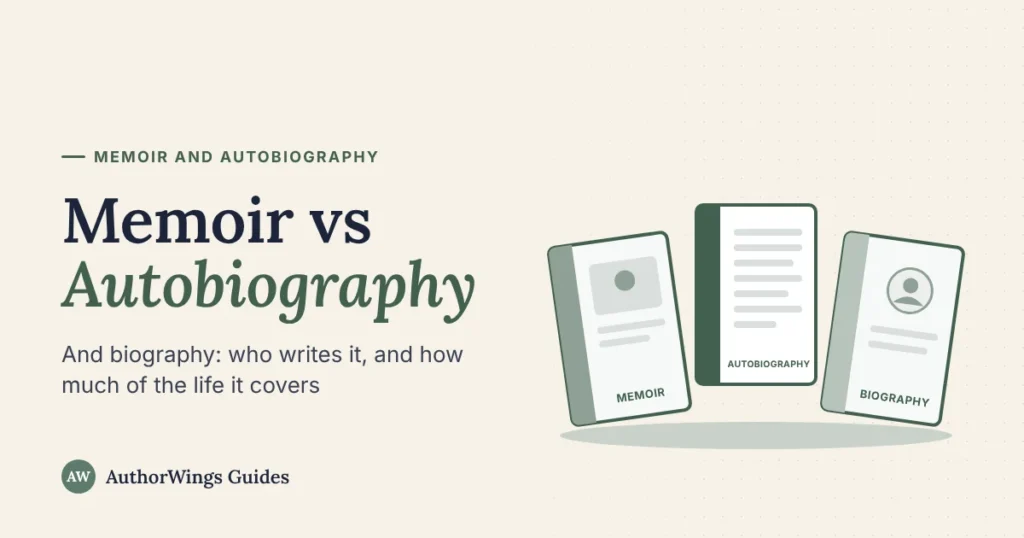
A memoir and an autobiography are both true stories written by the person who lived them. An autobiography covers the whole life so far, usually in order. A memoir covers one part of a life, told for what it meant. A biography is a life story written by someone else, usually from research.
The three words get swapped all the time, even on bookstore shelves. The difference comes down to two questions: who is writing, and how much of the life the book covers. This guide puts the three side by side, shows the same life written all three ways, and helps you see which one you’re writing. If you’d rather tell your story and have it written for you, a memoir ghostwriter can write it in your voice.
Memoir vs autobiography vs biography at a glance
| Compare | Memoir | Autobiography | Biography |
|---|---|---|---|
| Who writes it | The person who lived it | The person who lived it | Someone else |
| Whose life | The writer’s | The writer’s | The subject’s |
| How much of the life | One part: a period, relationship or theme | The whole life so far | Usually the whole life |
| Order | Any order that serves the theme | Usually in time order | Usually in time order |
| Main focus | What the experience meant | What happened, and when | The subject’s life and times, from the outside |
| Source | Memory and the writer’s own records | Memory and the writer’s own records | Research: interviews, letters, archives |
| Voice | Usually first person | Usually first person | Third person (“she,” “he”) |
| Typical reader question | “What was it like?” | “How did this person get here?” | “Who was this person?” |
| Example | Educated, Tara Westover (2018) | Long Walk to Freedom, Nelson Mandela (1994) | Grant, Ron Chernow (2017) |
For the full definitions, see what makes a book a memoir and the features of an autobiography.
Memoir vs autobiography: one part or the whole life
Both are true, both are written by the person who lived them, and both usually use “I.” The difference is how much of the life the book takes on.
- An autobiography aims at the whole life so far. It usually starts with family and childhood and moves forward to the time of writing. Readers expect the main events to be there.
- A memoir chooses one part. It might cover one year, one relationship, one illness or one career, and it leaves the rest out on purpose. Because it isn’t tied to the calendar, it can move back and forth in time.
A short test: ask what the book promises. If it promises your life, a missing decade is a gap, so it’s an autobiography. If it promises one story, that decade is a detour, so it’s a memoir.
Biography vs autobiography: who writes it
The difference here is the writer. An autobiography is written by its subject. A biography is written by someone else, about the subject.
That changes how the book is made. A biographer works from research: interviews, letters, diaries, records and other books. They can include things the subject never knew or wouldn’t say, and they can write about someone who died long ago. An autobiographer works from memory and their own papers, and can tell readers what it felt like from the inside.
A ghostwritten autobiography is still an autobiography. The subject tells the story and usually has the final say, even if a professional writer shapes the sentences.
Memoir vs biography: inside view or outside view
A memoir is the inside view of one part of the writer’s own life. A biography is the outside view of someone else’s life, usually the whole of it.
The two meet when a memoir is about another person. A writer can write a memoir about a parent, for example, as long as it’s told from their own memory and relationship. Alison Bechdel’s graphic memoir Fun Home (2006) centers on her father, but it’s her story of growing up with him, so it’s a memoir. A book about the same father built from his letters and other people’s interviews would be a biography.
The same life, three ways
Here is one invented woman, Elena Marsh, who worked at a small-town clinic for forty years. The same moment, her first night alone at the clinic, reads differently in each form.
As a memoir (one part of the life, told for meaning):
The first night Dr. Hale left me in charge, a farmer carried his son in through the back door with a nail through his foot, and I realized nobody was coming to tell me what to do. I was twenty-six. I didn’t know yet that I would stay for forty years. I only knew my hands were shaking and that the boy was watching them.
As an autobiography (the whole life, in order):
I was born in 1951 in Harlan County, the second of four children. After nursing school in Lexington I took a post at the Millbrook clinic in 1977, meaning to stay two years. On my first night alone a farmer’s boy came in with a nail through his foot, and I learned more that night than in two years of school. In 1979 Dr. Hale retired, and I ran the clinic alone until 2017, long after I’d stopped counting the years.
As a biography (someone else’s research, third person):
Elena Marsh arrived in Millbrook in the fall of 1977, according to the county’s employment records. Neighbors interviewed for this book remember her first winter as the one when the road washed out twice. “She never once closed the door,” said a farmer whose son she treated on her first night alone.
The memoir stays in that one night and looks back on it. The autobiography gives the night one sentence and moves on through the decades. The biography stands outside her and builds the picture from records and other people’s words.
One life, more than one book
Some well-known lives exist in more than one form, which is a good way to see the difference.
- Frederick Douglass told his own life three times, in three autobiographies. David W. Blight’s biography, Frederick Douglass: Prophet of Freedom (2018), tells it from the outside, drawing on letters, records and family papers with material Douglass’s own books leave out. It won the 2019 Pulitzer Prize for History.
- Ulysses S. Grant wrote Personal Memoirs of U. S. Grant (1885 and 1886) in his last year, while dying of cancer. It uses “memoirs” in the older sense, an account of public events the writer took part in: it covers his military career and barely mentions his presidency. Ron Chernow’s biography Grant (2017) covers the whole life, including the years Grant left out.
- Maya Angelou wrote seven books about her life, starting with I Know Why the Caged Bird Sings (1969). She called them autobiographies, but the first six each cover a different stretch of her life, so many readers treat each one much like a memoir. The seventh, Mom & Me & Mom (2013), revisits her life through her mother.
Why the labels blur
If the three seem mixed up in bookstores, that’s because they often are.
- They share a category. The book trade’s subject headings (BISAC, used by publishers and retailers in the US) put all three under one heading, “Biography & Autobiography,” with “Memoirs” (labeled “Personal Memoirs” in older lists) as one of its subjects. So a memoir and a biography of a president can turn up in the same section.
- Titles don’t follow the rule. Grant’s Personal Memoirs uses the word in its older sense, a record of public events, rather than a personal story told for what it meant.
The label on the cover is the publisher’s choice. The definitions above are a more reliable way to tell what a book actually is.
Choosing between them for your own book
If you’re writing a life story, what you have to work with often decides the form:
- You were there, and one stretch matters most. You have the memories and one clear subject, so a memoir fits.
- You want the whole record, start to finish. You have the timeline and want it all on the page, so an autobiography fits.
- The life is someone else’s. You’ll need interviews, letters and records, so you’re writing a biography. If the book is really your own memories of that person, it can still be a memoir.
To check your book in a minute, try our quick check: is your book a memoir? For one part of your life, see how to write a memoir, step by step. For the whole of it, see the steps to write an autobiography, and our guide helps you weigh your whole life or one part of it.
When to get help
You can write a memoir or an autobiography on your own. Help makes sense at two points:
- You want to write it yourself, with feedback. A book coach reads your pages every two weeks and sets your next deadline. Memoir is one of the genres our coaches cover. Book coaching is from $849, or try one session for $399.
- You’d rather tell it than write it. A ghostwriter interviews you and writes the book in your voice, whether it’s a memoir or a whole-life autobiography. The price is the same for both, set by length, from $13,600.
Memoir and autobiography ghostwriting
One part of your life, or all of it
Tell your story in recorded interviews. A memoir writer turns them into a memoir or an autobiography that sounds like you.
- 68¢ a word, from $13,600
- Same price for memoir or autobiography
- Every word written by a human writer
Questions about memoir, autobiography and biography
Is a memoir a type of autobiography?
In a broad sense, yes. Both are true accounts written by the person who lived them, and the book trade files memoirs under “Biography & Autobiography.” In the narrower sense writers and editors use, a memoir is different because it covers one part of a life rather than the whole. Many readers use the two words loosely, so context matters.
Can a memoir become an autobiography?
Not by itself, but a series of memoir-like books can add up to one. Angelou’s first six books each cover a different stretch of her life, and together they tell it from childhood to 1968. She called them autobiographies. A writer can also expand a memoir into a full autobiography later by adding the years before and after it.
Is an authorized biography the same as an autobiography?
No. An authorized biography is written by someone else, with the cooperation or approval of the subject (or, after death, their family or estate), often including interviews and access to papers. The subject or estate helps, but the biographer does the research and the writing, and tells the story in the third person. In an autobiography, the subject tells their own story, even when a writer helps shape it.
Is a memoir more emotional than an autobiography?
Often, though not always. Because a memoir focuses on one part of a life and what it meant, it usually spends more time on feelings and reflection. An autobiography covers more ground, so it tends to move faster through events. Both can be personal, and the writer’s voice matters more than the label.
AuthorWings editorial team
The AuthorWings editorial team writes and updates our guides for first-time authors. Every post is read and edited by a person on our team before it is published.