Home / Guides / Memoir and Autobiography
How to Write an Autobiography: Steps, Structure and Outline
 By AuthorWings editorial team
9 min read
Short answer
To write an autobiography, decide who it’s for, build a timeline of your whole life, choose a structure, then outline your chapters by stage of life. Draft one chapter at a time, check your facts and revise. A short autobiography for school follows the same idea in about five paragraphs.
An autobiography is the story of your whole life so far, written by you. If you’re not sure that’s what you’re writing, see what an autobiography is first. This guide covers the steps, three ways to structure the book and a full sample outline, plus a short version for school assignments. If you’d rather talk than type, an autobiography ghostwriter can turn your interviews into the book.
Check that it’s a whole-life book
An autobiography covers your whole life. If your story is really one period or one turning point, you’re writing a memoir, and the plan is different. Our comparison helps you decide between a memoir or autobiography.
How to write an autobiography in 7 steps
- Decide who it’s for. A book for your grandchildren, a book for the public and a book to make sense of something each need a different length and tone. Our life story guide explains who the book is for and why it matters.
- Build a timeline of your whole life. List the years and the events in each, from your family’s story before you to today. It’s the raw material for every chapter. See how to build a timeline first.
- Choose a structure. Time order is a common choice and the easiest to follow, but you have options. Three common structures are below.
- Outline your chapters. Group the timeline into chapters, usually one stage of life each, and give each chapter a one-line summary. Pick one thread that runs through your life, such as a calling, a place or a family, and use it to decide what stays in. A sample outline is below. Our free life story template gives you a grid to fill in.
- Draft from your outline. Work through it chapter by chapter, in any order, until every line of the outline has a draft.
- Check your facts. Memory slips with dates and places. Check what you can against records and the people who were there, and see how to check your memories and handle writing about people who are still alive.
- Revise, then publish or print. Read the whole draft through, fix the order and cut what doesn’t belong. Then decide how to finish and publish it, whether for a few family copies or for sale.
Three ways to structure an autobiography
| Structure | How it works | Good for | Watch out for |
|---|---|---|---|
| In time order | Starts with your family and birth, and moves forward to today | Family books and first-time writers; easy to follow | Slow early chapters; open with a strong scene to pull readers in |
| By theme | Each chapter covers one part of life (family, work, faith, places) across all the years | Lives with several separate threads | Repeating the same years; give readers dates to hold on to |
| Framed by the present | A present-day thread (a return home, an illness, a reunion) runs between chapters about the past; in a whole-life book, that thread is usually you today | Lives with one recent event that makes the past matter | Two timelines can confuse; keep the present thread short |
The usual parts of a life, from origins to later years, are laid out in the usual parts of an autobiography, and you can see how autobiographies begin in three classic openings.
A sample autobiography outline: 12 chapters
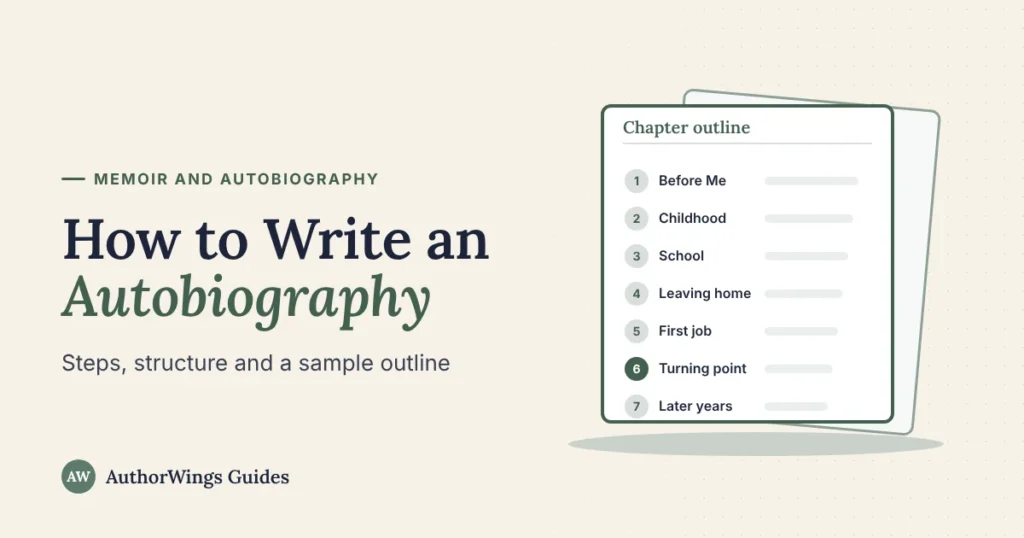
Here’s a full outline for one invented life, Elena Marsh, a nurse who worked at a small-town clinic in Kentucky for forty years. It uses time order, with one chapter per stage. A shorter family book may need fewer chapters, and a full timeline often turns up more. A classic full-life autobiography often runs 60,000 to 120,000 words, and a family book can be far shorter; our life story guide covers how long a book about your life should be.
| Chapter | Title | What it covers |
|---|---|---|
| 1 | Before Me | Her grandparents and parents in Harlan County, and the family stories she grew up with |
| 2 | The House on Clover Fork | Childhood in the 1950s, her brothers and sister, and the house they shared |
| 3 | The Schoolhouse Years | School, the teacher who lent her books, and the first time she wanted to be a nurse |
| 4 | Leaving Harlan | Nursing school in Lexington, money troubles and the friends who got her through |
| 5 | Two Years, I Said | Arriving at the Millbrook clinic in 1977, meaning to stay two years |
| 6 | The First Night Alone | The night Dr. Hale left her in charge, and what it taught her |
| 7 | The First Winter | The winter the road washed out twice, and the patients she reached anyway |
| 8 | On My Own | Dr. Hale retires in 1979, and she runs the clinic alone |
| 9 | Marriage and the Farm | Meeting her husband, the farm and the children |
| 10 | What Changed | New rules, new medicines and a town that got smaller |
| 11 | Closing the Door | Retiring in 2017, and handing the clinic on |
| 12 | What Forty Years Taught Me | What the clinic taught her, and what she’d tell a young nurse now |
Notice that the chapters aren’t equal in time. Chapter 6 covers one night, and chapter 10 covers decades. Give the most space to the stretches that changed you.
What each chapter needs
A chapter in an autobiography works best with three things:
- At least one scene. Show one key moment with place, action and what people said, so the chapter isn’t only a summary. Our memoir guide shows how to write in scenes.
- A year or an age. Because an autobiography covers decades, tell readers at the start of each chapter roughly when they are.
- A look back. A line or two on what this stage meant, from where you stand now.
How to write an autobiography for school
A school autobiography is a short version of the same idea: your life so far, told by you. It can be anything from one page to a project of several chapters, depending on your grade, so check your assignment for the length and what your teacher wants included.
For a short, essay-style assignment, a five-paragraph plan works well:
- Introduction: who you are, and one detail or moment that hooks the reader.
- Early life: where you were born, your family and your first memories.
- A turning point: one event that changed you, told as a short scene.
- Who you are now: your interests, what matters to you and what you’ve learned.
- Looking ahead: what you hope comes next, tied back to your opening.
A short example (invented for this guide):
The first thing I remember is the sound of my grandmother’s sewing machine through the wall, late at night, while everyone else slept.
I was born in early 2013 in Fresno, California, the youngest of three, and for my first seven years I shared a room with my sister and that sound. Then my family moved to Portland for my dad’s job. I cried for the whole drive. I didn’t know anyone at my new school, and I barely spoke in class for two years.
That changed in fourth grade, when my teacher asked me to read my story out loud at an assembly. The paper rattled in my hands. When I finished, people clapped, and a girl I’d never talked to asked if I’d write a story with her. We’re still friends.
Now I’m in eighth grade. I write for the school paper, I play soccer, and I’ve learned that the scary thing is usually worth doing.
I want to be a journalist someday. Sometimes, when I’m writing late, I think about that sewing machine, and how my grandmother made something out of pieces every single night.
That example covers each part of the plan in under 200 words. If your assignment is a memoir about one event instead, see our tips on writing a memoir for school.
Getting help with your autobiography
The steps above are yours to follow alone. If you’d like support with them:
- Keep steps 5 to 7 moving. A book coach reads your latest pages every two weeks and sets the next deadline. One of our coaches works with memoir writers. Book coaching is from $849, or $399 for a single session.
- Hand over the writing. A ghostwriter turns your timeline into interview sessions, plans the chapters with you and writes the book. Autobiography is priced like memoir, by length, from $13,600, and every word is by a human writer.
Autobiography ghostwriting
Your life, written for you
Tell your life story in recorded interviews. A professional writer plans the chapters and writes the book in your voice.
- 68¢ a word, from $13,600
- Every word by a human writer
- A chapter plan you approve before drafting
Questions about writing an autobiography
How do I end an autobiography?
End where you are now, looking back. The last chapter usually brings the story up to the present and says what the whole life adds up to: what you learned, what you’d do differently, or what you hope for the people reading it. Tie it back to an early scene or question if you can, so the book feels finished rather than stopped.
How do I write about the present if my life is still going?
Choose a clear stopping point, such as retirement, a move or a recent milestone, and end the main story there. The final chapter can look back from today without trying to cover every recent year. If big changes come later, you can add an afterword or a new chapter in a future edition.
Can I write my autobiography in parts?
Yes. Some writers publish their life in more than one volume, each covering a stretch of years. Doris Lessing did this with Under My Skin (1994), which runs to 1949, and Walking in the Shade (1997), which covers 1949 to 1962. It also makes a long project easier to finish. Plan the whole timeline first so each part has a clear beginning and end, then write and release them one at a time.
What’s the difference between a timeline and an outline?
A timeline lists what happened and when, across your whole life. An outline turns it into a book: it groups those events into chapters, picks which moments become scenes and decides the order. Build the timeline first, then use it to write the outline, one line per chapter.
AuthorWings editorial team
The AuthorWings editorial team writes and updates our guides for first-time authors. Every post is read and edited by a person on our team before it is published.