Home / Guides / Memoir and Autobiography
How to Start a Memoir: 10 Opening Strategies, With Examples
 By AuthorWings editorial team
9 min read
Short answer
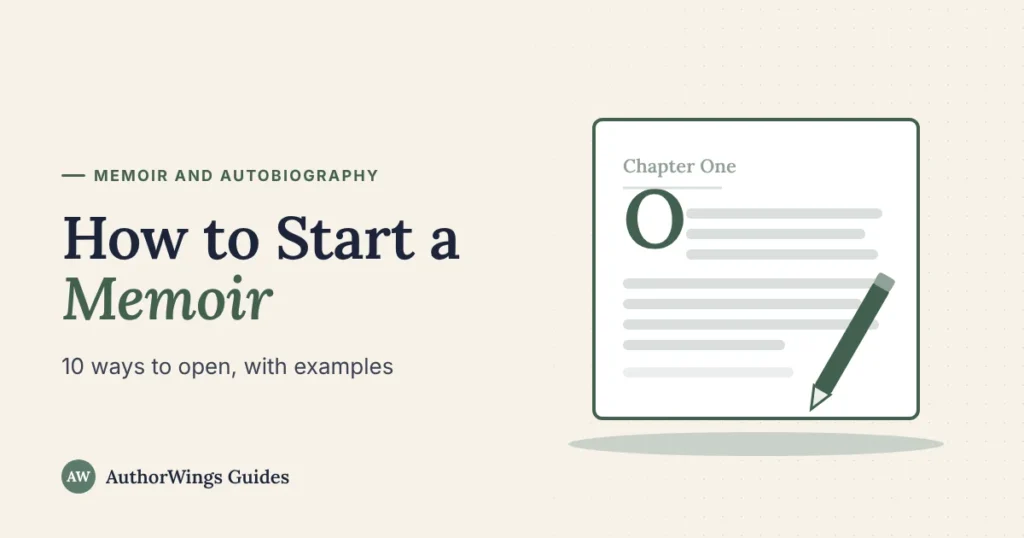
Start a memoir inside a moment that matters, close to your turning point, in a moment or line that raises a question the book will answer. Skip your birth and family history on page one; they can come in later. Below are 10 ways to open a memoir, each shown on the same story, so you can see which one fits yours.
The first page of a memoir does more work than any other. It tells readers whose voice they’re in, what kind of story this is and why they should keep going. This guide covers ten ways to open, a table to match an opening to your book, and a checklist for the whole first chapter. Prefer to talk it through instead? A memoir ghostwriter can write the whole book, first line included.
Starting the writing vs starting the book
“How do I start a memoir?” can mean two things. If you haven’t started writing at all, do three things first:
- Choose the story. Pick one stretch of your life and the question it answers. Our memoir ideas can help.
- Write the theme in one sentence. Our guide on how to write a memoir shows how.
- List your key moments. Then draft the moment you remember best first, wherever it falls in the story.
The rest of this guide is about the other meaning: how to open the book itself.
What the first page has to do
A strong memoir opening usually does three jobs at once:
- Raises a question. Something is wrong, about to change or not yet explained, so the reader wants to know what happens.
- Sets the voice. Within a few lines, readers should hear how you talk: wry, plain, lyrical or blunt.
- Places the reader. A time, a place and a body in it, so the reader is somewhere, not just being told things.
10 ways to start a memoir
Every example below opens the same invented memoir: a writer who cared for her father through three years of dementia, from the first worrying phone call to his funeral. The turning point is the day he no longer knew her name.
1. Open at the turning point
Start on the day everything changed, then go back to show how you got there.
On a Tuesday in March, my father looked up from his crossword, smiled politely and asked me what my name was.
When it works: books built around one moment. Watch for: giving away so much that the rest feels like a long flashback. Leave the reader wanting the how and the why.
2. Open just before everything changed
Show ordinary life a moment before it broke, so readers feel the loss when it comes.
The last normal Sunday, my father burned the pancakes and blamed the pan, the way he had every Sunday for forty years.
When it works: stories about loss or sudden change. Watch for: making the “before” too long. A page or two is usually enough.
3. Open with the question
State the question the book will spend its pages answering.
I have spent five years trying to work out whether I lost my father all at once or a little at a time.
When it works: reflective memoirs. Watch for: sounding like an essay. Follow the question quickly with a scene.
4. Open with a sense memory
Start with one sound, smell or texture that carries the whole story.
His study smelled of pipe tobacco long after he gave up smoking, and in the end it was the only room he still recognized.
When it works: quiet, lyrical memoirs. Watch for: pretty writing with no tension. The detail should point toward the story.
5. Open with a line of dialogue
Let someone speak first.
“Who’s paying you to be here?” my father asked, the night I moved into his spare room, two years in.
When it works: stories driven by a relationship. Watch for: a line readers can’t understand without context. Explain who’s speaking in the next sentence.
6. Open in the present, looking back
Start where you are now and turn to the past.
I’m writing this at his old desk, which I couldn’t bring myself to sell, two years after his funeral.
When it works: memoirs framed by the present. Watch for: staying in the present too long. Get to the past within a page.
7. Open with an admission
Tell readers something you’d rather not, so they trust you from the start.
The first time my father forgot my name, part of me was relieved, because it meant I could stop pretending things were fine.
When it works: honest, self-questioning memoirs. Watch for: confessions for shock alone. It has to matter to the story.
8. Open with a place
Put readers in one place that holds the story.
The memory clinic was on the fourth floor of a building with a dentist on every other floor, so the waiting room always smelled of mint.
When it works: stories tied to a house, town or institution. Watch for: describing the place without anyone in it. Bring yourself in early.
9. Open with an object
Start with one thing that stands for the whole story.
The notebook he kept by the phone started as a list of numbers and ended as a list of names he was afraid to forget.
When it works: stories with a meaningful keepsake. Watch for: an object that’s only decoration. It should come back later in the book.
10. Open with a surprising statement
Say something about yourself the reader doesn’t expect.
At forty-one, I started cutting my father’s toast into squares, the way he once cut mine.
When it works: memoirs with a strong, clear voice. Watch for: a line that promises more than the book delivers. Make sure the chapter backs it up.
Pick your opening by your book
| If your memoir is about… | Try opening with | Why |
|---|---|---|
| One event that changed everything | 1 (the turning point) or 2 (just before) | The event is the hook |
| A relationship | 5 (dialogue) or 9 (an object) | Readers meet the other person, or what they left behind, fast |
| Grief or illness | 2 (just before) or 4 (a sense memory) | Readers feel what’s at stake |
| Something you’re still working out | 3 (the question) or 6 (the present) | The reflection is the point |
| A place or a move | 8 (a place) or 4 (a sense memory) | The setting carries the story |
| A funny or unusual life | 10 (a surprising statement) or 5 (dialogue) | Voice comes first |
| Something hard to admit | 7 (an admission) | Honesty earns trust early |
Five openings to avoid
- Your birth. Unless the circumstances of your birth are the story, start later.
- A weather report. Describing the day before anything happens delays the story.
- A summary of the whole book. “This is the story of how I…” belongs in your notes, not on page one.
- An apology. Opening with “I’m not a writer, but…” undercuts the trust you need.
- A long cast list. Introduce people as they matter, not all at once.
A first chapter checklist
By the last page of chapter one, readers should know:
- Whose story it is, in your voice.
- Roughly when and where it starts.
- What’s at stake, or what question the book will answer.
- One scene, shown in full, not summarized. Our memoir guide shows how to write in scenes.
- A reason to turn the page, usually something not yet resolved.
Some memoirs open with a short prologue before chapter one. Our memoir guide covers whether you need a prologue. To see how real books handle their first pages, read a few from our memoir examples, or compare how autobiographies open.
Getting help with your opening
Openings are often rewritten many times, and a second reader helps:
- A reader for chapter one. Every two weeks, a book coach reads your newest pages, opening included, and marks where they hold and where they sag. We have a coach who works with memoir. Book coaching is from $849, or $399 for a single session.
- A writer for the whole book. A memoir ghostwriter interviews you and writes it, first page to last, in your voice, from $13,600. Every word is by a human writer.
Memoir ghostwriting
From first line to last, in your voice
You talk, we record, and a memoir writer shapes it into a book that sounds like you from page one.
- 68¢ a word, from $13,600
- Every word by a human writer
- A chapter plan you approve before drafting
Questions about starting a memoir
Should a memoir start at the beginning of your life?
Usually not. A memoir covers one part of your life, so it starts near the stretch the book is about, often close to the turning point. Childhood belongs on the first page only if the memoir is about childhood, or if one early memory sets up the whole story. Background can come later, a little at a time, as the reader needs it.
How long should the first chapter of a memoir be?
Long enough to do its job: introduce your voice, place the reader and raise the book’s question, usually with at least one full scene. Aim for about the same length as your other chapters. If yours is much longer, it may be carrying background that could move later in the book.
Can I start my memoir with a quote?
You can open with an epigraph, a short quotation set at the start of a book or chapter, but it doesn’t replace a strong first line. Song lyrics and poetry almost always need the rights holder’s permission, even for a line or two; for other copyrighted work, check with your publisher or a lawyer. A line of your own, or one someone in the story actually said, often does the job better.
What if my opening feels dull?
Look for the first moment of tension and cut everything before it. Often the real opening is a page or two into the draft, after the warm-up. Try two or three of the strategies above on the same scene, then read them aloud. The one that makes you want to keep going is usually the right one.
AuthorWings editorial team
The AuthorWings editorial team writes and updates our guides for first-time authors. Every post is read and edited by a person on our team before it is published.