Home / Guides / Design and Illustration
Book Cover Design Ideas: 16 Concepts and the Genres They Fit
 By AuthorWings editorial team
10 min read
Short answer
The best book cover design ideas are simple enough to read as a thumbnail and clearly signal your genre. Common concepts include big type with no image, one symbolic object, a silhouette, illustrated characters, and a tiny figure in a huge setting. Pick one idea, match it to your genre’s conventions, and test it small.
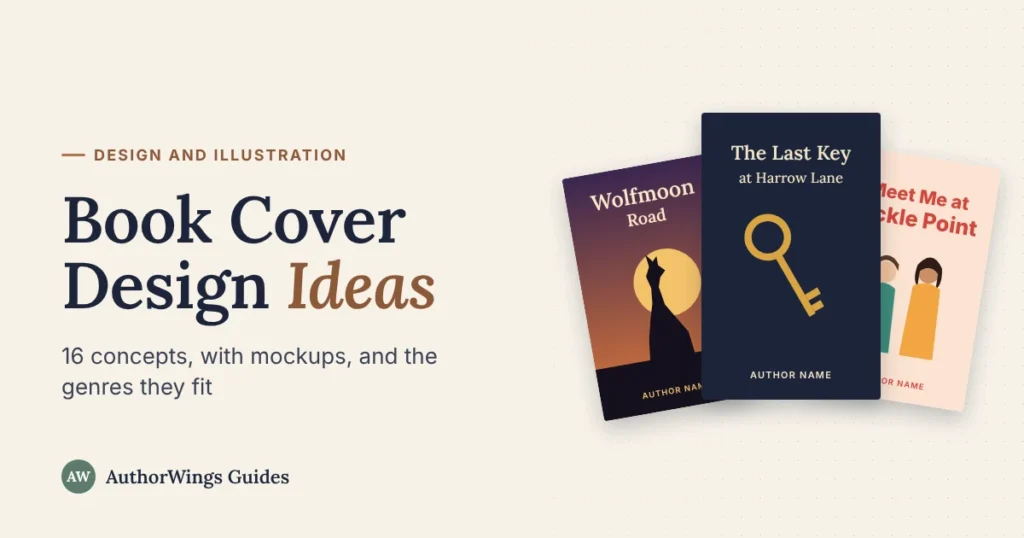
A cover idea is the one picture or arrangement that sells your book at a glance. Below are 16 concepts, each with a mockup, the genres it fits, and the trap to avoid. Use them to brief a book cover designer or to plan a cover you make yourself.
How to pick a cover idea
Choose the idea that passes three tests:
- It signals your genre. Put it beside the bestsellers in your Amazon subcategory. It should look like it belongs on that shelf.
- It reads as a thumbnail. Shrink it to search-result size. If the idea needs a second look to understand, it’s too complicated. Try our free thumbnail test.
- It’s one idea. A key, a road, and a face on one cover compete with each other. Keep the strongest one.
16 book cover design ideas
Filter the ideas by genre, or scroll through all 16. Every mockup uses an invented title, and you can add the ideas you like to a cover brief at the end of the list.
Show ideas for:
Showing all 16 ideas
1. Big type, no image
The title fills the cover in bold letters, sometimes with one accent color. It's simple to make well and stays readable at small sizes when the title is short.
2. One symbolic object
A single object stands for the story: a key, a feather, a cracked teacup. Readers fill in the meaning.
3. Silhouette
A dark shape of a person, animal, or building against a lighter sky or color. It suggests a character without showing a face.
4. Cropped close-up
Part of a face, a pair of hands, or an object, cropped tight. The crop creates curiosity and fills the frame at small sizes.
5. Negative space
A small image or title surrounded by empty color. The space makes the cover feel calm and confident.
6. Hand-lettered title
The title is drawn by hand in bold, chunky letters, often with small illustrations around it. It feels warm and personal.
7. Illustrated scene
A drawn or painted scene shows the setting or a moment from the story. It's common in children's books, cozy mystery, and much of fantasy.
8. Figure seen from behind
A person walks away or looks into the distance, face hidden. Readers can picture themselves as the character.
9. Illustrated characters
Flat, colorful drawings of the main characters, often a couple, set against a plain background with big hand-drawn type.
10. Split cover
The cover divides into two halves: two time periods, two places, or before and after.
11. Image inside a shape
The scene sits inside a shape: a keyhole, a circle, a house outline, or the letters of the title.
12. Tiny figure, huge setting
A small person against a vast plain, sea, or city. The scale suggests adventure or loneliness.
13. Solid color blocks
Bold flat color, often in two or three blocks, with clean type. It can stand out on a busy results page.
14. Duotone photo
A photo toned in two colors, such as navy and pink. It makes an ordinary stock photo look designed.
15. Ornate symbol
A crown, dagger, or flower drawn with fine gold lines and filigree on a dark background.
16. Map or diagram
A map, blueprint, or chart becomes the image. It promises an adventure or a clever puzzle.
Your cover brief
Pick a genre above and tap “Add to my brief” on the ideas you like. Then copy the brief to send a designer or to plan your own cover.
Matching an idea to your genre
Every genre has its own visual code, and the idea has to work inside it. For the full conventions, see genre conventions readers recognize.
| Genre | Ideas that often fit |
|---|---|
| Romance and romantasy | Illustrated characters, ornate symbol, one symbolic object, hand-lettered title |
| Thriller, mystery, and suspense | Big type, one symbolic object, silhouette, image inside a shape, duotone photo |
| Cozy mystery | Illustrated scene, hand-lettered title |
| Fantasy and sci-fi | Illustrated scene, ornate symbol, tiny figure in a huge setting, figure seen from behind |
| Literary fiction | Negative space, one symbolic object, cropped close-up, big type |
| Children’s | Illustrated scene, hand-lettered title, image inside a shape |
| Middle grade and young adult | Illustrated scene, illustrated characters, silhouette |
| Memoir | Cropped close-up, negative space, figure seen from behind |
| Business and leadership | Big type, solid color blocks, split cover |
| Self-help | Big type, solid color blocks, negative space |
Cover ideas for a series
A series cover idea has to work on every book in the series. Keep the layout, title position, fonts, and author name the same on each one, and change one thing: the color, the object, or the scene. Readers then spot book two as part of the set. At AuthorWings, series branding is included in the Illustrated tier, or $149 as an extra on Ebook and Print-Ready.
Book cover ideas to avoid
Some ideas cause problems no matter how well they’re made.
- Copying one bestseller. Use the genre’s signals rather than one book’s design. KDP’s metadata guidelines don’t allow covers that could mislead buyers by closely resembling another book’s layout, color scheme, fonts, or images.
- Real people and brands. A cover is commercial use, and using a recognizable real person can break right-of-publicity laws in many US states, and a logo or branded product can suggest the company endorses your book. Get written permission or leave them off.
- A stock photo other covers already use. Search for it among books in your genre before you buy it.
- Three symbols at once. Each one you add makes the others smaller.
- Thin script type for the title. It looks elegant at full size and disappears as a thumbnail.
- Cover text that differs from your book details. KDP’s metadata guidelines say the title, subtitle, author name, and series on the cover should match what you enter.
From idea to finished cover
Once you’ve chosen an idea, our guide on how to make a book cover takes you from layout to print-ready files. If you’d rather hand it off, AuthorWings cover tiers are Ebook ($199, 1 design idea), Print-Ready ($399, 2 design ideas), and Illustrated ($999, 3 design ideas as sketches), each designed against 3 to 5 books like yours.
Book cover design
Turn your idea into a cover that sells
A designer who works in your genre tests your idea against books like yours and builds it at professional quality.
- Ebook from $199
- Up to 3 design ideas
- Source files you keep
Frequently asked questions
Where can I find book cover ideas?
Start with the bestseller lists for your Amazon subcategory, then look at covers in bookstores and library displays in your genre. Save the ones that stop you, and note what they share: color, type, image style, and title placement. Then sketch two or three ideas of your own that use those signals without copying any one cover.
Can I use another book’s cover as inspiration?
Yes, for its genre signals: the color mood, type style, or kind of image. Don’t copy its layout, image, or title treatment. KDP’s metadata guidelines don’t allow covers that closely resemble another book’s, and readers may take a look-alike for a knockoff.
Should the cover show the main character?
It depends on the genre. Children’s books, many fantasy and YA covers, and many romance covers show characters, often illustrated, while thrillers, dark romance, literary fiction, and nonfiction often use objects, places, or type. A character seen from behind or in silhouette lets readers imagine the face themselves.
How many cover ideas should a designer show?
Many designers show one to three design ideas, depending on the package. At AuthorWings, the Ebook tier includes one, Print-Ready two, and Illustrated three, shown as sketches. More ideas help when you’re unsure of the direction; one is enough when you already know what your genre expects.
Related reading
AuthorWings editorial team
The AuthorWings editorial team writes and updates our guides for first-time authors. Every post is read and edited by a person on our team before it is published.