Publisher submission statistics 2026 · AuthorWings Research
Most Publishers Still Read Authors Without an Agent. Most Say Nothing About AI.
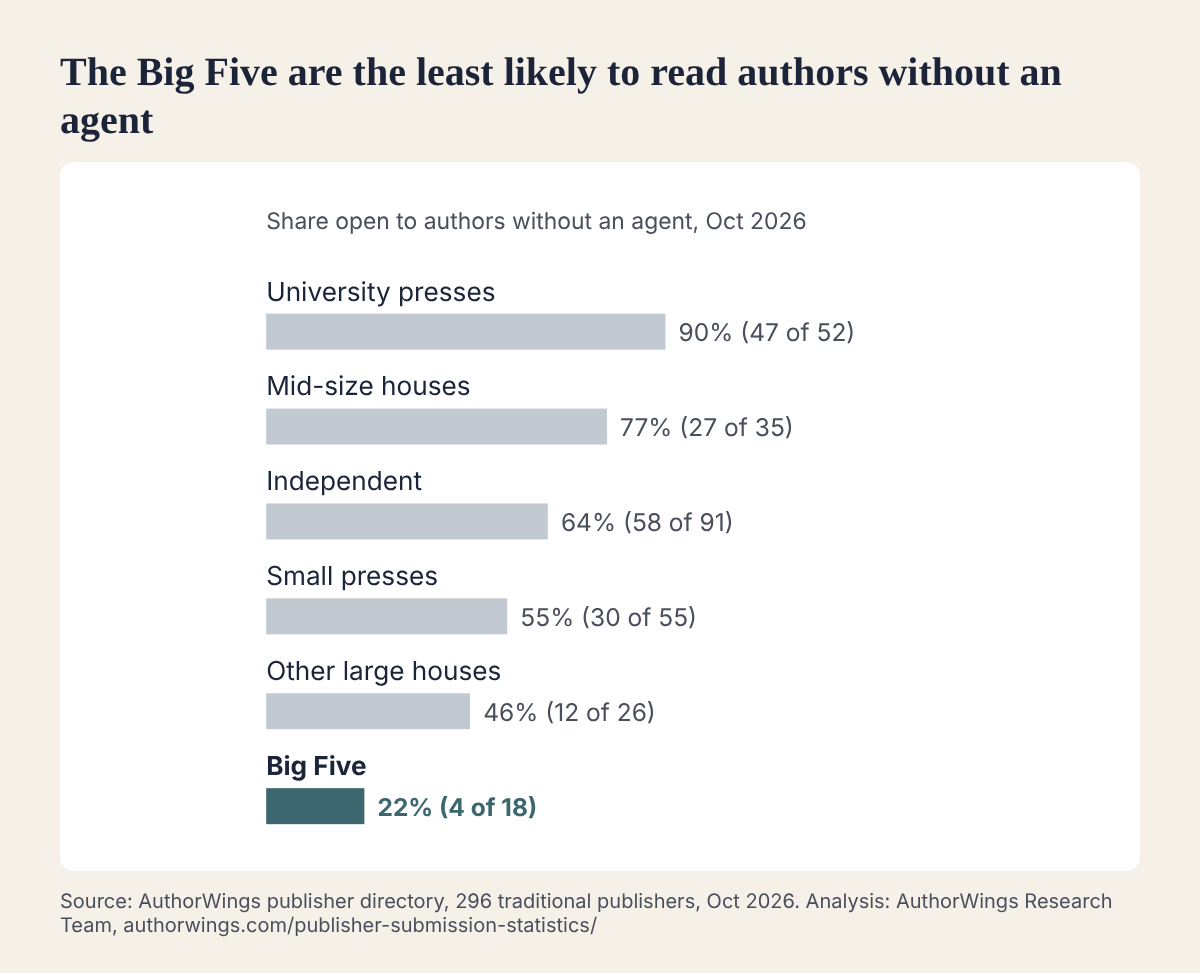
Writers often hear that publishers only read books sent by literary agents. We checked 296 traditional publishers on their own websites and found the opposite for most of them: 188 (64%) were open to authors without an agent. The exception is the Big Five, where 4 of 18 houses and imprints were. We also read each publisher’s submission page for an AI policy. Most say nothing, but in Canada, most say no.
By the AuthorWings Research Team · Media contact: Dr. Bazla M, Head of Research
Part of AuthorWings Research. See all studies.
The short answer
Yes, you can still send a book to a publisher without an agent. Of 296 traditional publishers we checked, 188 were open to unagented authors in October 2026. University presses (90%) and mid-size houses (77%) were the most open. Big Five houses and imprints were the least (22%). Fiction is harder than nonfiction: 45% of publishers that take fiction were open to unagented authors, against 67% for nonfiction.
Key findings
- 64%Of 296 traditional publishers were open to authors without an agent (188).
- 4 of 18Big Five houses and imprints were open to authors without an agent.
- 90%Of university presses were open to unagented authors, the most of any group.
- 45% vs 67%Publishers that take fiction vs nonfiction that were open to unagented authors.
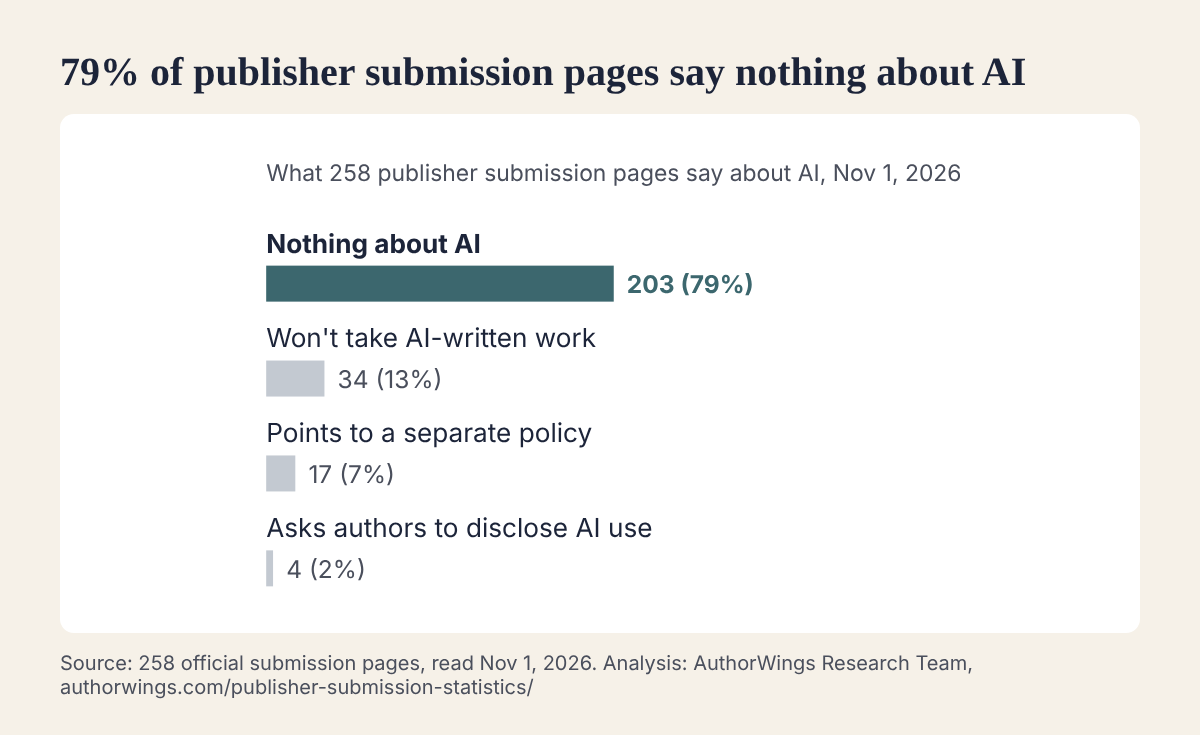
- 79%Of the submission pages we could read say nothing about AI (203 of 258).
- 10 of 17Canadian publishers say on their submission page that they won’t take AI-written work. In the US it’s 19 of 156.
Do publishers accept authors without an agent?
Most do. Of the 296 traditional publishers we track, 209 (71%) accept work from authors without an agent, and 203 (69%) were open to submissions in October 2026. 188 (64%) were both: open now and reading unagented authors. The rest were closed for now, read only during set windows, or worked only through agents.
The Big Five are the least likely to read authors without an agent
The Big Five are the least likely to read authors without an agent
The four Big Five names open to unagented authors were Hachette Australia (for authors in Australia and New Zealand), Arcadia (formerly Jo Fletcher Books; science fiction, fantasy, and horror only), Storey Publishing, and Zondervan (academic books only, through Zondervan Academic). In the US, Penguin Random House, Simon & Schuster, and Macmillan mostly work through literary agents. There are a few exceptions, such as Penguin Random House’s Berkley Open Submission Program and Simon & Schuster’s children’s imprint Salaam Reads. Hachette Book Group works mainly with agents, but a few of its imprints, including Storey, take work directly. University presses, which usually take proposals straight from scholars, top the list.
Fiction is harder than nonfiction
Publishers that take fiction were less open to unagented authors than those that take nonfiction.
| Kind of book the publisher takes | Open to unagented authors |
|---|---|
| Academic | 78 of 88 (89%) |
| Nonfiction | 175 of 263 (67%) |
| Memoir | 29 of 47 (62%) |
| Children’s | 57 of 100 (57%) |
| Poetry | 28 of 56 (50%) |
| Fiction | 61 of 135 (45%) |
Many publishers take more than one kind of book, so they appear in more than one row.
By country
| Country | Open to unagented authors |
|---|---|
| US | 122 of 182 (67%) |
| Canada | 11 of 17 (65%) |
| UK | 36 of 65 (55%) |
| Australia | 15 of 28 (54%) |
Each publisher is counted once, in its home country.
What publishers say about AI
Most say nothing. We read the submission page of every publisher in the directory on November 1, 2026, and could read 258 of them.
79% of publisher submission pages say nothing about AI
Canada stands out. 10 of the 17 Canadian publishers say on their submission page that they won’t take AI-written work, including House of Anansi, ECW Press, Groundwood Books, and Kids Can Press. In the US the figure is 19 of 156 (12%), in Australia 3 of 26, and in the UK 2 of 55.
Most Canadian publishers say no to AI-written work
Smaller houses were more likely to say no: 14 of 79 independent publishers and 9 of 50 small presses, against 1 of 18 Big Five houses and imprints (Pan Macmillan Australia).
Saying nothing is not the same as accepting AI. A publisher can also set rules in its author contracts; ECW Press, for example, says its contracts require everything it publishes to be 100% human-authored. This matters to publishers because in the US, text generated entirely by AI can’t be copyrighted; only what a person creatively adds or changes is protected (US Copyright Office, January 2025). For what AI can and can’t do for a book, see our guide, Can AI write a book?
The 34 publishers whose submission page says no to AI
Each of these says on its own submission page, as of November 1, 2026, that it won’t take AI-written work. Some go further and refuse any AI help at all, including for research or illustrations; Arsenal Pulp Press, Orca Books, and Second Story Press are examples. A few allow limited help: UNT Press allows grammar and spelling tools, and North Atlantic Books and United Methodist Publishing House allow some uses, such as brainstorming. Each name links to that publisher’s submission page.
Canada (10): Arsenal Pulp Press, Book*hug Press, Cormorant Books, ECW Press, Groundwood Books, House of Anansi, Kids Can Press, Orca Books, Owlkids Books, Second Story Press
US (19): Arte Público Press, Blair, Bull City Press, Charlesbridge, Dark Horse Comics, Epicenter Press, Haymarket Books, Holiday House, Image Comics, Llewellyn, North Atlantic Books, Northwestern University Press, Orbis Books, Parlyaree Press, Plough, Red Wheel/Weiser, Texas Review Press, UNT Press, United Methodist Publishing House
Australia (3): Pan Macmillan Australia, Text Publishing, UQP
UK (2): Luna Press, Seren Books
Four more ask authors to disclose any AI use: Fremantle Press, McFarland, Purdue University Press, and University of Michigan Press.
How long publishers take to reply
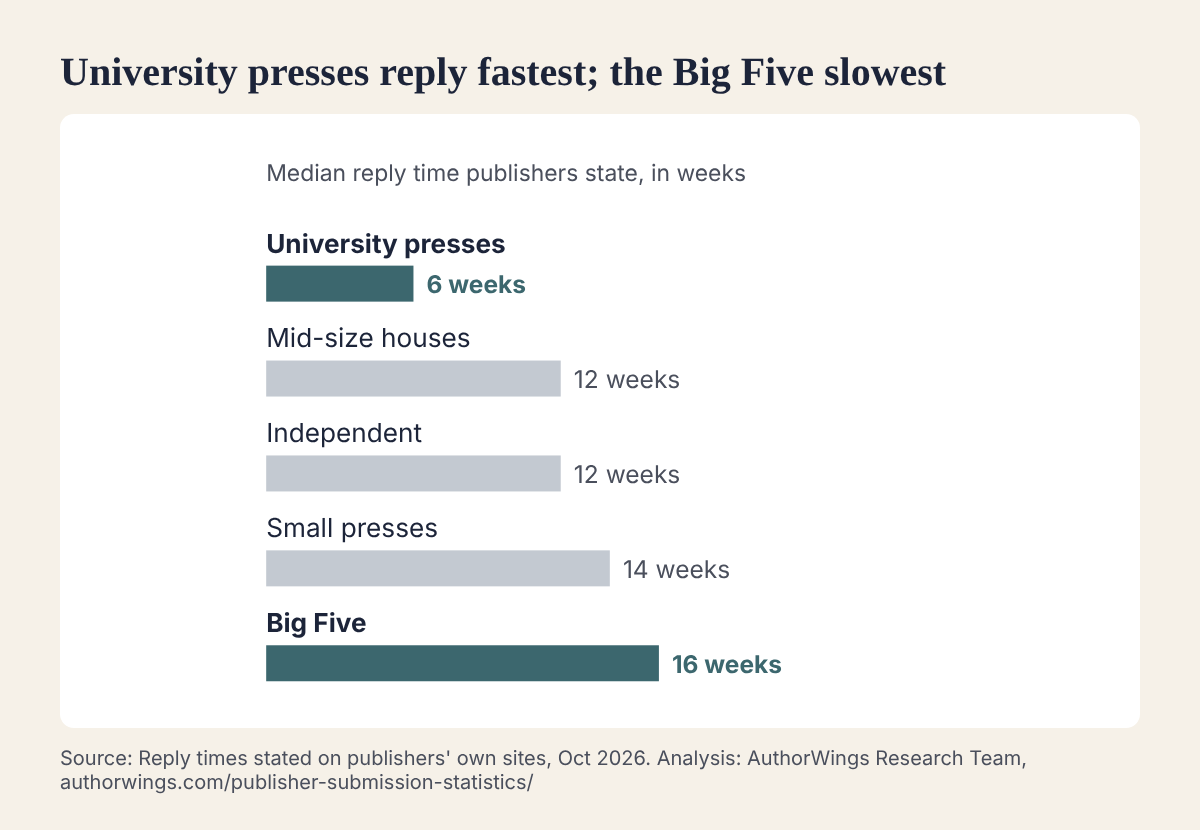
Most publishers don’t say. Only 132 of the 296 (45%) give a reply time on their own site. Among those that do, the median is 12 weeks. 52 say 8 weeks or less, and 32 say 24 weeks or more. 30 say they reply only if interested, or that no reply means no.
University presses reply fastest; the Big Five slowest
| Group | Publishers stating a time | Median reply |
|---|---|---|
| University presses | 22 | 6 weeks |
| Mid-size houses | 21 | 12 weeks |
| Independent publishers | 48 | 12 weeks |
| Small presses | 22 | 14 weeks |
| Big Five houses and imprints | 7 | 16 weeks |
What you send matters too. Publishers that ask for a proposal or sample chapters quote a median of 11 to 12 weeks; those that ask for a full manuscript quote 16. (Some ask for more than one.) Fiction publishers quote a median of 16 weeks, against 12 for nonfiction and 8 for academic books. Canadian publishers were the slowest, at a median of 24 weeks, though only 11 state a time.
What this means for authors
An agent is still the main route into the Big Five, but it isn’t the only route into publishing. Most traditional publishers we checked read work sent straight from authors, usually by email or an online form. Our publisher directory lists who is open now, rechecked every month.
- Start with the right group. Mid-size houses, independents, and university presses were the most open. If you write fiction, expect fewer open doors than in nonfiction.
- Check the date. Many publishers read only in set windows, and a page that was open last month may be closed now. Always read the publisher’s own submission page before you send.
- Read the AI line. Some publishers that say no to AI also rule out AI help with research, editing, or illustrations, while a few allow grammar tools. When the page says nothing, the contract may still cover it.
- Plan for the wait. The median reply time is 12 weeks, and some publishers reply only if they are interested. Send to several publishers that accept simultaneous submissions, and keep track of the dates.
The bottom line
The door isn’t closed. Nearly two in three traditional publishers we checked were open to authors without an agent in October 2026. The Big Five are the exception, not the rule. On AI, most publishers have yet to say anything on their submission pages, and of the 38 that state a rule there, 34 say no.
More from AuthorWings Research: book sales statistics and reading statistics.
Method and limits
AuthorWings offers editing and publishing services to authors. We ran no survey, and no data in this study came from our clients.
The data comes from the AuthorWings publisher directory: 296 traditional publishers, almost all in the US, UK, Canada, and Australia. Paid and vanity presses are not included. For each publisher, we recorded from its own website whether it was open to submissions, whether it reads authors without an agent, what kinds of books it takes, and how long it says it takes to reply. Every listing was checked in October 2026, and the directory is rechecked monthly.
For the AI question, we read each publisher’s official submission page on November 1, 2026. We searched each page for any mention of AI and read every mention in full; four pages that blocked automated access were checked by hand. A page counts as “won’t take AI-written work” only if it says so in plain words. We could read 258 of the 296 pages; the other 38 blocked access or were not available. We reloaded every page we name the same day to confirm its wording.
Limits
- The directory is a curated list of traditional publishers, not every publisher. Figures describe the 296 publishers we track, not the whole industry.
- The Big Five group is small: 18 houses and imprints. Some imprints are counted on their own.
- “Open to unagented authors” means open on the date we checked. Many publishers open and close in windows through the year.
- A submission page that says nothing about AI may still have a policy in its contracts or elsewhere on the site.
- Reply times are what publishers say, not what we measured, and only 132 publishers state one.
- This is one snapshot. We plan to repeat it each year to show whether publishers are opening or closing.
For journalists
Media contact: Dr. Bazla M, Head of Research, AuthorWings · bazla.mukhtar@authorwings.com. Dr. Bazla M is available for interviews.
About AuthorWings: AuthorWings offers editing, design, and publishing services to independent authors. AuthorWings Research publishes free studies on books, reading, and publishing.
“Writers are told the door is shut unless they have an agent. For most publishers, that isn’t true. The Big Five are the hard part. The open question now is AI: most publishers haven’t said anything yet, and when they do, the answer is almost always no.” Dr. Bazla M, Head of Research, AuthorWings
How to cite: AuthorWings Research Team. “Most Publishers Still Read Authors Without an Agent. Most Say Nothing About AI.” AuthorWings, November 2026. https://authorwings.com/publisher-submission-statistics/
Sources
- AuthorWings publisher directory, 296 publisher listings, checked October 2026.
- US Copyright Office, Copyright and Artificial Intelligence, Part 2: Copyrightability, January 2025.
- Each publisher’s own submission page, read November 1, 2026. The 34 publishers that say no to AI are linked to their pages above.