Reading statistics 2026 · AuthorWings Research
Gen Z Didn’t Kill Reading. Their Parents Did.
Twenty years of US government data show teens read for pleasure as much as they did in 2004. The drop comes from Americans over 45, Gen Z’s parents and grandparents. Meanwhile, kids lose the reading habit between 9 and 13, and library ebook and audiobook loans grew 3.6 times.
By the AuthorWings Research Team · Media contact: Dr. Bazla M, Head of Research · Download the data
Part of AuthorWings Research. See all studies.
The short answer
Americans spend 30% less time reading for pleasure than in 2004: 16 minutes a day, down from 23. All of that drop comes from people over 45. Teens aged 15 to 19 read about as much as teens did 20 years ago. The warning sign among the young comes earlier: many children stop reading for fun between the ages of 9 and 13.
Key findings
- No declineTeens aged 15 to 19 read 9.1 minutes a day in 2004 and 8 to 13 minutes a day from 2023 to 2025.
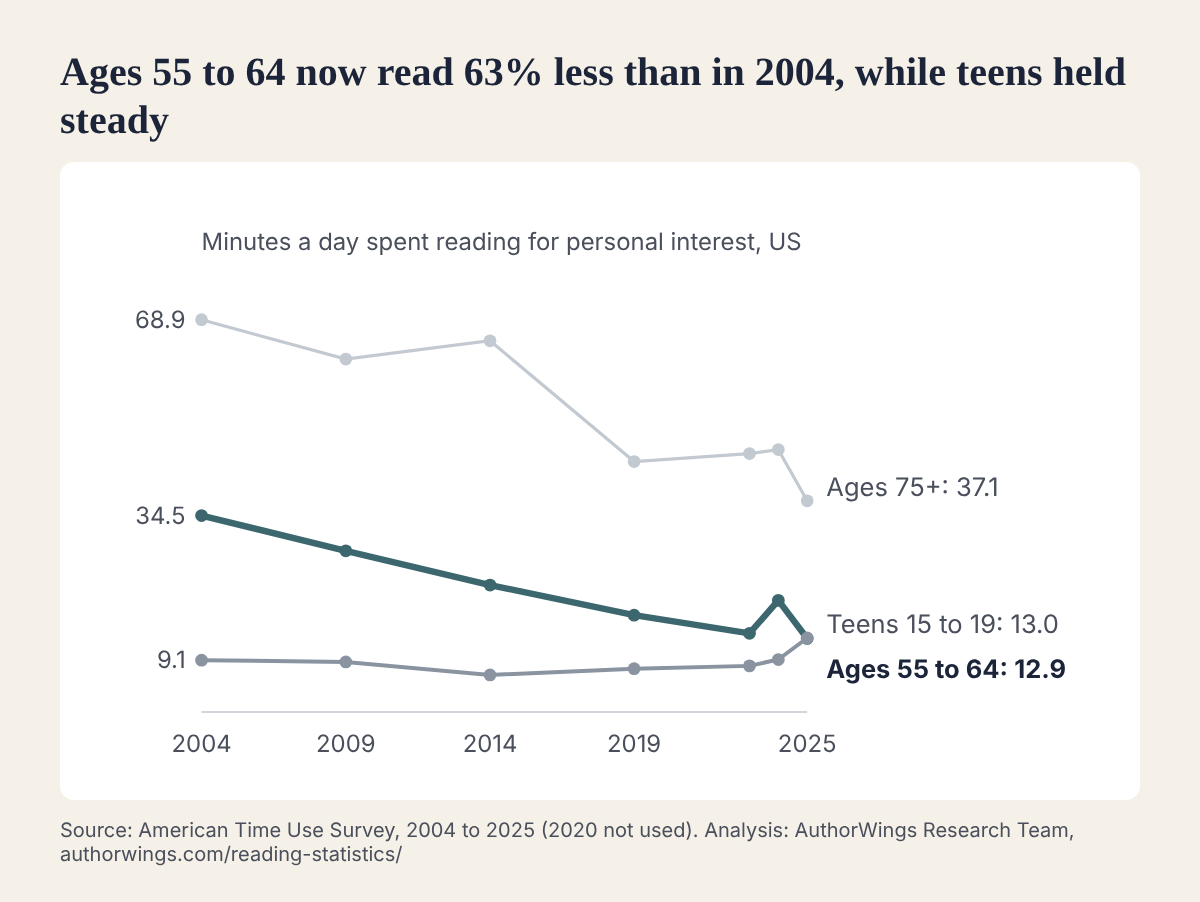
- Down 63%Reading time for Americans aged 55 to 64: 34.5 minutes a day in 2004, 12.9 in 2025.
- All of itPeople over 45 account for the whole drop in reading time. Younger age groups held steady or read slightly more.
- 42% → 14%Children who read for fun almost daily: 42% of 9-year-olds in 2020, 14% of 13-year-olds in 2025.
- 3.6xGrowth in digital library checkouts, from 152 million (2014) to 545 million (2023).
- About 3xUS searches for audiobooks in 2026 compared with 2019.
Reading statistics for 2026 at a glance
- Americans aged 15 and older spent 16 minutes a day reading for pleasure in 2025, down from 23 minutes in 2004 (American Time Use Survey).
- 16% of Americans read for pleasure on an average day in 2025, down from 28% in 2004 (American Time Use Survey).
- 59% of US adults read at least one book in 2025, and 40% read none (YouGov, Dec 2025).
- The typical American read 2 books in 2025; the average was 8 (YouGov, Dec 2025).
- 37% of 9-year-olds and 14% of 13-year-olds read for fun almost every day in 2025 (NAEP Long-Term Trend).
- 31% of US fourth graders read at or above the Proficient level (NAEP, 2024).
- 28% of US adults score at the lowest literacy levels (Level 1 or below), up from 19% in 2017 (PIAAC, 2023).
- US public libraries lent 545 million ebooks, audiobooks and other digital items in 2023, 3.6 times as many as in 2014 (Public Libraries Survey).
- In the UK, 36.1% of children and young people enjoyed reading in their free time in 2026, up from 32.7% in 2025 (National Literacy Trust, 2026).
Do people still read books?
Yes, but fewer people read on any given day. 59% of US adults read at least one book in 2025, according to YouGov, Dec 2025, yet only 16% of Americans read for pleasure on an average day, down from 28% in 2004. The people who still read are changing how they do it: digital library loans grew 3.6 times in 10 years, and audiobooks now make up about 44% of digital book checkouts. As our data shows below, young people read about as much as they did 20 years ago; the drop comes from people over 45.
Why we looked
In August 2026, The Atlantic ran a cover story titled “The End of Reading Is Here,” and young people often get the blame for the decline. Other recent research says Gen Z reads more than people think. We went to the US government’s own data to see which age groups actually read less, and since when.
We’re not the first to study this survey. A 2025 study by the University of Florida and University College London found that the share of Americans who read for pleasure each day fell from 28% in 2004 to 16% in 2023, with steeper declines among people 66 and older. It grouped everyone aged 25 to 65 together. We split the data into eight age groups, added 2024 and 2025, and compared it with school, library and search data, to answer one question: who is reading less?
Teens and young adults: steady for 20 years
Teens read for pleasure about as much today as they did in 2004. The American Time Use Survey asks thousands of Americans each year to log every activity of one day. In 2004, people aged 15 to 19 spent 9.1 minutes a day reading for personal interest. From 2023 to 2025, the figure was 8.1, 9.2 and 13.0 minutes.
Young adults aged 20 to 34 tell the same story: between 6 and 14 minutes a day in every year we checked, with no clear trend. Young people read little in this survey, and they always have. What changed is the reading time of everyone over 45.
Ages 55 to 64 now read 63% less than in 2004, while teens held steady
Over 45: where reading time fell
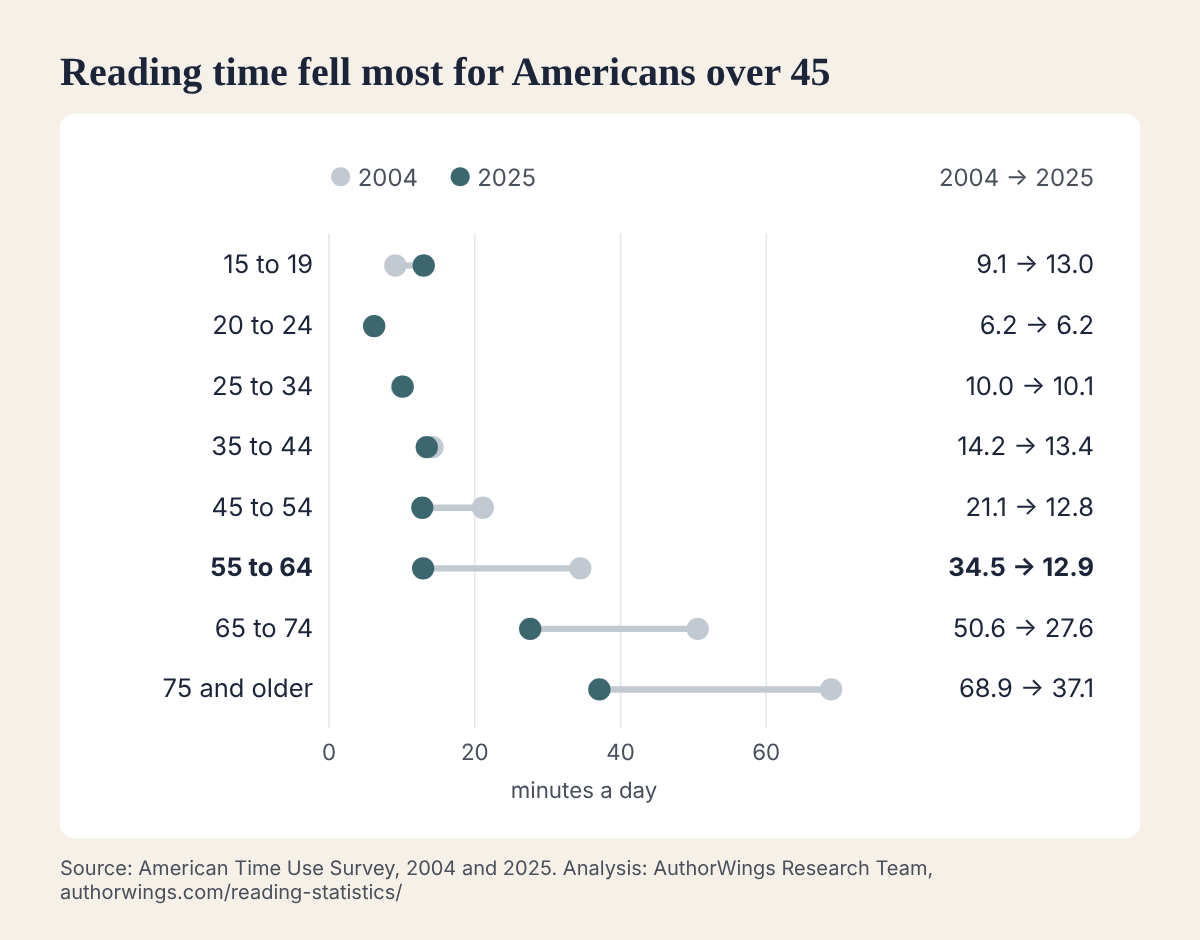
The biggest drop is among Americans in late middle age. In 2004, 39% of 55 to 64-year-olds read for pleasure on an average day. In 2025, 14% did.
| Age | Minutes a day, 2004 | Minutes a day, 2025 | Change | Read on an average day, 2004 | Read on an average day, 2025 |
|---|---|---|---|---|---|
| 15 to 19 | 9.1 | 13.0 | No significant change | 11.7% | 10.8% |
| 45 to 54 | 21.1 | 12.8 | Down 39% | 30.4% | 13.8% |
| 55 to 64 | 34.5 | 12.9 | Down 63% | 39.1% | 14.4% |
| 65 to 74 | 50.6 | 27.6 | Down 45% | 50.3% | 24.3% |
| 75 and older | 68.9 | 37.1 | Down 46% | 57.3% | 31.7% |
| All ages 15+ | 23.0 | 16.1 | Down 30% | 27.7% | 16.1% |
The decline among 55 to 64-year-olds has been steady: 34.5 minutes a day in 2004, 28.3 in 2009, 22.3 in 2014, 17.0 in 2019 and 12.9 in 2025.
People over 45 account for all of the drop in average reading time. Their losses add up to more than the national decline, while younger groups held steady or read slightly more. The national average fell by less than that, because older Americans, who still read the most, are a growing share of the population.
The gap between teens and their parents has closed
In 2004, 55 to 64-year-olds read 3.8 times as long as teens (34.5 vs 9.1 minutes a day). In 2025, the two groups read about the same (12.9 vs 13.0 minutes).
A different generation now fills that age group. In 2004, 55 to 64-year-olds were born between 1940 and 1949. In 2025, they were born between 1961 and 1970, the generation old enough to be Gen Z’s parents. They read far less than people their age did 20 years ago.
Reading time fell most for Americans over 45
Children: the habit breaks between 9 and 13
The warning sign is in childhood. The National Assessment of Educational Progress (NAEP) asks US students how often they read for fun on their own time.
- Age 9 (Gen Alpha): 37% read for fun almost every day in 2025, down from 53% in 2012.
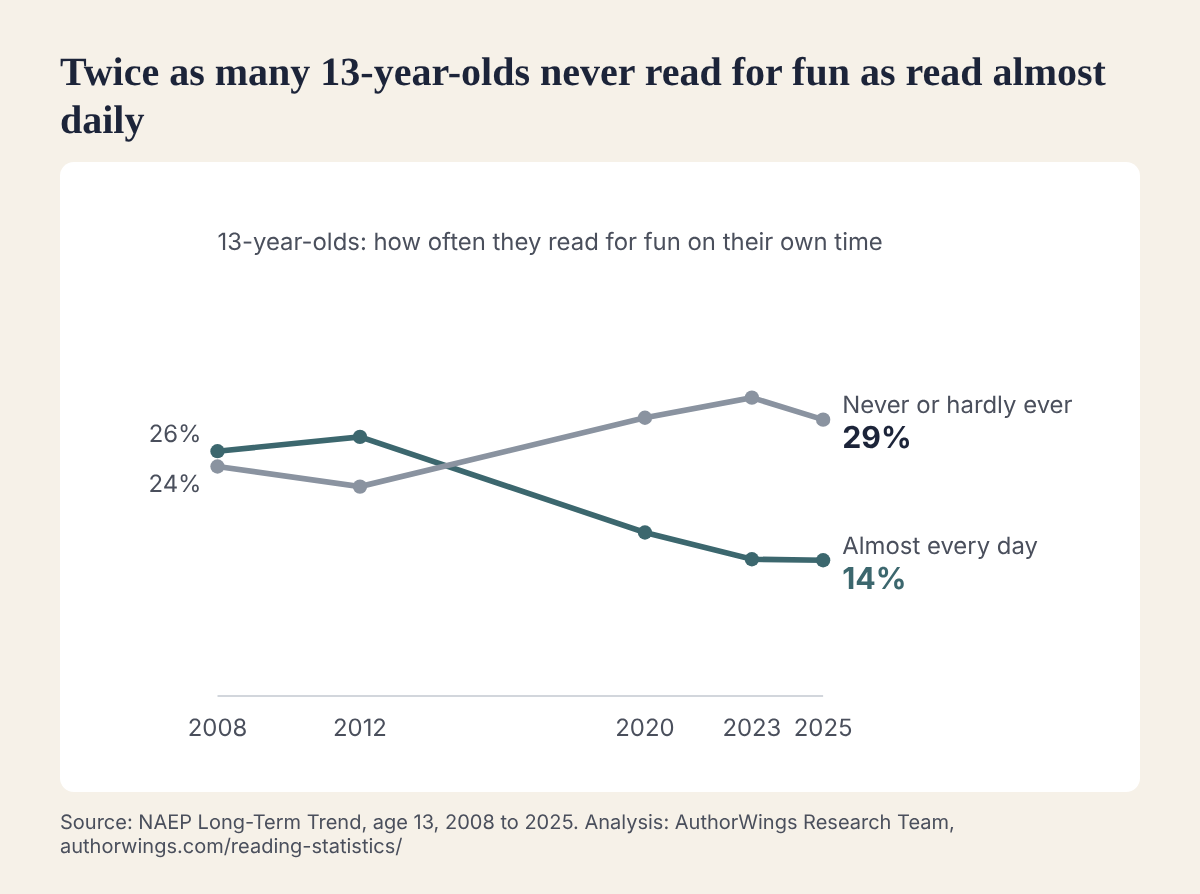
- Age 13 (the youngest Gen Z): 14% read for fun almost every day in 2025, down from 26% in 2008. 29% never or hardly ever do, up from 24%.
- Between the two ages: children born around 2011 and 2012 went from 42% daily readers at age 9 (2020) to 14% at age 13 (2025). That’s about two in three fewer daily readers between the two ages.
Among 13-year-olds, twice as many children never or hardly ever read for fun as read almost every day. The two lines crossed in 2020.
This sits alongside the steady teen numbers above. The school survey asks 13-year-olds how often they read for fun; the time-use survey starts at age 15 and measures minutes spent reading. Fewer young teens read for fun often, yet teens aged 15 to 19 spend about as much time reading as teens did in 2004. We treat the childhood drop as its own warning sign, separate from the adult decline.
The years between 9 and 13 are also when children move from chapter books to middle grade and young adult books.
There’s a hopeful sign abroad. In the UK, which made 2026 its National Year of Reading, 36.1% of children and young people said they enjoyed reading in their free time in 2026, up from 32.7% in 2025, after years of decline (National Literacy Trust, 2026). Falling childhood reading can turn around.
Twice as many 13-year-olds never read for fun as read almost daily
Reading is moving to screens and earbuds
People who read are changing how they get books. US public libraries show it most clearly:
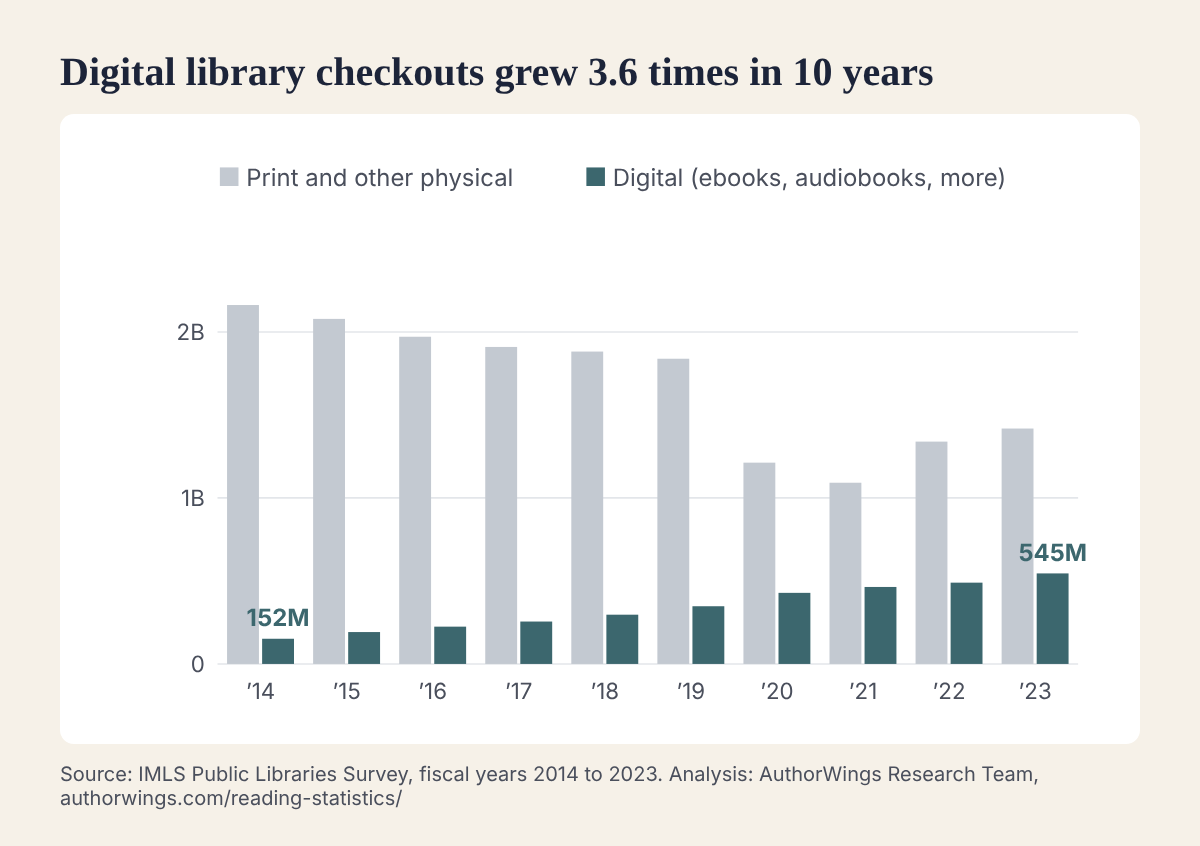
- Digital checkouts (ebooks, audiobooks and other digital items) grew from 152 million in 2014 to 545 million in 2023.
- Physical checkouts fell from 2.16 billion to 1.42 billion over the same years.
- Per person served, digital borrowing rose 51% from 2019 to 2023, while print borrowing fell 25%.
- In 2024, the first year libraries split digital checkouts by format, audiobooks made up about 44% of digital book checkouts.
Digital library checkouts grew 3.6 times in 10 years
Search data points the same way. US Google searches for “audiobooks” in 2026 run at nearly 3 times their 2019 level, and searches for “Libby,” the library reading app, at about twice. Searches for “BookTok” barely existed before 2020, and searches for “romantasy” before 2023. Both hit record highs in 2026.
How many books do people read a year?
The typical American read 2 books in 2025, and the average was 8. That’s from a YouGov, Dec 2025 survey of 2,203 US adults. The average is much higher than the typical figure because a small group of heavy readers reads a lot: 19% of Americans read 10 or more books, while 40% read none.
| Books read in 2025 | Share of US adults |
|---|---|
| None | 40% |
| 1 to 4 | 27% |
| 5 to 9 | 13% |
| 10 or more | 19% |
By age, Americans 65 and older read the most books on average (12.1 in 2025), followed by those aged 30 to 44 (8.2), 45 to 64 (6.4) and 18 to 29 (5.8). The typical reader in every age group read 2 books.
This is book-only data from a different survey, while our own findings cover all reading for pleasure. It points the same way: Americans aged 45 to 64 now read fewer books on average than those aged 30 to 44.
What this means for authors
Readers are still there, but how they read has changed. Young readers are holding steady, more reading happens on phones and in audio, and the years between 9 and 13 often decide whether a child keeps reading for fun.
Make your book easy to read in every format
Ebook, print and audio each reach different readers. See how ebooks, print books and audiobooks compare, or talk to our team about publishing your book on Amazon and beyond. Writing for young readers? Our children’s book publishing team works from picture books to middle grade.
Download the data
All four data sets, in CSV files with a short guide to each column. Free to use with credit.
Download the data (ZIP, CSV files)
Charts are free to use too: open “Use this chart on your site” under any chart for the embed code.
Method and limits
Every number comes from public US government data or Google Trends, analyzed by the AuthorWings Research Team in October 2026. We ran no survey of our own and used no customer data.
| Source | What we used | Years | Sample |
|---|---|---|---|
| American Time Use Survey (US Bureau of Labor Statistics) | Minutes a day spent reading for personal interest (activity code 120312) and the share who read on an average day, by age | 2004, 2009, 2014, 2019, 2023, 2024, 2025 | About 75,000 people |
| NAEP Long-Term Trend (National Center for Education Statistics) | How often students read for fun on their own time, ages 9, 13 and 17 | 1984 to 2025 | National student samples |
| Public Libraries Survey (Institute of Museum and Library Services) | Physical and digital checkouts, national totals | Fiscal years 2014 to 2024 | About 9,200 library systems |
| Google Trends | US search interest for audiobooks, Libby, BookTok and romantasy | 2004 to October 2026 | Index from 0 to 100 |
How we calculated
- Time-use figures are weighted averages using the survey’s final weights (for 2004, the revised weights the Bureau of Labor Statistics recommends for 2003 to 2005). Our 2024 results match the Bureau’s published figures: 16.8 minutes for all ages, 9.2 for ages 15 to 19 and 46.1 for ages 75 and older.
- Margins of error are approximate 95% ranges. Changes we call “no significant change” fall inside those ranges.
- Library totals add physical and digital checkouts for the 50 states and DC. We use 2023 as the main year, because in 2024 libraries serving about 21% of Americans didn’t report digital checkouts.
- Each Google Trends term was downloaded on its own 0 to 100 scale, so we compare each term only with itself over time.
- Figures from YouGov, NAEP 2024, PIAAC 2023 and the National Literacy Trust are those organizations’ published results, cited with links. They aren’t part of our own analysis.
Limits
- “Reading for personal interest” includes books, newspapers, magazines and audiobooks. Part of the decline among older Americans may come from reading fewer print newspapers and magazines, so we don’t call it book reading.
- Reading on a phone may be logged as another activity, such as using social media, so reading time may be undercounted for every age group.
- About 190 to 400 teens are surveyed each year, so teen figures swing from year to year. We say teens have held steady, not that they read more.
- Time-use data for 2020 isn’t used, because COVID-19 disrupted data collection that year.
- The NAEP assessment changed format in 2004, so for 13-year-olds we compare 2008 to 2025. The age 9 to age 13 comparison follows children about one year apart in birth year, not the same children.
- The school survey and the time-use survey ask different questions of different ages, so their results on young people aren’t directly comparable.
- Search interest shows attention, not reading.
For journalists
Media contact: Dr. Bazla M, Head of Research, AuthorWings · bazla.mukhtar@authorwings.com. Dr. Bazla M is available for interviews and questions about the data.
“Everyone blames Gen Z for the end of reading, but the government’s own time-use diaries say teens read about as much as they did 20 years ago. The drop comes from their parents and grandparents. The other warning sign is in childhood, between ages 9 and 13.” Dr. Bazla M, Head of Research, AuthorWings
How to cite: AuthorWings Research Team. “Gen Z Didn’t Kill Reading. Their Parents Did.” AuthorWings, November 2026. https://authorwings.com/reading-statistics/
Sources
- US Bureau of Labor Statistics, American Time Use Survey data files, 2004 to 2025.
- US Bureau of Labor Statistics, Americans age 15 and over read for an average of 16 minutes per day in 2025, July 2026.
- National Center for Education Statistics, NAEP Long-Term Trend results for 2023 and 2025 (2023 highlights), via the NAEP data service.
- Institute of Museum and Library Services, Public Libraries Survey, fiscal years 2014 to 2024.
- Bone, Bu, Sonke and Fancourt, The decline in reading for pleasure over 20 years of the American Time Use Survey, iScience, August 2025.
- YouGov, Most Americans didn’t read many books in 2025, December 2025.
- National Center for Education Statistics, 2024 NAEP Reading Assessment.
- National Center for Education Statistics, 2023 PIAAC results for US adults.
- National Literacy Trust, Children and young people’s reading in 2026.
- Google Trends, United States, January 2004 to October 2026.