Home / Guides / Publishing
What Is an Ebook? Meaning, How It Works and Examples
 By AuthorWings editorial team
9 min read
Short answer
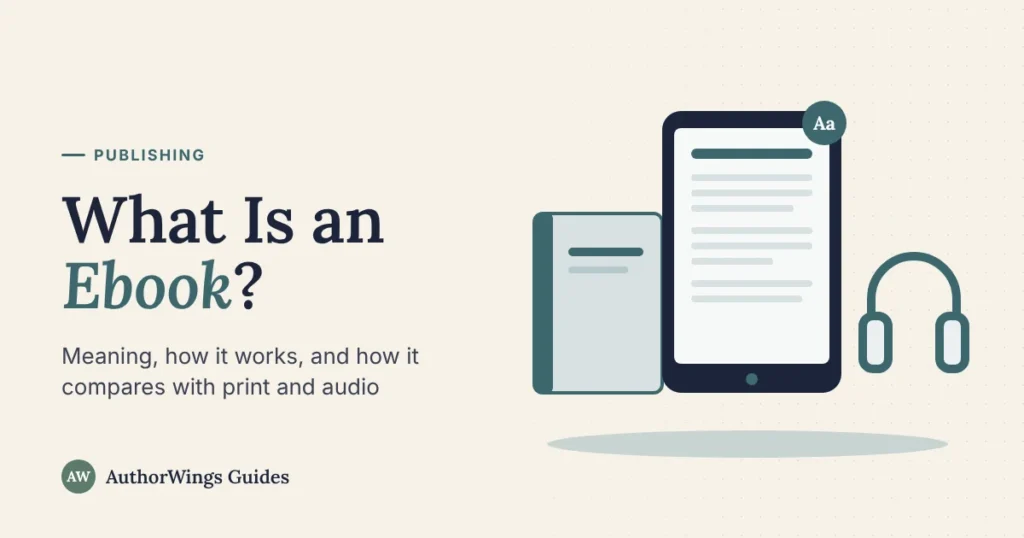
An ebook (electronic book) is a book in digital form that you read on a screen: an e-reader such as a Kindle or Kobo, a phone, a tablet, or a computer. Many ebooks let you make the text bigger or smaller, and many reading apps also let you change the font. Readers buy them from online stores, read them through subscriptions, or borrow them free from libraries.
An ebook holds the same words as a printed book, but you carry it as a file instead of on paper. That changes how you read it, how you get it, and, for authors, how you publish it. Here’s what an ebook is, how it works, and how it compares with print books and audiobooks.
Print book
Pages you hold. Bought, or borrowed from a library.
Ebook
A file you read on a screen, with text you can resize.
Audiobook
A recording of the book that you listen to.
Ebook meaning
An ebook is a book published as a digital file. The “e” stands for electronic, and you’ll see it spelled ebook, e-book, or eBook; all three mean the same thing.
Three spellings, one meaning: a book in electronic form.
The device you read on is called an e-reader, such as a Kindle or a Kobo, and you don’t need one: phones, tablets, and computers can all open ebooks through reading apps.
How does an ebook work?
An ebook is a file plus an app or device that displays it. When you buy or borrow one, the file downloads to your reading app, which shows it page by page and remembers where you stopped.
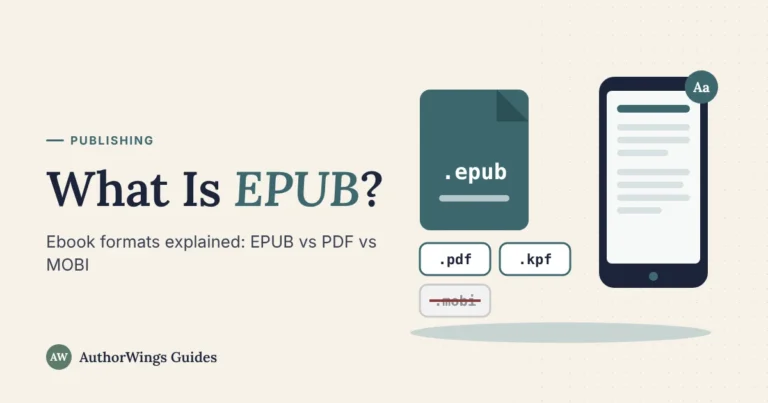
Many ebooks use EPUB, the open format maintained by the World Wide Web Consortium (W3C). EPUB comes in two layouts:
ReflowableEbook
Text rewraps to fit any screen, and readers can make it bigger. Novels, memoirs, and many nonfiction books.
Fixed layoutEbook
Each page keeps its design, like a printed spread. Picture books, comics, and magazines.
PDFFixed page
One page size, so on a small phone you zoom and scroll instead of the text rewrapping.
- Reflowable: the text rewraps to fit any screen, and you can make it bigger or smaller. This suits novels, memoirs, and many nonfiction books.
- Fixed layout: each page keeps its exact design, like a printed page. A W3C overview of EPUB says children’s books, comics and manga, and magazines need fixed layout to display properly. See how to format a children’s book.
Is a PDF an ebook? A PDF can be read on a screen, but its pages are fixed to one size, so text doesn’t rewrap on a small phone. As of October 2026, Amazon KDP’s help pages list DOCX, KPF, and EPUB as its suggested ebook formats; PDF is accepted only as an extra format, and only in some languages. Reflowable ebooks also help readers who need bigger text: the W3C lists resizable text among EPUB’s accessibility features.
How readers get ebooks
There are three main ways to get an ebook, as of October 2026:
Route 1Buy it
From an online store such as Amazon’s Kindle Store, Apple Books, Kobo, Barnes & Noble, or Google Play Books, and read it in that store’s app or device.
You get: a license to read it
Route 2Subscribe
To a reading service, such as Kindle+ (formerly Kindle Unlimited), and read books in its catalog while you’re a member. Authors join it through KDP Select.
You get: access while you’re a member
Route 3Borrow it free
From a public library through an app such as Libby, which needs a library card from each library you borrow from.
You get: a loan that ends on its due date
One thing many readers don’t realize: on major stores such as Amazon, buying an ebook means buying a license to read it, not owning a copy. Amazon’s Kindle Store Terms of Use, last updated 21 October 2026, say Kindle content “is licensed, not sold,” for personal, non-commercial use. Subscription books stay available only while you’re a member.
Buying an ebook on Amazon = a license to read it
Kindle Store Terms of Use, updated 21 October 2026: Kindle content "is licensed, not sold."
Read on your devicesPersonal use onlyNo reselling
Ebook vs print book vs audiobook
Each format reaches readers in a different way. Here’s how they compare, for readers and for authors.
Ebook
- How readers use it
- Read on a screen; resize text
- How readers get it
- Buy, subscribe, or borrow from a library app
- What the author supplies
- An ebook file and a front cover
- Printing and shipping
- None
- Time to change it
- Upload a new file
Print book
- How readers use it
- Read on paper
- How readers get it
- Buy, or borrow from a library
- What the author supplies
- A print-ready interior and a full cover with spine
- Printing and shipping
- Printed per order or in a print run
- Time to change it
- New file, and ideally a new proof copy
Audiobook
- How readers use it
- Listen
- How readers get it
- Buy, subscribe, or borrow from a library app
- What the author supplies
- Finished audio (your own recording or a hired narrator’s) and a square cover
- Printing and shipping
- None
- Time to change it
- Re-record the changed parts
For authors, the formats work together. A common plan is to release the ebook and paperback together, then add an audiobook later; see how to make an audiobook.
How many people read ebooks?
According to a Pew Research Center survey of 8,046 US adults in October 2025, 64% had read all or part of a print book in the past 12 months, 31% an ebook, and 26% had listened to an audiobook. In 2021, 30% had read an ebook.
US adults who read or listened to all or part of a book in the past 12 months
About 3 in 10 read all or part of an ebook.
October 20252021
Pew published these results in April 2026, and it’s the newest edition of this survey. Pew ran the 2025 survey online and by phone; editions from 2011 to 2021 were by phone only, and Pew marks this change on its charts. Print still leads, but about 3 in 10 US adults read all or part of an ebook in the past 12 months.
Examples of ebooks
Almost any book can be an ebook. Common examples:
Novels
In reflowable layout.
Memoirs and biographies
Text-led, so they read well on any screen.
How-to and self-help books
Practical guides, often with lists and short chapters.
Cookbooks
Often with photos.
Picture books and comics
Usually in fixed layout, so each spread keeps its design.
Business guides
Given away to build an email list or show expertise; see hiring a ghostwriter for an ebook.
Want to publish your own ebook?
As of October 2026, you can publish an ebook yourself for free on Amazon KDP and the other main stores. You’ll need an edited manuscript, an ebook file, and a cover. Our step-by-step guide on how to publish an ebook walks through each store.
Want help? Our ebook writing services turn your ideas into a finished manuscript, ebook formatting makes the file, and our ebook publishing services set it up on Amazon and the main ebook stores in your name. For everything in one plan, see our self-publishing packages.
Ebook publishing
Ready to publish your ebook?
We set up your ebook on Amazon and the main ebook stores, with every account in your name and 100% of your royalties kept.
- Kindle ebook on Amazon $249
- Amazon plus 4 ebook stores $549
- Ebook formatting $89
Ebook FAQ
Is an ebook the same as a PDF?
Not quite. A PDF keeps every page at one fixed size, so the text doesn’t rewrap on a small screen. Many store ebooks are reflowable, and many are built as EPUB files, where the text adjusts to your screen and you can make it bigger or smaller. A PDF can work as a simple ebook, especially for documents read on a computer, but it’s harder to read on a phone.
Do you need a Kindle to read an ebook?
No. A Kindle is one kind of e-reader, but you can read ebooks on a phone, tablet, or computer with reading apps from Amazon, Kobo, Google, and others; Apple Books works on Apple devices. Kindle books open in Kindle apps and devices, and Apple Books purchases open in Apple Books. Library ebooks open in apps such as Libby.
Do you own the ebooks you buy?
On major stores, you buy a license to read them, not the file itself. Amazon’s Kindle Store Terms of Use, for example, say Kindle content is licensed, not sold, for personal, non-commercial use. In practice, you can read your ebooks on your devices and apps, but you can’t resell or lend them the way you could a printed book, unless the store offers a lending feature.
Can you borrow ebooks for free?
Yes, from many public libraries. Apps such as Libby let you borrow ebooks and audiobooks with a library card, with no subscription fee or late fees (as of October 2026). Each library chooses which books it offers, so popular titles may have a waiting list, just like printed library books. You need a card for each library you borrow from.
Are ebooks cheaper than print books?
Often, but not always. There’s no printing or shipping, and the publisher or author sets the price. On Amazon, a self-published ebook with a print edition must be priced at least 20% below that edition’s Amazon list price to qualify for KDP’s 70% royalty, among other conditions (as of October 2026). Indie ebooks are often priced low, and some are free for up to 5 days in each 90-day KDP Select term.
Related reading
AuthorWings editorial team
The AuthorWings editorial team writes and updates our guides for first-time authors. Every post is read and edited by a person on our team before it is published.