Home / Guides / Marketing and Author Websites
How to Build an Author Newsletter (With Examples)
 By AuthorWings editorial team
12 min read
Short answer
An author newsletter is an email list of readers who asked to hear from you. To build one, pick an email service, add a signup form and page, offer a free reader magnet, and write a short welcome sequence. Then send regularly, at least monthly, with news, stories and your books. Below: example emails and a magnet finder.
Social media sites decide who sees your posts, and stores decide who sees your book. A newsletter is different: readers give you their email address and you write to them directly, for this book and every one after it. This guide walks through setting one up, from the email service to the welcome emails, with written-out examples, the rules to follow and how to grow your list. If you’d rather have it set up for you, see our author newsletter setup.
Why authors build a newsletter
A newsletter is a channel you own, unlike borrowed channels such as social media (see owned and borrowed reach). Your list stays yours if a social site changes its rules, and you can move it to another email service at any time. It lets you tell readers about a new book, a deal or an event on the day it happens, and it gives you people to ask for early reads and honest reviews.
It also works with almost every other marketing idea: your website, the back of your book, newsletter swaps and promotions can all send readers your way.
Choose an email service
You need an email service built for newsletters, not your personal inbox, which isn’t designed for sending to a list and can’t handle unsubscribes for you. Services often used by authors include MailerLite, Mailchimp and Kit (formerly ConvertKit). Several have free plans for small lists; check each one’s current plans, since limits change, and make sure the plan includes automations, which some free plans leave out.
Look for these features:
| Feature | Why it matters |
|---|---|
| Signup forms and a hosted signup page | So readers can join from your website, your book or a link in your profile |
| Automations | So your welcome emails go out on their own when someone joins |
| Unsubscribe and address handling | So every email includes an unsubscribe link and your postal address, as US law requires |
| Sending from your own domain | So your emails look like they come from you and are less likely to land in spam |
| Tags or groups | So you can send a series reader different news from a reader of one book |
| Easy export | So you can move your list later without losing anyone |
Add a signup form and page
Put a signup form where readers already are:
- Your website: on the home page and at the end of each book page. If you don’t have a site yet, see how to create an author website.
- The back of your book: a line about what readers get and a link to a page on your website where they can sign up. In ebooks, KDP’s hyperlink guidelines don’t allow links straight to web forms that ask for an email address, or to other ebook stores, so link to a page rather than the form itself.
- Your author profiles and social bios: a link to your signup page.
Your signup page needs only three things: what readers get (the magnet, and what you’ll send after), how often you’ll write, and the form. Keep the form to an email address and, if you like, a first name.
Offer a reader magnet
A reader magnet is something free you offer in return for signing up. It gives readers a reason to join now rather than “someday”, and it shows them your writing.
- Fiction: a short story or novella set in your world, a prequel, a bonus epilogue, deleted scenes, or character notes.
- Non-fiction: a checklist, worksheet, short guide or sample chapter that solves one small problem from your book. For a longer free guide written for you, see hiring a ghostwriter for an ebook.
- Children’s books: activity sheets or coloring pages for parents and teachers, aimed at adults rather than children signing up themselves.
Deliver it through your email service or a book delivery service (which sends readers the file for you), so readers get the file right away.
Reader magnet finder
Reader magnet finder
Four questions. You get a reader magnet idea, where to offer it and a first line for your signup page. Your answers stay on this page; nothing is saved or sent.
Fiction: a short story or bonus scene set in your world. Non-fiction: a checklist or short guide that solves one problem from your book. Children’s books: activity sheets for parents and teachers. Offer it on your website, in the back of your book and in your author bios.
Write your welcome emails
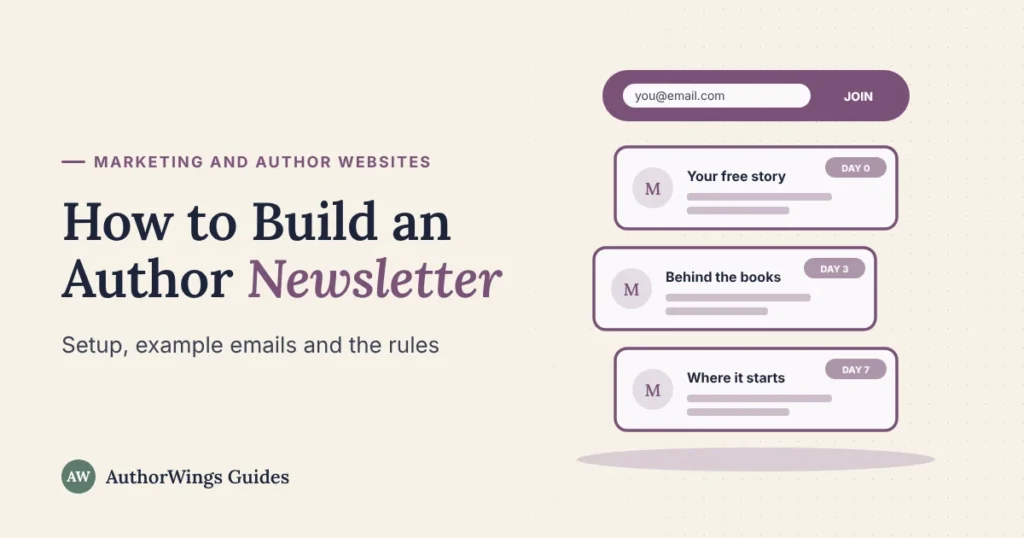
When someone joins, your email service can send a short series of welcome emails automatically. Readers have just asked to hear from you, so use these emails to deliver what you promised and introduce yourself. Three emails over about a week is enough to start.
Here’s a welcome sequence for an invented author, Maya Ellison, who writes cozy mysteries and offers a free prequel story.
Welcome email 1, sent right away
Subject: Your free Harbor Falls story is here
Hi Ana,
Thanks for joining! Here’s your copy of “The First Pot,” the story of how Nell found the empty shop that became the Harbor Falls Tea House: [Download the story]
I’ll write about once a month with news about the series, the occasional recipe from Nell’s kitchen, and first word on new books and deals.
Happy reading,
Maya
Welcome email 2, sent on day 3
Subject: The real place behind the tea house
Hi Ana,
Before I wrote mysteries, I spent 31 years as a librarian. Nell’s tea house is based on the old reading room where I worked, right down to the squeaky third step. Here’s a photo of the real one, and the book that made me fall in love with mysteries when I was ten.
What got you started on mysteries? Hit reply and tell me; I read every email.
Maya
Welcome email 3, sent on day 7
Subject: Nell’s first full-length case
Hi Ana,
If you enjoyed “The First Pot,” the first full-length Harbor Falls mystery is “Steeped in Secrets,” where Nell’s very first customer turns out to have something to hide. [See the book]
From next month you’ll get my regular newsletter. If it’s not for you, there’s an unsubscribe link at the bottom of every email.
Maya
Why it works:
- Email 1 delivers the promise at once, and says what to expect, so her next email isn’t a surprise.
- Email 2 is about her, not a sale, and invites a reply, which starts a conversation.
- Email 3 points to one book, once, after she’s given something first.
What to send each month
A regular issue can be short. Mix news with something readers enjoy even when you have nothing to sell:
- Progress on your next book, or a short excerpt
- A behind-the-scenes story, photo or piece of research
- A book you’ve loved by another author
- A deal or a new review
- An event, such as a reading or signing
- A question for readers to reply to
Feature one of your own books per issue, so readers know what to do next.
Monthly issue example
Subject: A secret ingredient, and book 2 news
Hi Ana,
Book 2 is with my editor! It’s called “A Brew to Die For,” and it’s out next spring. Here’s the first page, just for subscribers: [Read the first page]
From Nell’s kitchen: by popular request, the lemon shortbread recipe. [Get the recipe]
What I’m reading: “Murder at Willow Green” by June Hartley, a gentle village mystery I couldn’t put down. Tell me yours and I’ll share a few next month.
Maya
For the emails around a new release, use the timing in the launch emails part of the launch checklist.
How often to send
Aim for at least once a month, so readers remember who you are, and choose a rhythm you can keep up. A common rhythm is monthly or every two weeks, with extra emails around a launch or deal. Whatever you choose, say it on your signup page and stick to it.
Rules to follow
Email law depends on where your readers live, not just where you do. This is general information, not legal advice.
- United States (CAN-SPAM Act): the law doesn’t require consent before you email, but every commercial email needs honest sender details and subject lines, your postal address and a working unsubscribe link that keeps working for 30 days after you send. You must honor unsubscribes within 10 business days, and identify the email as an ad, unless the reader gave prior consent to receive it.
- UK and EU: marketing emails to individuals generally need their consent first, and you should be able to show when and how someone signed up.
- In practice: only add people who signed up themselves, never import contacts or buy a list, and keep your signup form clear about what people will receive. Double opt-in, where new subscribers click a link to confirm, isn’t required everywhere, but it keeps typos and fake addresses off your list.
Your email service adds the unsubscribe link and address for you; you’ll need to give it a postal address you’re comfortable showing, such as a PO box registered with the US Postal Service.
Keep your emails out of spam
- Send from your own domain, such as maya@mayaellison.example, rather than a free email address. You’ll need a domain, usually the one your website uses.
- Set up authentication. Your email service will walk you through adding records (SPF, DKIM and DMARC) to your domain. Since 2024, Gmail and Yahoo have required all senders to use basic authentication and keep spam complaints below 0.3%; bulk senders (for Gmail, more than 5,000 emails a day to Gmail accounts) also need both SPF and DKIM, DMARC and one-click unsubscribe.
- Keep your list clean. Remove addresses that bounce, and consider removing people who haven’t opened anything in many months, after one email asking if they want to stay.
- Write like a person. Clear subject lines and a familiar sender name help readers recognize you.
Grow your list
- Back-matter links in every book, pointing to a page on your website where readers can sign up (in ebooks, not straight to the form).
- Your reader magnet, offered wherever you have a profile or bio.
- Newsletter swaps with authors in your genre, where each of you recommends the other’s book or magnet.
- Group promotions with other authors, where readers browse free books and join the lists they like; see group promotions and their plans.
- Events, with a signup sheet or a link on a card.
For more ideas, see these other ways to grow your readership.
Track what works
Your email service shows a few numbers for each email:
- Opens: a rough guide only, because some email apps, including Apple Mail with its privacy setting on, can count an email as opened when it wasn’t.
- Clicks: a better sign of interest; watch which links readers use.
- Unsubscribes: expect a few after each email; a jump suggests that email missed the mark.
- Replies: the best sign of all that readers feel they know you.
Look at the trend over several months rather than one email, and note what you changed.
When to get help
If you’d rather focus on writing, we set up your newsletter in your name. Our Author Page ($499) is a one-page website with your newsletter set up and connected, a signup page you can share and 3 welcome emails written for new subscribers, with hosting for the first year. The Author Website ($1,499) has 5 pages, a free bonus to attract subscribers and 5 welcome emails. Launching soon? Launch emails can be added to the 8-week launch plan: 5 written for your subscribers for $349. You keep every account and login.
Book marketing
Want your newsletter set up for you?
We set up your newsletter in your name, with a signup page and welcome emails written for new subscribers.
- Author Page with newsletter $499
- Author Website with newsletter $1,499
- Launch emails +$349
Author newsletter questions
How often should an author send a newsletter?
Aim for at least once a month, so readers remember you, and choose a rhythm you can keep up. A common rhythm is monthly or every two weeks, with extra emails around a launch. Say how often you’ll write on your signup page, and then keep to it.
What should an author newsletter include?
A mix of news and things readers enjoy: progress on your next book, an excerpt, a behind-the-scenes story, a book you recommend, a deal or an event, and a question to reply to. Try pointing to one book at a time rather than many.
How many subscribers do you need before launch?
There’s no set number. A small list of readers who signed up because they like your genre can matter more than a large one. Start early, set goals you control, such as one newsletter swap a month or a signup link in every book, and build it with a reader magnet and newsletter swaps.
Is it legal to add readers to your newsletter?
Only add people who signed up themselves. In the US, the CAN-SPAM Act doesn’t require consent but sets rules for every email; in the UK and EU, you generally need consent first. Never import contacts, buy a list or add people who emailed you about something else.
Should you start a newsletter before your book is out?
Yes, if you can. Months before launch, a short story, your writing updates or a free sample give readers a reason to join, and on launch day you’ll have people to tell. A newsletter started after release still works; it just has less to launch with.
Related reading
AuthorWings editorial team
The AuthorWings editorial team writes and updates our guides for first-time authors. Every post is read and edited by a person on our team before it is published.