Home / Guides / Writing a Book
How to Finish Writing a Book You’ve Already Started
 By AuthorWings editorial team
Updated
9 min read
Short answer
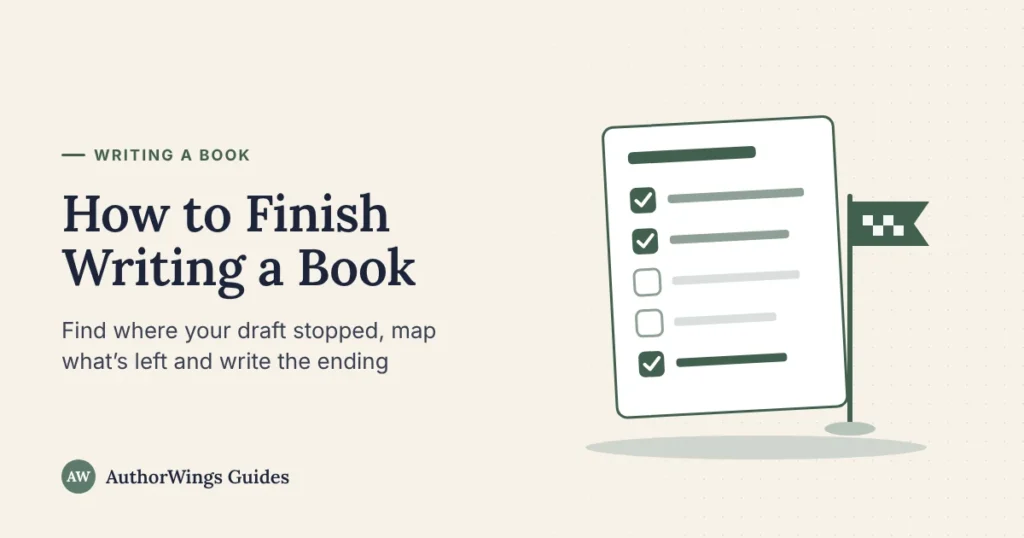
To finish a book you’ve started, find where your draft stopped, list exactly what’s missing, and write the ending next. Then fill the gaps in order, with a finish date you can see, and stop revising until the draft is whole. When every chapter exists and the ending lands, the first draft is done and ready to revise.
Starting a book is common. Finishing one is where many writers stall, often in the middle or just before the ending. This guide is for a draft you’ve already begun: how to see why it stopped, map what’s left, write the ending and get to the last page. If you’d rather have someone hold you to dates, book coaching with deadlines gives you a coach who reads your pages every two weeks. Not sure it suits you? See is a book coach worth it. Setting up time to write in the first place? Start with a writing routine.
Where did your draft stop?
Drafts often stall at one of four points, and each needs a different fix. Find yours first.
| Where it stopped | The signs | What’s usually going on | The fix |
|---|---|---|---|
| Before the middle | You’ve rewritten chapter one many times; the draft is well under halfway | You’re polishing the opening before you know the book | Freeze the opening. Sketch the ending in a paragraph, then write the next chapter rough |
| In the middle | The early chapters are done, but you don’t know what happens next | The book has lost its next goal or question | List the big moments still to come, and write toward the next one |
| Before the ending | Three-quarters or more is written, but the last chapters won’t come | You don’t know the ending, or finishing feels final | Write the ending now, even badly, then fill the gap to it |
| Stuck revising early chapters | The draft is nearly whole, but you keep reworking early chapters instead of writing the last ones | Fixing feels safer than finishing | Stop revising and write the ending, then the missing chapters |
For novels, a stalled middle is often a story problem; see how five turning points keep a plot moving. For non-fiction, check that each remaining chapter answers one reader question, using a chapter blueprint.
Quick check: what to do next
Quick check
What to do next with your draft
Your plan for this week
Make a finish map
A finish map turns “I’ll finish it someday” into a list you can work through. It shows every chapter still to write, roughly how long each is, and when you’ll be done.
Worked example: an invented mystery, Ten Days in Kestrel Bay, at 41,000 of about 80,000 words.
| Chapters | What happens | Estimated words | Status |
|---|---|---|---|
| 1 to 14 | Mara returns, finds the torn logbook, and the harbormaster lies about the dock log | 41,000 | Drafted |
| 15 to 17 | Mara traces the missing ten days; someone wrecks her boat | 9,000 | To write |
| 18 to 21 | Each suspect’s story falls apart, and someone she half-trusted turns out to have lied | 12,000 | To write |
| 22 to 24 | The storm traps her with the one person who knows the truth | 9,000 | To write |
| 25 to 27 | The truth about her father, and her choice to stay or leave | 9,000 | To write; ending first |
That’s about 39,000 words to go. At 500 words a session, five sessions a week, it’s about 16 weeks. To set your own date, use our timeline calculator. Pin the map where you write and tick off each chapter as it’s done.
Write the ending next
If you don’t know how the book ends, the middle has nowhere to go. Write the ending before you fill the gap.
- Fiction: write the final scene. Decide what your main character wants at the end, whether they get it, and what has changed in them.
- Non-fiction: write the last chapter’s result: what the reader can now do or understand, and the one action you want them to take.
- Draft it rough. It’s allowed to be bad. You’ll rewrite it once the rest of the book exists, and knowing where you’re heading makes every middle chapter easier.
If you can’t write the ending, write three possible endings in a paragraph each, and pick the one you’d be happiest to read. If you’re still before the middle, a one-paragraph sketch of the ending is enough for now; write the full scene once you’re past halfway.
Fill the gaps in order
With the ending written, work through your finish map from the first gap to the last. The drafting habits in Step 6 of our book guide still apply: [TK] for missing facts, a notes file for fixes, no editing while you draft, and five ways to get moving when a chapter won’t come. Two more help when the end is in sight:
- Tick off chapters. “Chapter 18 done” on your map shows progress more clearly than a word count this late in a draft.
- Track loose threads. Keep a list of every question, clue or promise the early chapters raised, and cross each off as a later chapter answers it.
Coming back to a draft after months away
A long break makes a draft feel strange. If you’ve been away more than six months, do this before you make your finish map. A one-week restart gets you back in without starting over.
- Day 1 to 2: read it through once. Read the whole draft without fixing anything. Note only what happens in each chapter.
- Day 3: make a quick reverse outline. Write one line per chapter, then see what’s missing; our guide shows how to reverse outline a draft.
- Day 4: make your finish map. List the chapters still to write, and set a date.
- Day 5 to 7: write. Write the ending rough first, then start on the first gap on your finish map.
If the draft no longer fits the book you want to write, keep what works and restart from a new outline. That’s finishing too, with a better plan.
When is a draft “done enough”?
A first draft needs to be whole; polish comes later. It’s done enough to stop drafting when:
- Every chapter exists, with no “write this later” chapters left.
- The ending is written and lands where you meant it to.
- You can sum up each chapter in one sentence.
- Every [TK] is listed, ready to fill in revision.
And it’s time to stop revising and let someone else read it when:
- Your changes move words around without improving them.
- You’re changing things back to how they were.
- You’ve done two or three full rounds of revision.
Then send it to two or three trusted readers, or get an editorial assessment for a professional read of the whole structure.
When to get help
You can finish a book on your own with a map and a date. Help makes sense when dates keep slipping, or when you’ve decided you’d rather hand the book over.
- You want deadlines and feedback. A book coach reads your pages every two weeks, sets your next target and helps you fix problems as you go. Coaching is from $849, or try one session for $399. Our coaches cover fiction, non-fiction and memoir, including romance, mystery, thriller, suspense, fantasy, young adult, women’s and contemporary fiction. Coaching works for fiction, non-fiction and memoir. If you would rather hand it over, a ghostwriter can finish the draft, and an editorial assessment helps once it’s whole.
- You’d rather someone else finished it. A ghostwriter can finish it from where you stopped, in your voice. The price is set by the final length of the manuscript, including the pages you’ve already written. If you start with coaching and switch, 50% of paid coaching fees count toward ghostwriting.
- The draft is done and you want a structural read. An editorial assessment gives you an 8 to 20 page letter on the whole book’s structure. It costs $180 for the first 10,000 words, then $0.018 a word, and the fee is credited toward a developmental edit booked within 60 days.
Book coaching
Finish the draft, one deadline at a time
A coach reads your pages every two weeks, sets your next deadline and answers questions between calls, until the draft is done.
- From $849
- Or try one session for $399
- Fiction, non-fiction and memoir
Questions about finishing a book
Is it normal to never finish a first draft?
Yes, it’s common. Plenty of writers set a draft aside, often in the middle or just before the ending. It doesn’t mean the idea is bad. A finish map, an ending written early and a date someone else knows about turn an open-ended project into a list you can complete, which is often what was missing.
Should I start a new book if I’m stuck?
Sometimes, but try one restart first. A new idea feels easier because it has no problems yet, and the next book can stall at the same point. Use the quick check above, write the ending, and give yourself four weeks with a finish map. If the draft still doesn’t fit the book you want, keep what works and plan a new one.
How do I finish a book I abandoned years ago?
Read it through once without fixing anything, then make a one-line-per-chapter outline to see what’s there. Decide whether it’s still the book you want to write. If yes, make a finish map and write the ending next. If your skills have grown, expect to revise early chapters later, after the draft is whole.
How do I know when my book is finished?
A first draft is finished when every chapter exists, the ending is written and every [TK] is listed. The book is ready for readers when your changes stop improving it and start moving words around, often after two or three rounds of revision. At that point, outside readers or an editor will help more than another pass on your own.
AuthorWings editorial team
The AuthorWings editorial team writes and updates our guides for first-time authors. Every post is read and edited by a person on our team before it is published.