Home / Guides / Writing a Book
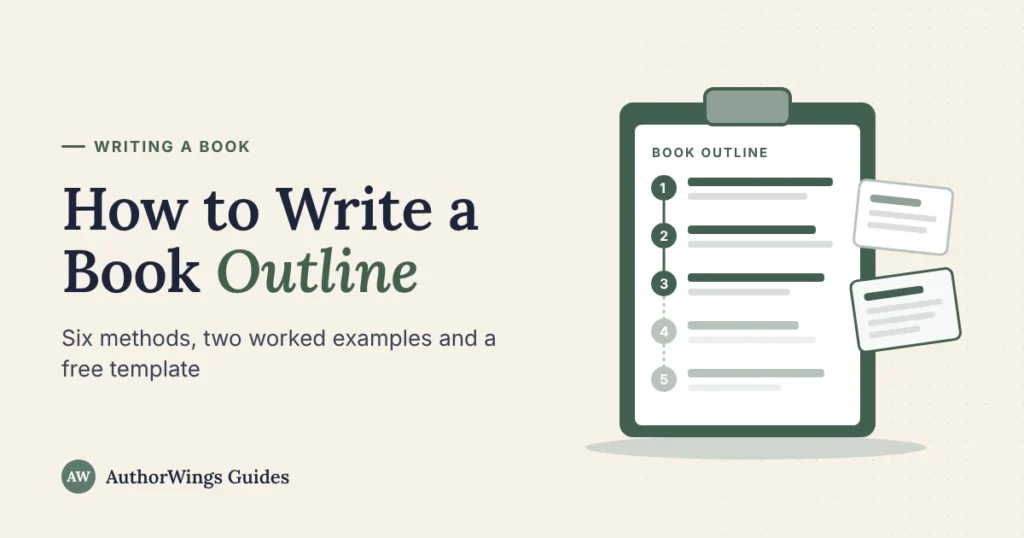
How to Write a Book Outline (With Free Template)
 By AuthorWings editorial team
Updated
10 min read
Short answer
To write a book outline, sum up your book in one sentence, then list its main turning points (fiction) or the questions your reader needs answered (non-fiction). Put them in chapter order and add a line or two per chapter about what happens or what the reader learns. Our free Word and PDF template walks you through it.
An outline is a map of your book before you write it, and you can redraw it as you go. This guide shows six ways to outline, then two worked examples, one novel and one non-fiction book. For every step around the outline, see the full process of writing a book. If you’d like someone to check your outline and keep you writing, a book coach can help.
What a book outline is, and how detailed to make it
A book outline is a list of your chapters, in order, with a short note on what each one does. How much you write per chapter is up to you. There are three common levels.
| Level | What you write | Good for |
|---|---|---|
| Skeleton | One line per chapter | Discovery writers, short books, a first pass |
| Working outline | A short paragraph per chapter | Many first books, fiction and non-fiction |
| Scene by scene | Every scene in every chapter | Complex plots, mysteries, series |
Start with a skeleton. Add detail only where you feel unsure. Writing a memoir? Its outline follows the turning points in your life, so see how to outline a memoir.
Six ways to outline a book
There’s no single right way to outline a book. Pick the method that matches how you think, and mix them if it helps.
| Method | How it works | Best for |
|---|---|---|
| Chapter list | Write each chapter’s title and one line about it | Non-fiction, and any first outline |
| Turning points | Pin down the big story moments first, then fill the chapters between them | Novels |
| Snowflake Method | Novelist Randy Ingermanson’s ten-step method: grow one sentence into a paragraph, then character pages and, later, a scene list | Writers who like to plan in layers |
| Index cards | One card per scene or idea, laid out and moved around | Visual thinkers, books written out of order |
| Mind map | Put the main idea in the center and branch out to topics, then turn branches into chapters | Non-fiction with many topics |
| Reverse outline | Outline a draft you’ve already written, chapter by chapter | Revising a finished or stalled draft |
How to outline a novel, step by step
To outline a novel, start with what your main character wants and what stands in the way, then build the chapters around the story’s turning points. Our fiction guide shows the five turning points on a worked example.
- Write the premise in one sentence: a character, a goal, an obstacle and what they lose if they fail.
- Mark the turning points: the event that starts the story, the point of no return, the midpoint, the lowest point and the climax.
- Fill the chapters between them. For each chapter, note what the point-of-view character wants, what gets in the way, and how it ends.
- Check the chain. Each chapter’s ending should push the character into the next one.
Here are the first six chapters of an outline for our invented mystery, Ten Days in Kestrel Bay.
Premise: A ferry captain must learn why her late father tore the last ten days out of his logbook, before the person who wrecked her boat silences her too.
| Chapter | Goal | What gets in the way | How it ends |
|---|---|---|---|
| 1. Coming home | Mara wants to bury her father and catch Monday’s ferry. | The town treats her like an outsider. | At the wake, Ellis says her father “wasn’t himself” for ten days. |
| 2. The logbook (the story starts) | She wants to clear out her father’s boat. | The cabin lock has been changed. | She gets in through the hatch and finds his logbook, with the last ten days torn out. |
| 3. The harbor office | She asks the harbormaster for the dock log. | He says it was lost in a flood. | She sees the dock log on his desk. He’s lying. |
| 4. The morning ferry (point of no return) | She has to decide: go home or stay. | Her job on the mainland wants her back. | She watches the ferry leave without her. |
| 5. Ellis | She wants Ellis to explain what he meant. | He changes his story about where he was the night her father died. | He slips her the key to her father’s locker and walks off. |
| 6. Night on the dock | She watches her father’s boat after dark. | Someone else is already on board. | A light in the cabin goes out as she gets close. |
Notice that every chapter ends with something new. That’s what keeps a reader turning pages and keeps you writing.
How to outline a non-fiction book, step by step
To outline a non-fiction book, start with the promise to your reader, then order your chapters so each one answers the next question the reader would ask.
- Write the promise in one sentence: what the reader will know or be able to do by the end.
- List your reader’s questions. Write down everything a reader would ask, then group them. Each group can become a chapter.
- Put the chapters in order. A common order is problem, then method, then result. A how-to book often follows the order the reader does things in.
- Give each chapter four parts: the question it answers, its key points, an example or story, and the takeaway.
Here are three chapters from the outline for an invented non-fiction book, The First-Year Hive (chapter 3, on getting your bees home, is skipped here).
Promise: By the end, you’ll keep a healthy hive through its first year.
| Chapter | Reader’s question | Key points | Example | Takeaway |
|---|---|---|---|---|
| 1. Why your first year decides everything | Why is year one so hard? | What a new colony needs; the jobs you can’t skip; what goes wrong when you wait | A first-time beekeeper who checked the hive too late in summer | Plan the year before the bees arrive |
| 2. Choosing a hive and a spot for it | Which hive should I buy, and where should it go? | Hive types for beginners; sun and shelter; distance from neighbors | Two backyard setups compared | Choose the spot before you buy the hive |
| 4. Spring: the first inspections | What do I look for when I open the hive? | What a healthy frame looks like; how often to check; what to write down | A sample inspection note | Keep a simple log from day one |
Outline a draft you’ve already written
If you already have a draft, a reverse outline shows you its real structure. It’s a quick way to see why a draft stalls or sags. To get a stalled draft moving again, see how to finish writing a book.
- Read one chapter at a time.
- Write one line saying what happens or what the reader learns.
- Add a second line: what this chapter does for the book. If you can’t answer, mark it.
- Look at the whole list. Repeated chapters, missing steps and a slow middle stand out quickly.
If the list shows bigger problems than you can solve alone, a developmental edit looks at the structure of the whole manuscript.
Free book outline template
Our free book outline template has separate pages for fiction and non-fiction, plus a reverse outline page. It opens in Word or Google Docs, and there’s a PDF to print. No email needed. Prefer to outline in an app? Compare the options in our book writing software guide.
Book Outline Template (free)
Download the Word template- Your book in one sentence (fiction premise or non-fiction promise)
- Fiction turning points
- Fiction chapter grid: goal, what gets in the way, how it ends
- Non-fiction chapter grid: question, key points, example, takeaway
- Reverse outline for a draft
- Outline checklist
Free to use for your own book.
Planning the whole book, with word-count targets and a weekly tracker? Use our whole-book planner too.
Outline mistakes that cost you later
- Outlining forever. When every chapter has one clear line, start writing.
- No ending. Even discovery writers often do better with the last chapter in mind.
- Chapters that do the same job. If two chapters make the same point or the same thing happens twice, merge them.
- Topics in no particular order. A non-fiction outline needs a reason for its order, such as problem, method, result.
- Treating the outline as fixed. Change it when the draft teaches you something better.
When to get help
You can outline a book on your own with the template. Help makes sense when you’re stuck.
- You want feedback on your outline and deadlines to keep going. A book coach reads your pages and keeps you on schedule, from $849, or try one session for $399. Our coaches work with fiction, non-fiction and memoir, including romance, mystery, thriller, suspense, fantasy, young adult, women’s and contemporary fiction.
- Your draft is written but the structure isn’t working. A developmental edit gives you an editorial letter of 8 to 20 pages, plus chapter notes. For fiction it is $330 for the first 10,000 words, then $0.033 a word.
Book coaching
Get your outline checked and your book moving
A book coach reads your outline and pages, sets your next deadline and answers questions between calls.
- From $849 for a coaching package
- Or try one session for $399
- Coaching for fiction, non-fiction and memoir
Book outline questions authors ask
How long should a book outline be?
As long as you need to start writing with confidence. A skeleton outline is one line per chapter, which for a 20-chapter book fits on a page. A working outline gives each chapter a short paragraph. Complex plots, such as mysteries, often need every scene listed. Start short and add detail only where you’re unsure what happens next.
Do I need an outline to write a book?
No, but it helps many first-time authors finish. Some writers, often called discovery writers, find the story as they draft. Even then, it helps to know your ending and two or three key moments, so the middle doesn’t stall. Non-fiction usually needs at least a chapter list, because the order of ideas carries the book.
Can I change my outline while I write?
Yes, and you probably will. Drafting often shows you a better order, a missing chapter or a scene that doesn’t work. Update the outline when that happens, so it stays a useful map. Some authors do a quick reverse outline after the first draft to see the book’s real shape before they revise.
What’s the difference between an outline and a synopsis?
An outline is your private plan, chapter by chapter, and it can be as rough as you like. A synopsis is a summary you send to agents or editors. Publishing expert Jane Friedman recommends one or two single-spaced pages, about 500 to 1,000 words, usually in present tense, and says it must reveal the ending. You usually write an outline before the book and a synopsis once the draft is done.
AuthorWings editorial team
The AuthorWings editorial team writes and updates our guides for first-time authors. Every post is read and edited by a person on our team before it is published.