Home / Guides / Children's Books
How to Market a Self-Published Children’s Book
 By AuthorWings editorial team
Updated
10 min read
Short answer
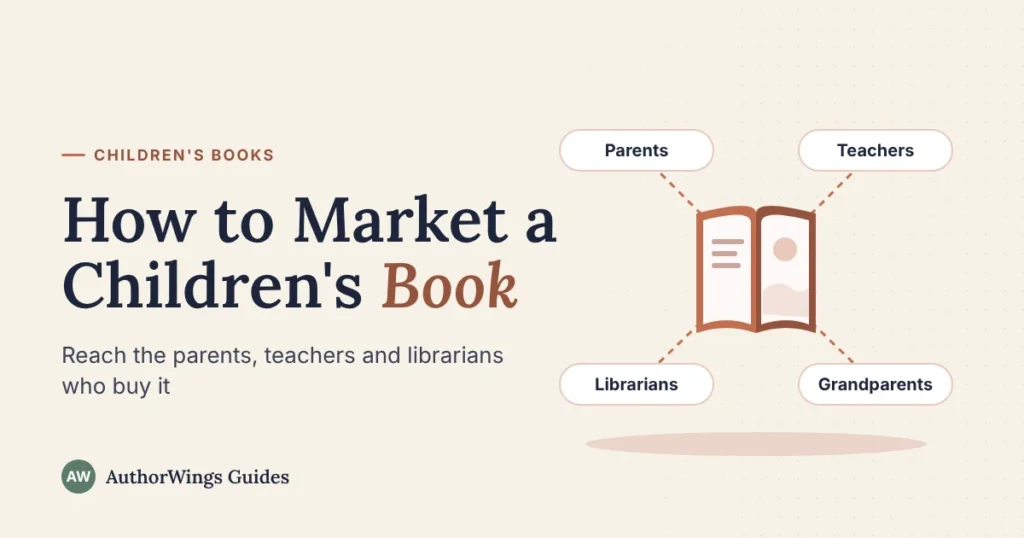
Market a children’s book to the adults who buy it: parents, grandparents, teachers and librarians. Set up your Amazon page for the right reading age, make the book orderable by libraries and bookstores, then build local reach through library events, school visits and a simple author page with a newsletter for parents.
A children’s book has two audiences. The child decides whether the book gets read again; an adult decides whether it gets bought. So aim your marketing at the adults, through the places they already trust. If you’d rather have help with the launch, our book marketing services cover the website, the Amazon page and the launch plan. Still early in your writing career? Start with becoming a children’s book author.
Who buys a children’s book (and what each buyer needs)
Each buyer finds books in a different place and looks for something different. Plan your marketing around them, not around the child alone.
| Buyer | Where they find books | What they look for | What to give them |
|---|---|---|---|
| Parents | Amazon, other parents, the library, social media | The right age, a story their child will ask for again | A clear age range, sample pages, a short reading video |
| Grandparents and gift buyers | Bookstores, Amazon, local events | A gift that looks good and suits the age | A strong cover, a hardcover, signed copies at events |
| Teachers | Colleagues, school librarians, conferences | A book that fits a lesson or a reading level | A one-page sheet with the age range and a classroom activity |
| Librarians | Wholesalers, review journals, patron requests | Reviews, a sturdy format, a book patrons ask for | An ISBN they can order through a wholesaler, reviews, a hardcover |
| Kids | Their library, their classroom, friends | Characters, humor, pictures | A visit, a reading, a character they remember |
Libraries matter a great deal. Scholastic’s Kids & Family Reading Report (8th edition, the latest as of October 2026) found that 63% of children get most of their books from public, school and classroom libraries.
Set up your book so buyers can find it
Before any promotion, make sure the book is easy to find and easy to judge.
- Set the reading age on KDP. The field is optional, but KDP says that without a suitable reading age a book may not be eligible for children’s categories and won’t appear in age-specific search results. Our guide shows where the KDP reading age goes.
- Choose your 3 categories carefully. KDP lets you pick 3 categories. Pick the narrowest ones that truly fit, by age and topic.
- Check the cover at thumbnail size. Parents first see your cover as a small image on a phone. See what makes good children’s book cover design.
- Write the description for the adult buyer. Say who it’s for, what happens and why a child will love it, in plain words.
If you’d like this done for you, we can set the book up for the right age group on every store.
Make it orderable by libraries and bookstores
Libraries and bookstores order through wholesalers, so your book needs to be in their catalog.
Publishing through IngramSpark puts your book in Ingram’s catalog, which IngramSpark says reaches more than 40,000 bookstores, libraries and retailers. That route matters more since Baker & Taylor, which Publishers Weekly called the country’s largest library wholesaler, announced in October 2025 that it would shut down in January 2026. An Ingram executive told Publishers Weekly that most large library systems already had at least one Ingram account. Our comparison of how IngramSpark reaches libraries and stores covers the setup and discount.
Then ask. Check your library’s website for a “suggest a purchase” form; some libraries have one just for local authors, and some only accept a donated copy. Reviews from established sources, rather than store ratings, and local interest give a librarian reasons to say yes. A sturdy hardcover for libraries can also help, because library books get a lot of handling.
Reviews librarians read are harder to get for self-published books. Kirkus offers paid reviews for independent authors, with picture book reviews starting at $399 (as of October 2026). It doesn’t guarantee a positive review, so treat it as optional.
Start local
Local readers are a good place to start, because parents talk to other parents.
- Your library. Offer a free storytime reading, and ask whether they take purchase suggestions from local authors.
- Independent bookstores. Some work on consignment: the store stocks a few copies and pays you only for what sells, keeps a share of the price and sometimes charges a small fee, often for a set period such as 90 days. Bring a one-page sheet with the ISBN, price, age range and a short description.
- Playgroups, parent groups and preschools. A short reading and a few copies to sell.
- Local events and fairs. A small table, signed copies and a sign-up sheet for parents.
- Local press. A short note to a local paper or community site about a local author’s new book.
School visits
School visits put you in front of a whole class of readers at once, and the Authors Guild calls them “a much-needed source of income for children’s authors.”
- Start with schools you know: your own children’s school, schools near you, or the school you went to.
- Contact the school librarian or literacy coordinator, not just the main office.
- Offer a clear session: a reading, a short talk about how the book was made, and an activity tied to the story. Say how long it takes and which ages it suits.
- Plan book sales with the school. Ask whether you can send an order form home before the visit, and bring signed copies.
- Ask early. Contact schools well before the date you want.
SCBWI also runs a Speakers Bureau, a searchable database of SCBWI authors and illustrators who have signed up to speak at events. If you’re a member, check with SCBWI about being listed.
Free template
School visit email
Hi [Name],
I’m [your name], a local children’s author. My picture book, [Book title], is about [one line]. I’d love to visit [School] to read it with your [grade] classes.
The session takes about [30] minutes: a reading, a short talk about how a picture book is made, and a quick [drawing / writing] activity. I can visit [days or months], and I’m happy to send an order form home so families can buy signed copies.
Would this suit your students? I can send a one-page sheet with details.
Thank you,
[Name] · [website] · [phone]
Replace everything in brackets before you send it.
Online: an author page, a newsletter and reviews
Online marketing for a children’s book is mostly for the parents and teachers who look you up after hearing about the book.
- A simple author page with the book, the age range, sample pages, a short bio and a way to book a visit. Our author page with a newsletter signup costs $499, including year 1 hosting.
- A newsletter for parents, not kids. In the US, the FTC’s COPPA rule generally requires verifiable parental consent before a site aimed at children, or one that knowingly collects from children under 13, gathers their contact details. Sign up parents only; see how to build an author newsletter.
- Reviews from real readers. Ask early readers to leave an honest review on the stores, and once your book is listed on Goodreads, claim your free author profile there.
- Short reading videos of a page or two, if you’re comfortable on camera.
Ads: when they make sense for a children’s book
Ads work best for a book that already sells a little and has a few reviews. An ad can’t fix a weak cover or an empty review section.
KDP authors can advertise through Amazon Ads, and Amazon requires book ads to suit a general audience. Start with a small daily budget, track what each ad earns back, and stop what doesn’t work. If you’d rather not manage it, we can set up the account in your name, but ad spend is always paid by you directly and results aren’t guaranteed.
A first-90-days marketing plan
| When | Do this |
|---|---|
| Before launch | Set the reading age, categories and description. Publish on IngramSpark too, with your own ISBN, so libraries and stores can order it. Set up an author page and a newsletter for parents |
| Weeks 1 to 4 | Tell your own circle. Ask early readers for honest reviews. Contact your library and two or three local bookstores |
| Weeks 5 to 8 | Book your first school visit and library storytime. Send a note to local press |
| Weeks 9 to 12 | Run a reading at a local event. Try a small ad if you have a few reviews. Write to your newsletter |
Marketing mistakes children’s authors make
- Marketing to kids instead of the adults who buy.
- No reading age on Amazon, so the book may miss children’s categories and age-specific searches.
- Not being orderable by libraries, when libraries are where many children find books.
- Collecting children’s email addresses. Write your newsletter for parents.
- Paying for ads before the book has a few reviews.
- Giving up after one school or bookstore says no. Local marketing builds slowly. For more ideas at each stage, see these book marketing strategies.
When to get help
Marketing a children’s book takes time more than money. If you want help with the parts that need setup, our book marketing covers an author page and newsletter from $499, your Amazon page and author profiles from $399, and an 8-week launch plan for $749. Ads are optional, in your name.
Children’s book marketing
Launch your children’s book with a plan
An author page for parents, an Amazon page set up for the right age, and a launch plan built around schools and libraries. Ads optional, in your name.
How to market a children’s book: common questions
Should I market to kids or parents?
Mostly parents and other adults, because they buy the book. Children still matter: a child who loves the book asks for it again and tells friends, which is why school and library visits work. Write your Amazon page, website and newsletter for the adults, and save the fun for readings, visits and the book itself.
How do I get my book into a school library?
Make the book orderable through a wholesaler such as Ingram, then contact the school librarian with a short note, the age range, the ISBN and any reviews. A visit to read the book often helps, because the librarian sees the students’ reaction. A book that fits a lesson or a reading level gives the librarian another reason to add it.
Do I need social media to sell a children’s book?
No. Children’s books can sell well through libraries, schools, local bookstores and events. Social media can help you reach parents and teachers if you enjoy it, but it isn’t required. A simple author page and a newsletter for parents give people somewhere to find you without posting every day.
How much should I spend on marketing?
You can start with very little. An author page, library and bookstore visits, and school visits cost mostly time. Spend money first on what helps every sale, such as a strong cover and a good Amazon page. Add paid reviews or ads only once you know your reader and have a few honest reviews.
Related reading
AuthorWings editorial team
The AuthorWings editorial team writes and updates our guides for first-time authors. Every post is read and edited by a person on our team before it is published.