Home / Guides / Marketing and Author Websites
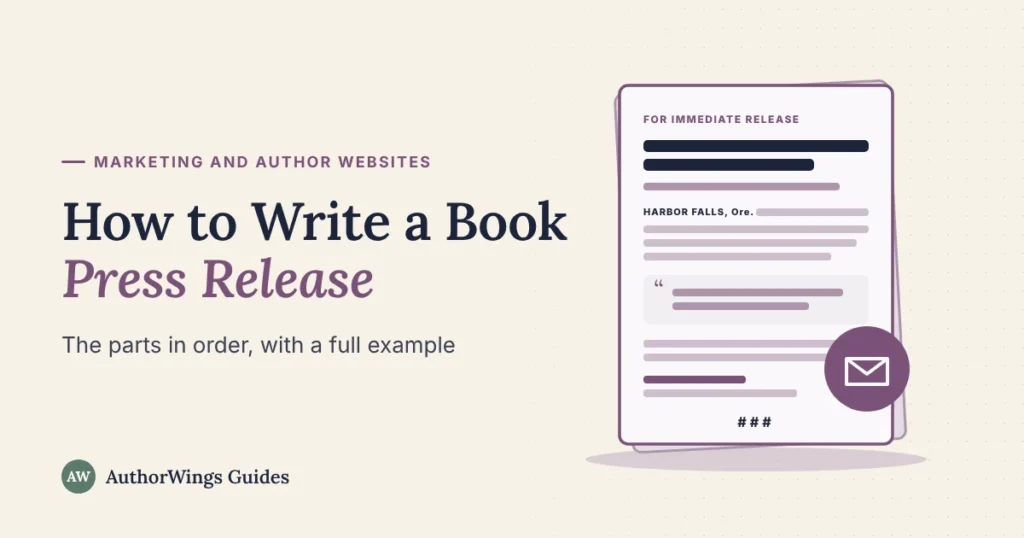
How to Write a Press Release for a Book (With an Example)
 By AuthorWings editorial team
11 min read
Short answer
To write a press release for a book, lead with a news angle rather than the book itself. Then add a headline, a dateline, an opening paragraph covering who, what, when, where and why, a quote, short book and author details, and contact information. Keep it to one page, and send it to journalists who cover your angle.
A press release is a short news story about your book, written so an editor can use it as it is or call you for more. Done well, it can get you into a local paper, a trade newsletter or a podcast lineup. Done badly, it reads like an ad and goes nowhere. This guide shows when a release is worth writing, how to find the news in your book, each part in order, and a complete example you can learn from. If you’d rather have it written and sent for you, see our book press release service.
When a press release is worth it
A press release works when there’s something an editor’s readers would want to know. Good reasons include:
- A local author or setting. Local papers, radio and community sites look for local stories.
- An event. A launch reading, a library talk or a signing gives the outlet a date to share; see these book launch party ideas.
- Your expertise. A non-fiction book on a topic in the news can make you a source journalists call.
- A milestone. An award, a big anniversary or a charity tie-in is news in its own right.
It’s less useful for a debut with no angle beyond “my book is out”. In that case, spend your time on your newsletter, early readers and other book marketing strategies, and save the release for when you have an event or a hook.
Find your news angle
News editors don’t cover a book just because it’s out; they cover stories. Before you write a word, finish this sentence: “This is news because…”. Common angles:
- Local: a hometown author, a book set in town, or a launch at the local library.
- Timely: a link to a season, an anniversary, or something in the news this month.
- Expert: you can explain a problem readers care about, backed by your work or research.
- Human story: something unusual behind the book, such as a career change or a family history.
- Event: a reading, signing, talk or fundraiser with a date, time and place.
- Milestone: an award, an anniversary or a charity tie-in.
- New information: a survey, data or a finding from your research that no one has reported.
If you have more than one, start with an event if you have one, and adjust the lead for each outlet. A local paper wants the local angle; a trade newsletter wants the expert one.
News angle check
News angle check
Six yes or no questions. You get your strongest angle, the outlets it suits and a headline pattern. Your answers stay on this page; nothing is saved or sent.
Lead with the strongest angle you have: an event with a date first, then a local link, a timely tie-in, your expertise, new data, or an unusual story behind the book. If you have none yet, wait for an event or hook before sending a release.
The parts of a book press release, in order
- “For immediate release” at the top, or “Embargoed until” a date, time and time zone if the news can’t run before then.
- Headline: the news in one line, in plain words. Put the angle first and the book second.
- Subheadline (optional): one sentence that adds the next most useful detail.
- Dateline: at the start of the first paragraph, the city in capitals, then the AP state abbreviation (such as Ore.; large cities such as Boston need none), then the date you send it (Feb. 16, 2027).
- Lead paragraph: who, what, when, where and why, in two or three sentences. An editor should be able to stop here and still have the story.
- Body: one or two short paragraphs with the detail: what the book is about, why it matters to this audience, and event details.
- Quote: a sentence or two from you, or from a librarian, expert or organizer, that sounds like a person talking, not a blurb.
- Book details: title, genre, publication date, formats, price and where to buy, as a short list.
- About the author: two or three sentences, ending with your website.
- Media contact: your name, email, phone and a link to a page with your photo and cover.
- “###” centered at the end, the usual sign that the release is over.
Keep it to one page, write in the third person apart from quotes, and leave out praise you can’t attribute to a named source.
Example: a press release for a debut novel
This is a complete release for an invented author, Maya Ellison, whose first cozy mystery is set in her (also invented) hometown. Her angle is local, plus an event.
Example press release
FOR IMMEDIATE RELEASE
Retired Harbor Falls librarian sets debut mystery in fictional hometown, reads at library March 6
First novel by Maya Ellison follows a librarian-turned-tea-shop-owner whose first customer has an alibi that doesn’t add up
HARBOR FALLS, Ore. (Feb. 16, 2027) — Maya Ellison, who spent 31 years as a librarian in town, will give a free reading from her debut novel, “Steeped in Secrets,” at 2 p.m. Saturday, March 6, at the Harbor Falls Public Library, 120 Main St. The cozy mystery, which comes out March 2, is set in a tea shop on a fictional version of Main Street, and the reading marks her return to the library as an author.
In the novel, a retired librarian opens a tea shop, then realizes her very first customer may have lied to the police. Readers who know the town will spot the harbor walk, the Friday farmers market and a library that looks a lot like the real one. The event is open to all ages, with tea from a local shop and a question-and-answer session.
“I spent three decades helping people find mysteries on our shelves,” Ellison said. “Writing one set in the town I love felt like the right way to say thank you.”
Book details:
- Title: Steeped in Secrets (Book 1 of the Harbor Falls Mysteries)
- Genre: cozy mystery
- Publication date: March 2, 2027 (ebook and paperback)
- Price: $4.99 ebook, $14.99 paperback
- Ebook available for preorder now from Amazon and other ebook stores; paperback on sale March 2, when local shops can order it
About the author: Maya Ellison was a reference librarian in Harbor Falls for 31 years. She lives two blocks from the harbor with her husband and an opinionated cat. Find her at mayaellison.example.
Media contact: Maya Ellison, press@mayaellison.example, (541) 555-0142. Cover image and author photo: mayaellison.example/press
###
Why it works:
- The headline leads with the local story and ends with the event, not the title. A local editor sees at once why their readers would care.
- The lead paragraph answers who, what, when, where and why, so it could run on its own as a listing.
- The quote sounds like a person, and adds a reason for the book that isn’t in the facts.
- Everything an editor needs is there: dates, a free event, book details, a photo link and a direct contact.
How to send it
Send it to each person individually, not as a mass email, before you think about wide distribution.
- Make a short list. Find 10 to 30 outlets that fit your angle: local papers, radio and community sites for a local story; trade newsletters, niche sites and podcasts for an expert one. Look for the reporter or editor who covers books, events or your topic, and skip general inboxes where you can.
- Write a short pitch email. Put the angle in the subject line, give the story in two or three sentences, and paste the release below your signature rather than attaching it. For example: Subject: Retired local librarian reads debut mystery at library March 6. Hi Sam, I’m a retired Harbor Falls librarian, and my first novel is set in a tea shop on our Main Street. I’m reading at the library on March 6 at 2 p.m. and would be glad to talk about the book or send a copy. The release is below.
- Time it. Send event news two to three weeks ahead, so listings and weekly papers can include it. Timely angles need sending before the date they tie into, not on the day.
- Put it on your website. Add the release and a photo to a press page on your author website, so editors can find what they need.
- Consider a distribution service last. Wire services post your release on their network and partner sites, which may get it onto more sites, though the search benefit is limited. They don’t make editors write about you, and “as seen on” logos from those partner sites aren’t the same as an editor choosing to cover your book.
For when this fits around your launch, use the book launch checklist.
Follow up and track results
If you hear nothing, send one short follow-up a few days to a week later, with a new detail if you have one, such as a confirmed event time. Then move on; repeated chasing can cost you the contact.
Keep a simple list of who you sent it to, who replied and what ran. Track what you can see: articles and listings published, interview requests, event turnout, and any rise in newsletter signups or sales in the days after coverage.
Common mistakes
- Writing an ad. Words like “gripping”, “must-read” or “unputdownable” in your own voice tell an editor it’s marketing, not news.
- Burying the news. If the angle is in the fourth paragraph, the editor may not get there.
- Sending to everyone. A mystery release sent to a food editor wastes both your time and theirs.
- Attaching files. Editors may not open attachments from people they don’t know; paste the text and link to images.
- Asking for a review in the release. Reviews are a separate request with their own rules; see getting book reviews.
- No contact details. An editor with a question and no way to reach you will likely drop the story.
When to get help
If you’d rather focus on writing, our press options are priced on the page. 1 press release is $199: one news announcement written in 5 business days and sent to media sites on your chosen date. The press campaign is $999: two news announcements, a media kit and a 40-outlet media list you can pitch, a professional review managed for you, and a shortlist of reputable awards to enter. Distribution, review and award fees are paid by you. Editors decide what they cover, so we never promise coverage, sales or reviews.
Book marketing
Want your press release written for you?
We write your news announcement and send it to media sites on your chosen date, or run a full press campaign.
- 1 press release $199
- Press campaign $999
- Packages from $1,197
Book press release questions
How long should a book press release be?
One page, or about 300 to 500 words, is a common length. Editors skim, so the headline and first paragraph should carry the story on their own. If yours runs longer, cut the plot summary first and keep the news, the quote and the details.
Do press releases still work for books?
They can, when there’s news in them. A local angle, an event, expertise on a topic in the news or an award gives an editor a reason to run the story. A release that only says a book is out rarely gets covered, however it’s distributed.
Should you pay for press release distribution?
Only after you’ve pitched the outlets that matter to you directly. A wire service posts your release widely, but it doesn’t make editors cover your book. Treat it as an extra, not a replacement for a targeted pitch.
When should you send a book press release?
For an event, two to three weeks ahead, so weekly papers and listings can include it. For a timely angle, before the date it ties into. For a launch with another angle but no event, around release week, once the book can be bought; for a launch event, follow the event timing.
What’s the difference between a press release and a media kit?
A press release is one news story about a specific event or announcement. A media kit is a standing set of materials about you and your books, such as your bio, photos, cover images, a book summary and past coverage, usually on a press page of your website.
Related reading
AuthorWings editorial team
The AuthorWings editorial team writes and updates our guides for first-time authors. Every post is read and edited by a person on our team before it is published.