Home / Guides / Publishing
The Best Self-Publishing Companies, by What They Do
 By AuthorWings editorial team
10 min read
Short answer
The best self-publishing companies depend on the job. Amazon KDP sells your book to Amazon readers, IngramSpark makes print books available for bookstores and libraries to order, and a distributor such as Draft2Digital sends ebooks to many stores at once. KDP and IngramSpark charge nothing to set up a book. Paid services help with editing, design and setup, while vanity presses charge you to publish and often keep part of your royalties or rights.
“Self-publishing company” covers very different businesses: stores where readers buy books, distributors that pass your book to stores, printers that make each copy when it sells, and services you pay for help. Some of the best are free or low-cost tools you use yourself; some of the worst charge thousands. This guide sorts them by what they do, names the best self-publishing platforms you upload to yourself, and explains what to look for in a paid service. No company on this list paid to be here, and we sell a service ourselves, so ours appears separately at the end, labelled as our service.
Types of self-publishing companies
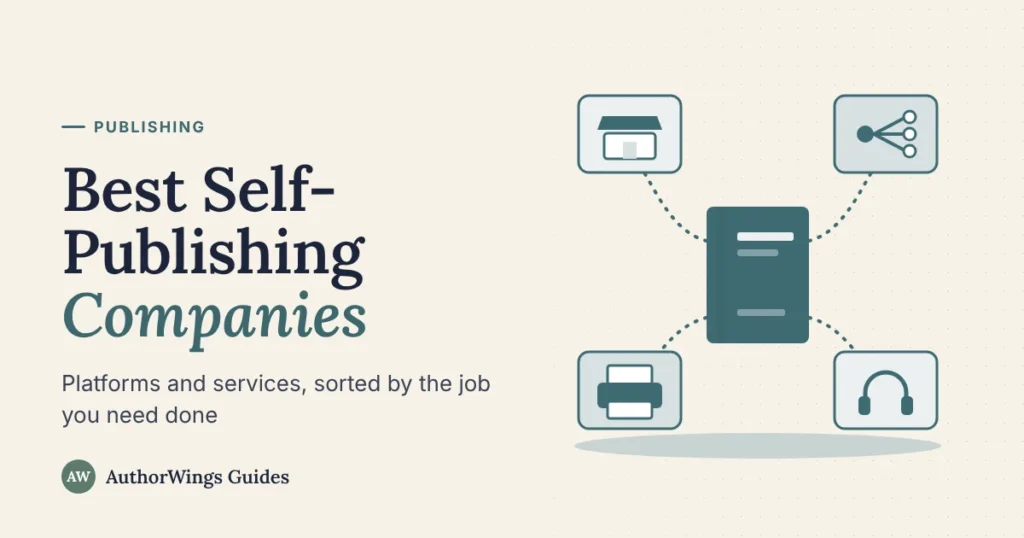
There are seven kinds of self-publishing company, and the first four are platforms you upload to yourself.
| Type | What it does | Examples | What you pay | Rights and royalties |
|---|---|---|---|---|
| Store | Sells your book to readers on its own site and apps | Amazon KDP, Apple Books, Kobo Writing Life, Barnes & Noble Press, Google Play Books | Nothing to publish; the store keeps a share of each sale | Yours |
| Distributor | Sends your book to many stores and library apps from one upload | Draft2Digital (ebooks, paperbacks), IngramSpark (print and ebooks) | A share of each sale; Draft2Digital also charges new accounts a one-time $20 activation fee | Yours |
| Print-on-demand printer | Prints each copy when it’s ordered, so you pay no print run | KDP, IngramSpark, Lulu, Blurb | The print cost, taken out of each sale, or paid when you order copies | Yours |
| Audiobook platform | Sells or distributes your audiobook | ACX (Audible), Spotify for Authors, Voices by INaudio | A share of each sale | Yours |
| Freelancer marketplace | Lists editors, designers and marketers you hire one by one | Many websites; you choose and manage each person | Each freelancer’s fee, sometimes plus a marketplace fee | Yours, if the contract says so |
| Assisted self-publishing service | Edits, designs and sets up your book on the platforms above for a published price | Paid services, including ours | A fixed price for the work | Yours, if every store account is in your name |
| Vanity press | Charges you to “publish” your book, often with costly packages and a share of your royalties | Paid companies that present themselves as publishers | Often thousands of dollars | Often shared with the company, or partly signed away |
Our comparison of self-publishing platforms shows each store’s royalties, print costs and payment terms in detail.
The best self-publishing companies for each job
Many authors use two or three companies together, each for a different job.
Selling on Amazon
Amazon KDP is the standard choice for selling ebooks, paperbacks and hardcovers on Amazon, and it’s free to use. Enrolling an ebook in KDP Select puts it in Kindle+ (formerly Kindle Unlimited), Amazon’s reading subscription, in exchange for selling the ebook only through Amazon.
Bookstores and libraries in print
IngramSpark is a print-on-demand distributor that many bookstores and libraries order from. Setting up a title is free, and since February 1, 2026, revisions are free too. Many authors use KDP for Amazon and IngramSpark for everyone else; our guide on how to use KDP and IngramSpark together explains how.
Ebooks in many stores
You can publish ebooks to Apple Books, Kobo and Google Play Books directly, or reach them all through Draft2Digital, which keeps about 10% of each sale’s retail price. Draft2Digital also charges new accounts a one-time $20 activation fee, and $12 a year for accounts with books on sale that earn less than $100 a year.
Photo, art and special-format books
Lulu and Blurb print formats the big platforms don’t, such as photo books and art books, and both let you sell from their own stores. Lulu can also print and ship orders from your own website.
Audiobooks
ACX puts your audiobook on Audible, Amazon and Apple Books, but only authors in the US, UK, Canada and Ireland can use it. Voices by INaudio distributes audiobooks to other stores and library apps, and Spotify for Authors can pass your audiobook to it. Our guide shows how to make an audiobook, from narration to upload.
Help with editing, design and setup
For the work around publishing, you can hire freelancers yourself or pay an assisted service to manage it. A fair service publishes its prices, opens every store account in your name and leaves 100% of your royalties with you. Our breakdown of what each publishing service costs shows typical prices for editing, covers and formatting.
Which type of company do you need?
Answer four questions to see which type of company fits your book.
Which type of company do you need?
Answer four questions for a suggestion. Nothing is saved or sent.
Our suggestion
See moreIf a company has asked you to pay upfront to be accepted, or to keep part of your royalties after you have paid it, check it before you sign.
If you want to do all the work yourself, or have no budget beyond printing, publish on the platforms yourself: compare the platforms.
If you’ll hire some help, publish yourself and hire an editor or designer: what to do yourself and what to hire.
If you want to do as little as possible and have the budget, use an assisted self-publishing service that publishes its prices and keeps every account in your name: our self-publishing services.
Self-publishing companies in the UK, Canada and Australia
Every platform in the table below accepts authors in the US, UK, Canada and Australia except ACX, which doesn’t accept Australian authors.
| Platform | US | UK | Canada | Australia | Note |
|---|---|---|---|---|---|
| Amazon KDP | Yes | Yes | Yes | Yes | Non-US authors fill in a tax form; a treaty can lower US tax withheld |
| Apple Books | Yes | Yes | Yes | Yes | Tax and bank details set up in your account |
| Barnes & Noble Press | Yes | Yes | Yes | Yes | Author copies ship to US addresses only (no PO boxes) |
| Google Play Books | Yes | Yes | Yes | Yes | Usually paid in local currency |
| IngramSpark | Yes | Yes | Yes | Yes | Publishers must be based in a listed country; all four are listed |
| Kobo Writing Life | Yes | Yes | Yes | Yes | Paid monthly by bank transfer or PayPal, depending on your country |
| Draft2Digital | Yes | Yes | Yes | Yes | 30% US tax withheld unless a treaty applies |
| ACX (Audible) | Yes | Yes | Yes | No | Open to residents of the US, UK, Canada and Ireland with valid tax details |
| Voices by INaudio | Yes | Yes | Yes | Yes | Open to authors in all countries |
ISBNs, the ID numbers each format of a book needs, come from your country’s agency, and what an ISBN costs varies a lot by country. As of October 2026, Bowker sells one ISBN for $125 or ten for $295 in the US; Nielsen sells one for £93 or ten for £174 in the UK, including VAT; Library and Archives Canada gives them free to authors and publishers based in Canada; and Thorpe-Bowker sells one for A$44 or ten for A$88 in Australia, plus a one-time A$55 fee for first-time buyers. KDP, IngramSpark (in the US), Draft2Digital and Lulu also offer free ISBNs, but each is tied to the platform that issued it, and none lists you as the publisher. KDP’s free ISBN covers print editions only. Our guide on KDP and IngramSpark outside the US covers payments and printing by country.
How we judged these companies
We looked at five things, checked on each company’s own help pages in October 2026:
- Cost to the author: what you pay to publish, and what the company keeps from each sale.
- Rights and accounts: whether your book, account and royalties stay in your name.
- Reach: which stores, countries and formats the company covers.
- Published terms: whether prices, royalties and payment dates are public before you sign up.
- Help and support: whether the help pages answer the questions a first-time author asks.
None of the companies named here pays us to appear. The platforms are listed because many authors use them and they let you publish on your own. Paid services aren’t named, because their packages change often and we sell a competing service; our page on five things to check before you hire any publishing service covers how to judge one.
Self-publishing companies to avoid
Avoid any company that charges you to be “accepted,” keeps part of your royalties or rights on top of what you paid it, or sells you things that are free elsewhere, such as an ISBN, a KDP upload or a so-called bestseller campaign. Those are the marks of a vanity press, and they can cost authors a great deal: in May 2026, one of four defendants behind fake publishing and film companies pleaded guilty to a scheme that took more than $48 million from over 800 authors, most of them seniors, according to the US Department of Justice.
Before you pay anyone:
- Run our 10-question vanity press check.
- Read the red flags before you pay any publishing company.
- Look the company up with independent watchdogs: Writer Beware, sponsored by the Science Fiction and Fantasy Writers Association, and the Alliance of Independent Authors’ ratings of self-publishing services.
Hybrid publishers sit between a vanity press and a traditional publisher; our guide to how hybrid publishing works explains how to test one. If you want a publisher that pays you instead, see the traditional publishers that never charge authors in our directory.
When to get help
If you’d rather not manage the platforms, the files and the freelancers yourself, an assisted service can do it for a fixed price. Check that it opens every account in your name and leaves your royalties with you.
Our service
Publish on the same platforms, with every account in your name
We set up your book on Amazon, Apple Books, Kobo, Barnes & Noble, Google Play and IngramSpark, with every account opened in your name and 100% of your royalties paid to you. Every price is published before you commit.
- Amazon Kindle ebook setup $249
- Online Stores: five ebook stores plus an Amazon paperback $549
- Global: adds bookstores, libraries and hardcover $999
See self-publishing servicesBook a free call
AuthorWings is an author services company. We never take a share of your royalties.
Self-publishing companies: questions authors ask
What is the best self-publishing company?
There isn’t one best company, because each does a different job. Amazon KDP is the standard choice for selling on Amazon, IngramSpark for bookstores and libraries, and Draft2Digital or the stores directly for ebooks outside Amazon. For help with editing and setup, the best service is one that publishes its prices, opens accounts in your name and leaves you all of your royalties.
Are self-publishing companies free?
The platforms mostly are free: KDP, IngramSpark, Apple Books, Kobo, Barnes & Noble Press and Google Play Books charge nothing to set up a book and earn their share from each sale. Draft2Digital charges new accounts a one-time $20 activation fee, and $12 a year if an account with books on sale earns under $100. Paid services charge for their work, and vanity presses often charge thousands, sometimes while also taking a share of your royalties.
What are the best self-publishing companies in the UK?
UK authors can use the same main platforms as US authors: Amazon KDP, IngramSpark, Apple Books, Kobo, Barnes & Noble Press, Google Play Books and ACX for audiobooks. The main difference is the ISBN: in the UK you buy it from Nielsen, at £93 for one or £174 for ten as of October 2026, unless you use a platform’s free ISBN, which works only on that platform.
Do self-publishing companies take a share of my royalties?
Platforms keep a share of each sale before paying you: a store keeps part of the price, and a distributor such as Draft2Digital keeps about 10% of the retail price on top of the store’s share. A fair paid service charges for its work and takes nothing from your royalties. A company that wants a share of your royalties or rights for years after publishing is acting like a vanity press, so check the contract before you sign.
Related reading
AuthorWings editorial team
The AuthorWings editorial team writes and updates our guides for first-time authors. Every post is read and edited by a person on our team before it is published.