Short answer
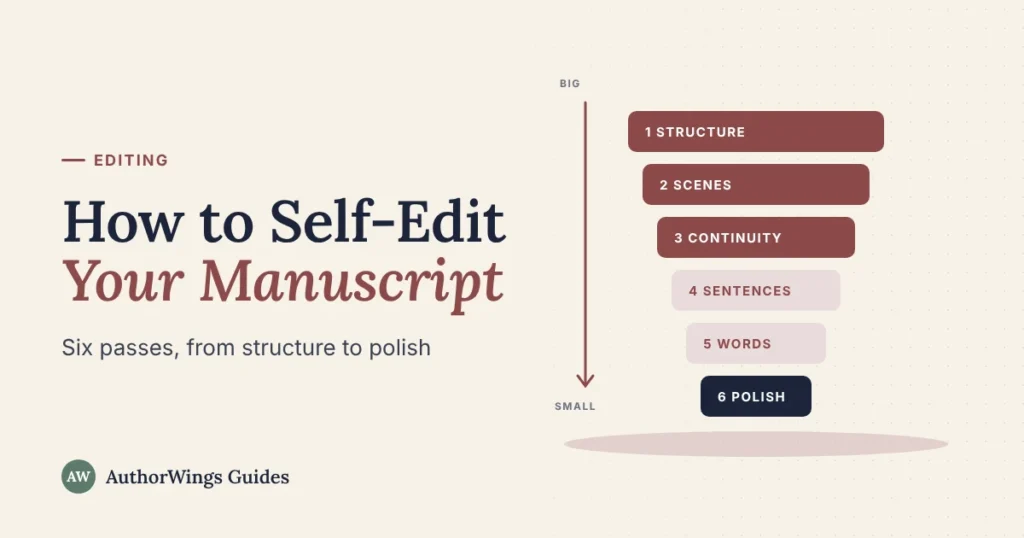
To edit a manuscript yourself, save a copy, read it straight through taking notes only, then revise in passes from big to small: structure, chapters and scenes, characters and continuity, sentences, word choice, and a final polish. Fixing structure first means you don’t polish scenes you later cut. Then let beta readers or an editor find what you can’t see.
You can’t catch everything in your own book, but you can fix a lot before anyone else reads it. This guide gives you a six-pass method, a reverse outline template, a free overused-word finder, and the signs that it’s time to hire a book editor. For the basics of resting and revising a first draft, see Step 7 of our book-writing guide.
Before the first pass
- Save a copy and number your versions (Draft 2, Draft 3), so you can always go back.
- Read the whole draft in as few sittings as you can, as a reader. Don’t fix anything yet.
- Take notes as you go: where you got bored, confused or lost track, with the chapter number.
- Turn the notes into a problem list, biggest problems first.
- Keep a “cuts” file for anything you remove. You may want a line back later.
Self-edit in six passes
Each pass looks for one kind of problem, from the biggest to the smallest. If you polish sentences first, you’ll polish scenes that a later pass cuts.
| Pass | What you check | Best tool |
|---|---|---|
| 1. Structure | Does the order work? Does each part serve the story or argument? | A reverse outline |
| 2. Chapters and scenes | Does each one start late, end strong and change something? | Notes on each chapter’s first and last page |
| 3. Characters and continuity | Names, ages, timeline, places, facts | A story bible: one list of every name and detail |
| 4. Sentences | Clarity, rhythm, dialogue | Reading aloud |
| 5. Words | Filler words, repeats, crutch phrases | Search, and the word finder below |
| 6. Final polish | Spelling, punctuation, formatting | Spell check, then a proofreading checklist |
Pass 1: Structure
Make a reverse outline (below) and look at the book’s shape. Watch for chapters that repeat each other, a middle where nothing changes, a subplot that disappears, or non-fiction chapters in the wrong order. Fix it by cutting, merging or moving chapters. Don’t touch sentences yet.
Pass 2: Chapters and scenes
For each chapter, name what has changed by the end. Cut slow openings that warm up before the action starts, and check that the last lines pull the reader into the next chapter. In non-fiction, check that each chapter delivers what its title promises.
Pass 3: Characters and continuity
Build a story bible as you read: names and spellings, ages, eye colors, dates, places and invented terms. In fiction, track the timeline. In non-fiction, check facts and sources. Share it with your copy editor later; it helps them build the style sheet.
Pass 4: Sentences
Read the book aloud, or have Word read it to you (Review, then Read Aloud, in current versions). Where you stumble, fix the sentence. Vary sentence length, untangle long sentences, and check that dialogue sounds like people talking. Our guide to writing dialogue covers the rules.
Pass 5: Words
Search for your crutch words: filler such as “just,” “really” and “very,” filter words such as “felt” and “seemed,” the same word used twice in a few lines, and adverbs that repeat what a dialogue tag already says (“whispered softly”). Run one chapter at a time through the word finder below. Don’t cut every instance, only the ones that add nothing.
Pass 6: Final polish
Run spell check, make the formatting consistent with standard manuscript format, then work through our proofreading checklist. Do this last, because every earlier pass changes the text.
Make a reverse outline
A reverse outline lists what’s actually in your draft, chapter by chapter, so you can see the whole book on one page. Write one line per chapter. Here’s an example for an invented novel:
| Chapter | What happens | Why it’s there | Words | Problem? |
|---|---|---|---|---|
| 1 | Mara finds her mother’s letter | Starts the story | 3,200 | |
| 2 | Mara remembers the lake | Explains her fear of water | 4,100 | Same purpose as chapter 5 |
| 3 | Mara meets Sam at the dock | Introduces her ally | 3,600 | |
| 4 | Mara and Sam argue | Not sure | 2,900 | Purpose unclear |
| 5 | Flashback: the accident | Explains her fear of water | 3,800 | Repeats chapter 2 |
How to read it: two chapters with the same purpose can often merge. A “Why it’s there” you can’t fill in means the chapter needs a job or a cut. A chapter much longer than the rest is worth checking for pace. For non-fiction, change “What happens” to “What the reader learns.”
Find your overused words
Paste a chapter or a few pages to see which words you lean on. The tool runs in your browser; nothing is uploaded or saved.
Overused word finder
Works best on one chapter at a time. Runs in your browser; nothing is uploaded or saved.
Search your draft with Find for these common filler words: “just”, “really”, “very”, “quite”, “suddenly”, “then”, “started to”, “began to”, “seemed”, “somehow”, “felt”.
Treat the results as a list to check, not rules. “Then” and “felt” are often fine. A word that appears far more than others is worth a look.
What editing tools catch, and what they miss
Software helps with the small things. None of it can tell you whether the story works.
| Tool | Catches | Misses |
|---|---|---|
| Spell check | Misspelled words | Real words in the wrong place, such as “form” for “from” |
| Grammar checker | Agreement errors, some punctuation, wordy phrases | Some real errors; it also flags things that are fine and may “correct” deliberate style, such as fragments in dialogue |
| Read Aloud | Missing and doubled words, clunky rhythm | Structure and pacing |
| Find or search | Every use of a word or name, spelled the way you searched for it | Whether each use works |
| Word count by chapter | Chapters much longer or shorter than the rest | Whether the length suits the story |
When to stop self-editing and hire an editor
You know what you meant to write, so you can’t read your own book cold. These are signs it’s time for outside help:
- Beta readers point to the same problem, and you can’t see how to fix it.
- You’re changing words back and forth instead of improving the book.
- You’ve done the structural passes and still aren’t sure the book works.
- You’re about to query agents or publish.
If you’re not sure what the book needs:
- Editorial assessment: an editor reads the whole manuscript and writes an 8 to 20 page letter on what to fix, with no edits in the file. $180 for the first 10,000 words, then $0.018 a word, or $1,260 for 70,000 words. The fee is credited toward a full edit booked within 60 days. See developmental editing.
- $49 sample edit: up to 1,000 words edited in tracked changes, with a note on which level your draft needs.
When you’re ready to hire a book editor, each level is priced by genre and word count. For what each level does, see what a book editor does. One lead editor handles the edit, with a fresh proofreader for the final check.
Editorial assessment
Find out what your draft needs
An editor reads your whole manuscript and tells you what’s working and what to fix first, before you pay for a full edit.
- Assessment from $180
- 8 to 20 page letter
- $49 sample edit
Frequently asked questions
How many times should you edit your own manuscript?
As many times as it takes to clear your problem list. Work through the passes in order rather than rereading from page one each time, and note what each pass fixed. When your changes stop improving the book and only change it, it’s time for outside readers.
How long does it take to self-edit a novel?
It depends on how much needs fixing. A structural revision can take weeks or months, while a sentence and word pass on a clean draft goes faster. Time how long one chapter takes for a pass, then multiply by your number of chapters for a realistic estimate.
Should you self-edit before or after beta readers?
Both. Do your structural and sentence passes before beta readers see the book, so they react to your best version, not problems you already know about. Then revise again from their notes, and save the final polish for last. Our guide to beta readers explains when to bring them in.
Can self-editing replace a professional editor?
It makes an editor’s time go further, because a cleaner draft lets them focus on bigger issues. But you know what you meant to write, and your brain fills in the gaps, so structural blind spots and consistency errors slip through. For a book you’re selling, plan at least a copy edit and a proofread by someone else.
Related reading

AuthorWings editorial team
The AuthorWings editorial team writes and updates our guides for first-time authors. Every post is read and edited by a person on our team before it is published.