Home / Guides / Comics and Graphic Novels
How to Become a Comic Book Artist: Skills, Portfolio, Pay and First Jobs
 By AuthorWings editorial team
8 min read
By AuthorWings editorial team
8 min read
Short answer
You don’t need a degree to become a comic book artist. Learn to tell a story in panels, build a portfolio of consecutive comic pages, publish your own short comics, then look for paid work with publishers and writers. Comic art is often paid by the page or by an advance, and many artists combine comics with other work.
This guide covers the jobs, the skills, what a portfolio needs, where paid work comes from and what it pays, with sources and dates. Already working professionally? Experienced illustrators can join our specialist network and get matched with authors.
The jobs in comics
“Comic book artist” covers several jobs. On some books one person does them all; on others, each stage has its own artist.
| Role | What they do | Average page rate |
|---|---|---|
| Penciller | Draws the pages from the script: layouts, figures, backgrounds | $87 |
| Inker | Goes over the pencils in black ink for clean, printable lines | $76 |
| Colorist | Adds flat colors, then shading and lighting | $68 |
| Letterer | Places balloons, captions and sound effects | $43 |
| Cover artist | Draws covers, often paid separately from interior pages | Not in the survey |
| Cartoonist | Writes and draws the whole comic | Often paid an advance for a whole book instead of a page rate |
Swipe the table sideways to see every column.
Page rates are averages from the Cartoonist Cooperative’s latest Comics Worker Survey of 189 comics workers. Use them as a guide to the range; real rates vary by publisher, role and experience.
The skills that get you hired
Editors and writers hire artists who can tell a story clearly, page after page. A strong single illustration doesn’t show that.
- Storytelling. Each panel shows one clear moment, the camera shots vary, and the reader always knows where to look next.
- Consistency. The same character looks like the same person on page 1 and page 20, from any angle.
- Backgrounds. Real places, drawn in perspective, so the scenes feel grounded.
- Deadlines. Comic art is page work. Know how long a page takes you, and hit the dates you agree to.
To practice the basics, from panels to inking, see our guide on how to draw a comic book.
Do you need a degree?
No. The US Bureau of Labor Statistics says a bachelor’s degree is common for craft and fine artists (fine artists include illustrators), and an art degree can speed up your training. But comics work is offered on the strength of your pages, and no publisher we checked asks for a degree in its submission guidelines. Courses, books, workshops and a lot of finished pages can get you there too.
Build a portfolio editors will read
A comics portfolio shows that you can carry a story across pages. Use this checklist:
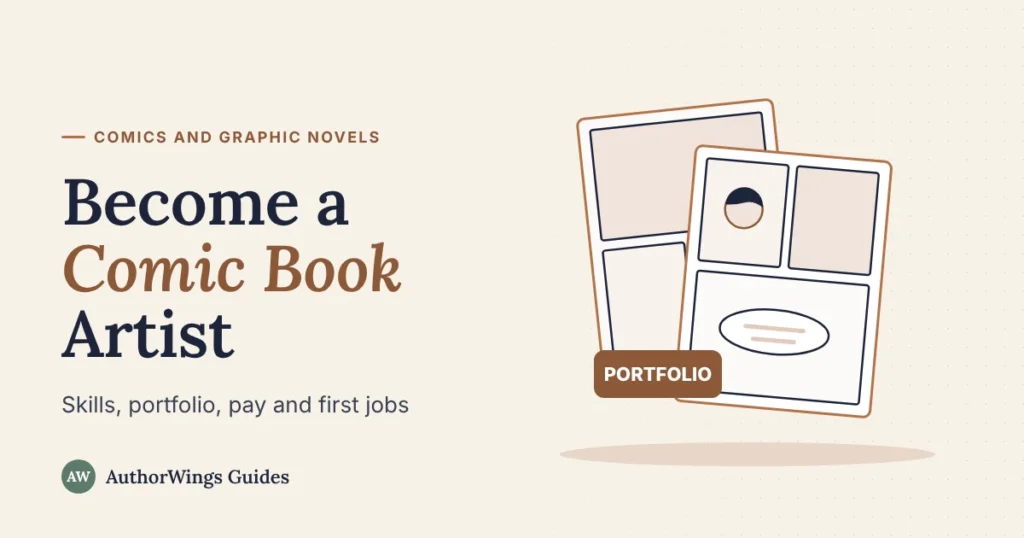
- 4 to 6 consecutive story pages, from one scene, with the same characters. Publisher submission pages ask for runs like this: Dark Horse asks for up to six consecutive art pages with a story proposal, and Image asks for at least five fully inked and lettered pages with a pitch.
- A scene with talking and a scene with action, so editors see both quiet and big moments.
- Real backgrounds, so your characters stand in a place.
- Your strongest stage. If you pencil, show pencils; if you ink or color, show the before and after.
- A cover or a pinup, at most one or two. Pinups don’t prove storytelling, so keep them to a minimum.
- Lettered pages, or space left clearly for the balloons.
- Easy access: a simple website or one PDF, with your name, email and the role you want.
Only show work you have the right to share, and leave out anything under a confidentiality agreement.
Publish your own comics first
Finished comics are the best proof you can make. Start short:
- A webcomic, posted on a regular schedule.
- A minicomic or short story of 8 to 24 pages, printed in small numbers or sold as a PDF.
- An anthology entry, which gives you a deadline and a team.
Short, finished stories teach you the whole process and give editors something real to read. Need a story? Start with these comic book ideas, and use our free comic page templates to set up your pages.
Where to find paid work
Paid work can come from several places at once:
- Publishers. Of 30 publishers we checked in October 2026, 13 weren’t taking unsolicited pitches, and policies change, so check each one’s own page. Our list of comic book publishers accepting submissions shows who was open when we checked.
- Writers who need an artist. Writers with a script need an artist for their pages. Pitch packets, crowdfunded books and self-published graphic novels all need pages drawn.
- Conventions and portfolio reviews. At San Diego Comic-Con, companies hold portfolio reviews, with sign-ups each morning and each company setting its own requirements. Reviewers are there only to give professional feedback, so go to learn what to fix.
- Illustration clients. Book covers, children’s books, games and commissions use the same skills and can pay the bills between comics.
- Networks that match artists with authors, which handle the client and the contract for you.
What comic book artists earn
Comics pay is uneven, so plan for a mix of work. Here are the figures we could source:
| Measure | Figure | Source |
|---|---|---|
| Average page rate, pencils / inks / colors / letters | $87 / $76 / $68 / $43 | Cartoonist Cooperative, Comics Worker Survey |
| Median yearly income from traditionally published comics | $12,000 (average about $27,000) | Same survey |
| Median pay, fine artists including illustrators | $55,490 a year | US Bureau of Labor Statistics, May 2025 |
| Craft and fine artists who are self-employed | About 58% | US Bureau of Labor Statistics |
Swipe the table sideways to see every column.
The survey covers comics income only, and the Cooperative has concluded that the overwhelming majority of cartoonists need multiple projects or other jobs to support their comics work. The BLS figure covers illustrators in all fields, not only comics.
Contracts: work-for-hire or creator-owned
Read every contract for one thing first: who owns the art.
- Work-for-hire: the company that hires you is treated as the author and owns the work. Under US law, commissioned work from a freelancer counts as work made for hire only if it fits one of nine categories and all parties sign a written agreement saying so (US Copyright Office, Circular 30). Work on characters a company already owns is commonly done as work for hire.
- Creator-owned: you and your co-creators keep the rights to the story and characters, and the publisher handles printing and distribution.
Check the page rate, the deadlines, how many rounds of changes are included, when you’re paid, and whether you can show the work in your portfolio. Have a lawyer or a creators’ rights organization review anything you’re unsure about. This is general information, not legal advice.
A 12-month plan
| Months | Goal |
|---|---|
| 1 to 2 | Draw every day. Do the 7-day practice plan from our drawing guide, then repeat it with new characters |
| 3 to 4 | Finish a 4-page comic, start to finish, including lettering |
| 5 to 6 | Finish an 8- to 12-page story and publish it online or as a printed minicomic |
| 7 to 8 | Pick your best 4 to 6 consecutive pages and build the portfolio from the checklist above |
| 9 to 10 | Get feedback: a portfolio review at a convention, a critique group or a working artist |
| 11 to 12 | Send your portfolio to writers looking for artists and to publishers that are open, and pitch your own short story |
Swipe the table sideways to see every column.
Track how long each page takes. By month 12 you’ll know your real speed, which is what you need to quote a page rate.
Join our specialist network
For experienced illustrators
Get matched with authors who need art.
AuthorWings matches independent specialists with authors and manages the brief, the contract and the client, so your time goes into the pages. We ask for at least three years of professional experience and a portfolio of published or print-ready work. Applications are free, and we reply within five business days.
- Apply under: Book Illustrator (Illustration on the form), and mention comics in your application
- Fully remote, on your own schedule
- Never a fee to apply or to join
Frequently asked questions
Do you need a degree to be a comic book artist?
No. A degree in illustration or fine art can help you learn faster, and the US Bureau of Labor Statistics says a bachelor’s degree is common for craft and fine artists. But comics work is offered on the strength of your portfolio, and none of the publisher guidelines we checked ask for a degree. Finished, consistent comic pages matter most.
How much do comic book artists make per page?
It varies widely by publisher, role and experience. According to the Cartoonist Cooperative’s Comics Worker Survey of 189 comics workers, average page rates were about $87 for pencils, $76 for inks, $68 for colors and $43 for letters. Treat them as a guide, since rates differ by publisher and experience.
How do comic artists get their first paid job?
Start with finished comics. Publish a few short stories, build a portfolio of 4 to 6 consecutive pages, then approach writers who need an artist, publishers that accept submissions and convention portfolio reviews. Finished pages give editors and writers something to read before they hire you.
Can you be a comic book artist working only digitally?
Yes. Many artists now work digitally from sketch to lettering, and the US Bureau of Labor Statistics notes that illustrators increasingly use computers in their work. Printers and publishers receive digital files anyway. What matters is the result: clear storytelling, consistent characters and files at the right size and resolution for print.
Related reading: How to draw a comic book · Graphic novel terms · Comic book ideas
AuthorWings editorial team
The AuthorWings editorial team writes and updates our guides for first-time authors. Every post is read and edited by a person on our team before it is published.