Home / Guides / Comics and Graphic Novels
Graphic Novel Terms: Panels, Gutters and Spreads Explained
 By AuthorWings editorial team
8 min read
By AuthorWings editorial team
8 min read
Short answer
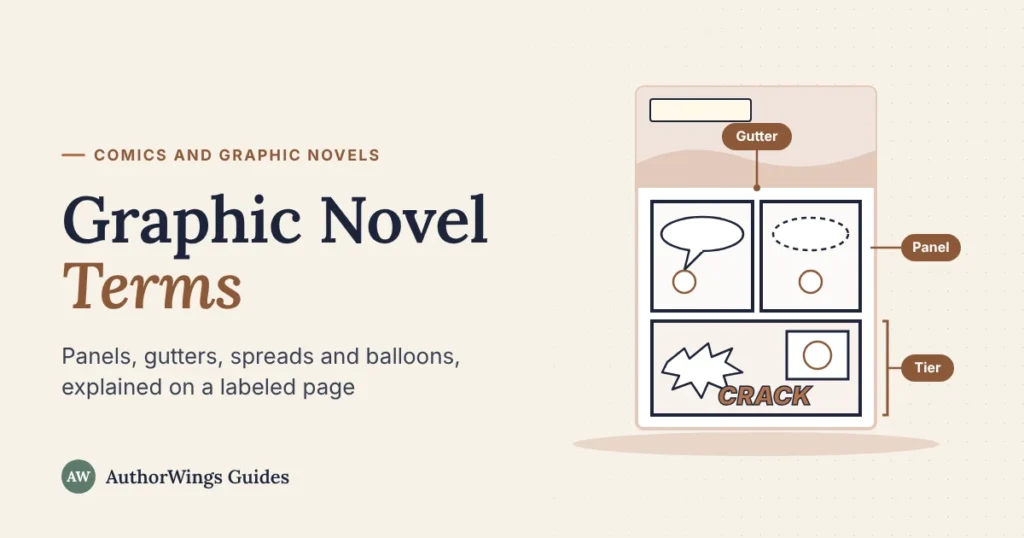
A panel is one framed picture in a comic or graphic novel, showing a single moment of the story. The gutter is the blank space between panels, where the reader imagines what happens in between. A spread is one image or layout that runs across two facing pages.
These are the words artists, letterers and printers use. If you’re writing a graphic novel and plan to work with a comic book illustrator, knowing them makes your script and your feedback clearer. Each term below is defined in plain English, and the main ones are marked on a sample page.
What is a panel in a graphic novel?
A panel is a single drawing on the page that shows one moment of the action. Panels are usually framed by a border, a drawn outline, though some have none. A page can hold one panel or many.
Panel size changes how a page reads. One large panel slows the reader down, and a run of small panels speeds things up. The reader moves from panel to panel and links them into one story. How many panels suit a page depends on the format and trim size, covered in our guide to comic book sizes and page counts.
The parts of a comic page, labeled
The parts of a comic page
One sample page in three tiers. Each number matches a term below.
- 1Bleed panelArt runs off the edge of the page
- 2CaptionA box for narration
- 3BorderThe line around a panel
- 4GutterThe space between panels
- 5Speech balloonHolds spoken words
- 6TailPoints to the speaker
- 7Whisper balloonDashed outline for quiet speech
- 8Borderless panelA panel with no border
- 9TierOne row of panels
- 10Inset panelA small panel inside a bigger one
- 11Sound effect (SFX)A sound word drawn into the art
- 12Burst balloonJagged edge for shouting
Free comic terms cheat sheet
Download the cheat sheet (PDF)
Free to print and share in classes and workshops. Please don’t sell it.
Page layout terms
| Term | What it means |
|---|---|
| Border | The drawn line around a panel. |
| Gutter | The blank space between panels. |
| Tier | One horizontal row of panels across the page. |
| Grid | Panels lined up in straight rows and columns, such as a nine-panel grid. |
| Splash page | One large panel, usually filling the whole page, often used to open a story or show a big moment. |
| Spread (double-page spread) | One image or layout that runs across two facing pages. |
| Inset panel | A small panel placed inside a larger one, often for a close-up or a second action happening at the same time. |
| Borderless panel | A panel with no border, so its art opens onto the page around it. |
| Bleed panel | A panel whose art runs to the edge of the page instead of stopping at a border. |
| Page turn | The moment the reader turns the page. A reveal placed at the top of a left-hand page stays hidden until the turn. |
| Reading order | The path through the page. In English-language comics, left to right and top to bottom. Manga is traditionally read right to left (see manga vs graphic novel). |
The page turn is easy to overlook. A reader sees two facing pages at once, so a surprise on a right-hand page can be spotted early. Put the setup at the bottom of a right-hand page and the reveal on the next left-hand page.
Gutter: two meanings you’ll run into
On the page, the gutter is the space between panels. Nothing is drawn there, yet the reader fills in what happened between two moments. Comics theorist Scott McCloud calls this “closure” in his book Understanding Comics (1993).
In printing, the gutter is the inside margin next to the binding, where the pages curve into the spine. Amazon KDP calls it the inside (gutter) margin and sets a minimum from 0.375 inch to 0.875 inch, depending on page count (as of October 2026). That minimum is for text and margins, not for art that crosses the spine.
The two meet on a spread. Keep speech balloons, text and faces out of the center of a two-page image. One comic printing guide notes that in square-bound books, at least 1/8 inch of each page next to the spine can’t be seen. Ask your printer how much room to leave.
Lettering terms
| Term | What it means |
|---|---|
| Speech balloon | The shape that holds a character’s spoken words. Also called a word balloon or speech bubble. |
| Tail | The point on a balloon that aims at the speaker. |
| Thought balloon | A cloud-shaped balloon with a trail of small bubbles, for unspoken thoughts. Many modern comics use captions for thoughts instead. |
| Whisper balloon | A balloon for quiet speech, traditionally drawn with a dashed outline. |
| Burst balloon | A balloon with a jagged edge for shouting, often with bold lettering. |
| Caption | A box for narration, time and place, or a character’s inner voice. |
| Sound effect (SFX) | A sound word drawn into the art, such as a crash or a knock, with lettering that shows how loud it is. |
| Letterer | The person who places the balloons and captions on each page, and sometimes the sound effects. Artists often draw sound effects into the art themselves. |
| Hand lettering vs comic font | Comics were traditionally lettered by hand. Today many are lettered digitally with fonts made for comics. |
Art terms you’ll see in a script or quote
| Term | What it means |
|---|---|
| Thumbnails | Small, rough sketches of each page, used to plan the panels and the flow before the real drawing starts. |
| Pencils | The first full drawing of the page: panel placement, figures, backgrounds and expressions. The artist is the penciller. |
| Inks | The pencils gone over and finished in black ink, for clean, sharp lines. The artist is the inker. |
| Flats | Plain base colors filled into each area of the page, so the colorist can select and shade each part. |
| Colors | The final coloring, with shading and lighting, which sets the mood. The artist is the colorist. |
| Screentone | Patterns of small dots used for gray shading, widely used in manga. Once stuck on as printed sheets, now often added digitally. |
For how these steps fit together from script to finished page, see how to make a comic book.
Print terms
| Term | What it means |
|---|---|
| Trim | The line where the printer cuts the page to its final size. |
| Bleed | Extra art, usually 0.125 inch, past the trim on any edge where art runs off the page, so no white edge shows after cutting. |
| Safe area | The zone inside the trim where text and faces are safe from cutting. |
| Binding area | The center of a spread, where pages curve into the spine. Keep key art and text out of it. |
Our free comic page templates mark the trim, bleed and safe area on real pages, and the comic book size guide lists the print specs for each format.
When to get help
Knowing the terms helps you describe the page you want. Drawing it, page after page with the same characters, is the long part. Want to draw comics for a living? See how to become a comic book artist. If you have a script, an illustrator can take it from thumbnails to lettered, print-ready pages.
Comic and graphic novel illustration
You write the panels. We draw them.
One illustrator draws your whole comic from character sheets you approve, with lettering in every page price.
- Full-color page: $249, or $219 from 24 pages
- Black-and-white page: $199, or $169 from 24 pages
- Manga page with screentone: $199, or $169 from 24 pages
Frequently asked questions
What is a gutter in a comic?
The gutter is the blank space between panels on a comic page. Nothing is drawn there, but the reader fills in what happens between the two moments, which comics theorist Scott McCloud calls closure. In printing, gutter also means the inside margin next to the binding, so keep text and faces out of the center of a two-page spread.
What is a splash page?
A splash page is one large panel, usually filling a whole comic page. It’s often used to open a story, to set the scene, or to land a big moment. Because one image takes the full page, it slows the reader down. Save splash pages for scenes that need that weight, so they keep their impact.
What’s the difference between a splash page and a spread?
A splash page is one large panel on one page. A spread runs across two facing pages, either as one large image or as a layout designed to be read across both pages at once. A spread needs extra care in the middle, where the pages meet the spine, so balloons, text and faces stay clear of the binding.
What is a tier in comics?
A tier is one horizontal row of panels across a comic page. A page with three rows of panels has three tiers. Readers in English-language comics read each tier from left to right, then drop to the next one. Manga is traditionally read right to left, row by row.
Related reading: Comic Book Size: Page Dimensions, Page Count and Format · Free comic book and graphic novel templates · What is a graphic novel?
—
AuthorWings editorial team
The AuthorWings editorial team writes and updates our guides for first-time authors. Every post is read and edited by a person on our team before it is published.