Home / Guides / Comics and Graphic Novels
How to Make a Comic Book: 7 Steps From Script to Print
 By AuthorWings editorial team
Updated
10 min read
By AuthorWings editorial team
Updated
10 min read
Short answer
To make a comic book, you go through 7 steps: plan the story, write a script, sketch thumbnails, design the characters, draw the pages (pencils, inks and colors), letter the dialogue, and prepare print-ready files. The same steps work for a 22-page comic issue and a 200-page graphic novel. Only the scale changes.
Every comic, from a short stapled issue to a thick graphic novel, is made in the same order. Each step builds on the one before it, so skipping ahead usually means redrawing pages later. This guide walks through all 7 steps, with what you make at each one, what it costs and how long it takes. If you have a story but would rather not draw it, our comic book illustration services cover the art, lettering and files.
The 7 steps at a glance
| Step | What you make | Who usually does it |
|---|---|---|
| 1. Plan | Story outline, format and page count | Writer |
| 2. Script | Panel-by-panel script with all dialogue | Writer |
| 3. Thumbnails | Small rough layouts of every page | Artist, sometimes the writer |
| 4. Characters | Character sheets with turnarounds and expressions | Artist |
| 5. Draw the pages | Pencils, inks and colors | One artist, or a penciler, inker and colorist |
| 6. Lettering | Speech balloons, captions and sound effects | Letterer or artist |
| 7. Files | Print-ready PDFs, cover file and ebook files | Artist or book formatter |
Step 1: Plan the story and pick a format
Start by deciding what kind of comic you’re making, because the format sets your page count, budget and schedule. A single comic issue runs about 22 story pages and is usually stapled. A graphic novel tells a complete story in one bound book, often well over 100 pages. If you are not sure which you’re writing, our guide to what a graphic novel is explains the difference.
Next, write a one-page outline: who the story is about, what they want, what stands in the way and how it ends. Stuck for a story? Start with these comic book ideas. Then estimate pages. Comic writer John Ostrander estimates about 5 panels a page, so count the scenes you need and how many panels each one takes. That number decides almost every cost that follows.
Step 2: Write the script
A comic script tells the artist what to draw in every panel and gives every line of dialogue. There are two common ways to write one:
- Full script: you describe each panel and write all the dialogue before any art starts. This is the usual choice when the writer and artist are different people.
- Plot first: you write a page-by-page summary, the artist draws the pages, and you add dialogue to fit the finished art. This works best when writer and artist work closely together.
Here is one panel from a full script:
| Script part | Example |
|---|---|
| Page and panel | PAGE 3, PANEL 2 |
| Panel description | Close on MAYA at the lookout window, binoculars raised. |
| Dialogue | MAYA: Is that… smoke? |
Keep panel descriptions to what can be drawn in a single moment. A panel can’t show a character walking across a room and then sitting down. If two things happen, that’s two panels. For the full format, word limits and a free template, see how to write a graphic novel script.
Step 3: Sketch thumbnails
Thumbnails are small, rough sketches of each page that show panel shapes, camera angles and where the balloons will sit. They’re quick to draw and quick to change, so this is the cheapest place to fix pacing problems.
Plan in spreads, not single pages. In a printed book, the reader sees a left and a right page together, so they can glance at the right-hand page before reading the left. Put a big reveal on a left-hand page, so the reader turns the page into it. Our free graphic novel templates include blank pages, panel layouts and two-page spreads you can sketch on.
Step 4: Design your characters
Before anyone draws a page, design each main character on a character sheet. A sheet shows the character from the front, side and back (called a turnaround), plus a range of facial expressions and any outfits they wear. Note the exact colors for skin, hair and clothes.
The sheet is the reference for every panel. Without one, faces and proportions tend to drift over a long book, and a character on page 60 no longer looks like the one on page 1. Approve the sheets before page art starts, because changing a design later means redrawing every page it appears on.
Step 5: Draw the pages: pencils, inks and colors
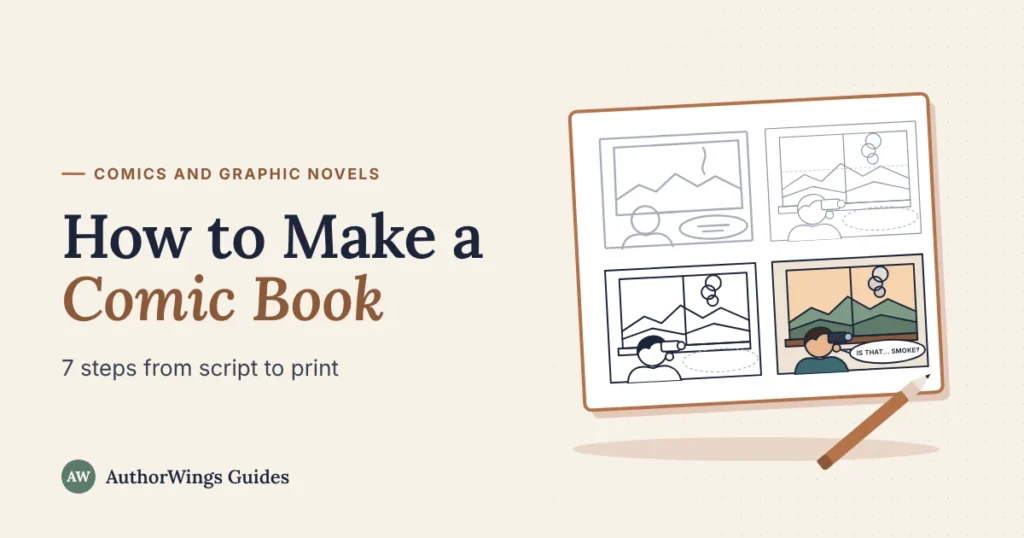
Each page goes through three drawing stages. Here is one panel from the script above at each stage:
One panel, four stages
1Thumbnail
Tiny, rough layout: panel shape, camera, where the balloon goes.
2Pencils
Full-size drawing with every shape and expression in place.
3Inks
Clean final lines and solid blacks over the pencils.
4Colors
Flat colors, then light and shadow. Lettering sits on top.
- Pencils: the full-size drawing of every panel, with each figure, background and expression in place. This is the stage to check the art against the script and character sheets.
- Inks: clean final lines drawn over the pencils, with solid black areas added for depth. In a black-and-white comic, inks are the finished art.
- Colors: flat colors are laid in first, then shading and light. Colorists work on separate layers, so a color can change without touching the line art.
You can draw on paper and scan, or draw digitally from the start. Either way, set your page to the final print size or larger, at 300 DPI for color and 600 DPI for black-and-white line art, so the art stays sharp in print.
Step 6: Letter the pages
Lettering adds the speech balloons, captions and sound effects. For balloon types, tails and captions, see these comic lettering terms. It’s the last art step, done digitally on its own layer so typos can be fixed without touching the art. Four rules keep a page easy to read:
- Place balloons in reading order: left to right and top to bottom (right to left for manga).
- Point each balloon’s tail at the speaker’s mouth, and don’t let tails cross.
- Keep all text inside the safe area, away from the trim and the spine.
- Never cover a face or key action. If a balloon crowds the art, cut words, not art.
Use one comic lettering font at one size across the book, and save bold or larger type for emphasis and sound effects.
Step 7: Prepare print-ready files
Printers and print-on-demand platforms reject files that miss their specs, so check these before you upload:
- Bleed: art that runs off the edge extends 0.125 in past the trim on every side.
- Safe area: text and faces sit well inside the trim. Our templates use 0.5 in.
- Resolution: 300 DPI for color pages, 600 DPI for black-and-white line art.
- Page count: stapled comics need a multiple of 4, counting the covers. An Amazon KDP paperback needs at least 24 pages (as of October 2026).
- Cover: a separate file with front, spine and back, sized with your printer’s cover calculator.
- Export: a flattened PDF with fonts embedded, plus your layered masters saved for later edits.
Our comic page templates already have bleed, trim and safe lines marked for three common sizes. For full print-ready file specs and the steps to get your book on sale, see how to self-publish a comic book or graphic novel. Pitching a publisher instead? See which comic book publishers take submissions.
What it costs and how long it takes
If you draw it yourself, your costs are software, a drawing tablet if you don’t have one, and your time. If you hire an illustrator, the page rate sets the budget. Here is what a 24-page comic costs at AuthorWings, with thumbnails, pencils, inks, colors on color pages, lettering and 2 revision rounds included in every page:
| Full color | Black and white | |
|---|---|---|
| 24 pages | $5,256 ($219 a page) | $4,056 ($169 a page) |
| Character sheets (up to 4 main characters) | Included | Included |
| Cover art | $249 | $249 |
| Total | $5,505 | $4,305 |
From 24 pages, the page rate drops and character sheets are included. Below 24 pages, full-color pages are $249 each and each character sheet is $199. So a 20-page full-color comic with 2 main characters and cover art comes to $5,627 (20 × $249, plus $398 for the sheets and $249 for the cover), which is $122 more than 24 pages.
Time: a 24-page comic takes 3 to 4 weeks from approved character sheets to final files, plus your review time. If you draw it yourself, time one finished page from pencils to lettering, then multiply by your page count to get an honest schedule.
Should you make it yourself or hire an artist?
| Option | Fits when | You handle |
|---|---|---|
| Make it all yourself | You can draw the same characters consistently and have the time | Every step, plus software and printing |
| Write it, hire the art | You have the story and script but not the drawing time or skill | Script, approvals and publishing |
| Hire art and print files | You want print-ready files without learning print specs | Script and approvals |
Many comics are made by a writer and an artist working together, so hiring the art is a normal way to make one. Drawing it yourself? Start with these 8 skills for drawing a comic book. If you go that route, finish the script first. Character sheets can start from descriptions, but pages are drawn from the script. Our comic book illustration team draws, letters and prepares the files, and you approve each stage before the next one starts.
Comic book illustration
Have a script? We’ll draw the pages.
One illustrator draws your comic from character sheets to lettered, print-ready pages. You own the finished art.
- Full-color page: $249, or $219 from 24 pages
- Black-and-white page: $199, or $169 from 24 pages
- Cover art: $249. Character sheets free from 24 pages, up to 4 main characters
Frequently asked questions
How long does it take to make a comic book?
It depends on the page count and who draws it. The art takes the longest. A professional illustrator can finish a 24-page comic in about 3 to 4 weeks once the character sheets are approved, plus your review time. If you draw it yourself, time one finished page from pencils to lettering and multiply by your page count. Add time for the script before and the print files after.
How many pages is a comic book?
A standard US comic issue has about 22 story pages. A graphic novel is longer; a middle grade graphic novel, for example, often runs 150 to 200 pages. If you print a paperback through Amazon KDP, it needs at least 24 pages (as of October 2026). Stapled comics need a page count in multiples of four, counting the covers, because each sheet folds into four pages. See comic book sizes and page counts by format.
Can I make a comic book if I can’t draw?
Yes. Many comics are made by a writer working with an artist. You write the script, describe what happens in each panel and approve the character designs. The artist draws, inks, colors and letters the pages from your script. Stick-figure thumbnails are a useful way to show the artist the layout you have in mind.
What software do comic artists use?
Popular choices include Clip Studio Paint, Procreate on iPad, Krita, which is free, and Adobe Photoshop. Many artists still draw on paper and scan the pages, then color and letter them digitally. Whichever you pick, learn its panel and lettering tools, and set your canvas to print size at 300 DPI before you start.
Related reading
AuthorWings editorial team
The AuthorWings editorial team writes and updates our guides for first-time authors. Every post is read and edited by a person on our team before it is published.