Home / Guides / Comics and Graphic Novels
How to Write a Graphic Novel Script (With a Sample Page and Free Template)
 By AuthorWings editorial team
10 min read
By AuthorWings editorial team
10 min read
Short answer
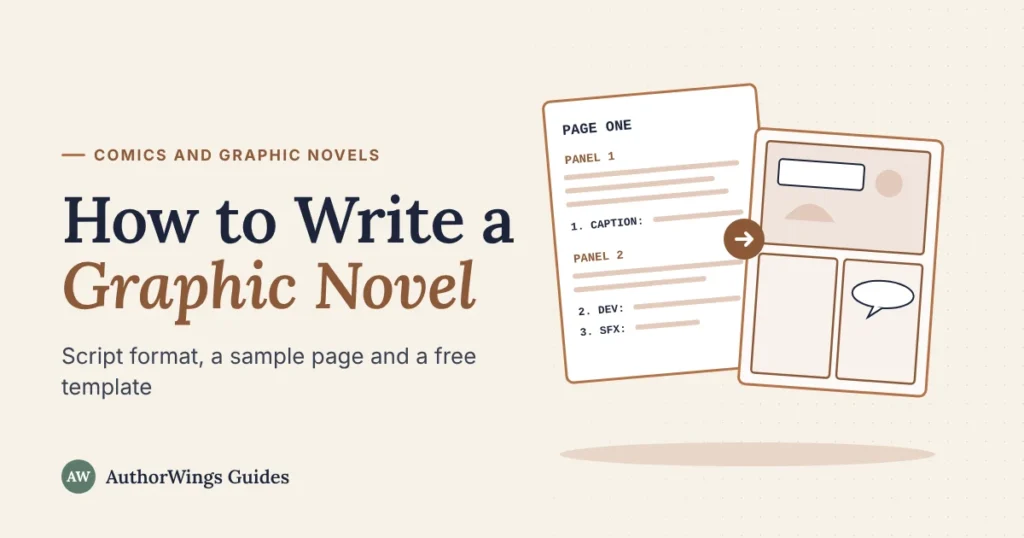
To write a graphic novel, start with a one-page outline, break the story into pages, then break each page into panels. Then write a full script: for every panel, a short description of what to draw and every word of dialogue, captions and sound effects, kept to about 25 words per balloon.
The script is the writer’s whole job in a comic, and it’s what the artist draws from. This guide shows each step, a sample page with notes, and a free template. If you write the script and want someone else to draw it, our comic book illustration services take it from character sheets to finished pages.
Full script or plot first: which should you write?
Write a full script if someone else will draw your book. It’s the clearest brief an artist can get.
| Full script | Plot first (the “Marvel method”) | |
|---|---|---|
| What you write | Every page and panel, with descriptions and all the dialogue | A summary of the story, page by page |
| What the artist does | Draws what the script describes | Breaks the story into panels and pages, then draws |
| When dialogue is written | Before the art | After the art, to fit the pages |
| Best for | A writer hiring an artist, or a first graphic novel | A writer and artist who work closely and trust each other |
Swipe the table sideways to see every column.
The plot-first way of working took hold at Marvel in the 1960s, with the artist building the pages from a short premise. It can work well, but it leaves the pacing to the artist. It suits a writer and artist who have worked together for a long time, so if you’re hiring an artist, write a full script.
Step 1: Write a one-page outline
Before any script page, write the whole story on one page: who it’s about, what they want, what stands in the way, and how it ends. Include the ending. It decides what every earlier page has to set up.
Stuck for a story? Start with these comic book ideas.
Step 2: Break the story into pages
Decide how many pages you have, then give every scene its share. Comics are planned in pages because the page is the unit everything is built on: comic artists are commonly paid a page rate, and readers take in the story a page or a spread at a time.
Start from the format. A single comic issue runs about 22 story pages, and a middle grade graphic novel typically runs 150 to 200 pages, according to literary agent Britt Siess. Our comic book size guide lists page counts for each format.
Then list your scenes and give each one a number of pages. Here’s a page budget for a 22-page first issue:
| Scene | Pages | Running total |
|---|---|---|
| Opening: the hero’s normal day, with a hint of trouble | 3 | 3 |
| The problem arrives | 4 | 7 |
| First attempt to fix it fails | 5 | 12 |
| A new clue or ally | 4 | 16 |
| Things get worse | 4 | 20 |
| Cliffhanger | 2 | 22 |
Swipe the table sideways to see every column.
If the total runs over, cut or merge scenes now. Cutting a page from a script takes minutes. Cutting a drawn page means paying for art you won’t use.
Plan the page turns. A reader sees two facing pages at once, so anything on a right-hand page can be spotted early. Build tension at the bottom of a right-hand page and put the reveal at the top of the next left-hand page, where the reader only sees it after turning. When page 1 sits on the right, the even-numbered pages fall on the left. Check the page order with your printer or publisher before you plan reveals.
Step 3: Break each page into panels
Give each page its panels, one moment per panel. A panel is a single frozen instant, so a character can’t cross a room and sit down in the same panel. If two things happen, that’s two panels.
How many panels fit depends on the scene. Writer Buzz Dixon puts a typical American comic page at 5 to 6 panels and a manga page at 3 to 4. The script format guide hosted on Dark Horse’s website suggests about three or four panels for an action page, because big action needs room. A quiet conversation can take more, as long as the page doesn’t get crowded.
Want the panel words explained, from tiers to splash pages? See our guide to graphic novel terms.
Step 4: Write the panel descriptions
A panel description tells the artist what the reader should see. Keep it to a sentence or two, and cover:
- Where we are, the first time a scene appears.
- Who’s in the panel, listed left to right in the order they speak, so the balloons read in the right order.
- What’s happening in that one moment, including faces and body language.
- The shot, if it matters: wide, medium, close-up, or looking down from above.
The Dark Horse-hosted guide puts the rule plainly: “if it isn’t in the script, don’t expect to see it in the art.” Leave the panel layout and the camera angles that don’t matter to the artist. That’s the part of the job they’re best at.
Step 5: Write dialogue, captions and sound effects
Everything the reader will read goes in the script, in reading order: speech balloons, captions and sound effects. Keep it short, because words take space from the art.
| Limit | Rule of thumb | Source |
|---|---|---|
| Words per balloon | About 25 | Script guide hosted on Dark Horse’s site; Alan Moore says that if a balloon has “more than 20 or 25 words in it, it’s going to look too big” |
| Words per panel | 35 to 50 at most | Moore, recalling DC editor Mort Weisinger (35); Dark Horse-hosted guide (about 50) |
| Words per page | About 200 for a US comic, about 60 for manga | Moore (6 panels × 35 = about 210); Buzz Dixon (200 and 60) |
Swipe the table sideways to see every column.
Mark how each line should be lettered, so the letterer doesn’t have to guess:
- (OP) for a speaker who is off panel, and (thought) for a thought.
- (whisper), (small) or (burst) for quiet or shouted lines.
- Bold or underline for stressed words. A lettering guide from Blambot points out that writing them in capitals means the letterer has to convert them back to lowercase.
- CAPTION for narration, and SFX for sound effects, with a note on size.
For balloon types, tails and captions, see these comic lettering terms.
A sample script page, annotated
THE ROOF / Part 1 / Writer’s nameScript page 1
PAGE ONE (five panels)
PANEL 1
Wide. A rooftop garden above a laundromat at dusk. Tomato plants in buckets, a string of lights. DEV (11), in an oversized raincoat, kneels beside a cardboard box with holes punched in the lid.
1. CAPTION: Every Thursday, the roof is mine.
PANEL 2
Close on the box. Something inside is scratching.
2. SFX (small): skritch skritch
PANEL 3
Dev lifts the lid an inch. Behind her, her grandmother NANI (70s) steps through the roof door with two mugs.
3. NANI: Dev. What did you bring up here?
4. DEV: Nothing!
PANEL 4
Nani raises one eyebrow. Dev hugs the box to her chest.
5. DEV: Okay. Not nothing.
PANEL 5
The lid starts to lift on its own. Dev and Nani both freeze.
6. NANI (whisper): Dev…
7. DEV (whisper): He’s friendly. Mostly.
PAGE TURN: show what’s in the box on page 2, panel 1.
What each number shows
- 1The page heading gives the panel count, so the artist can plan the layout.
- 2Panels are numbered on every page.
- 3The description covers one moment and introduces each character with their age the first time.
- 4Every lettering item is numbered in reading order.
- 5Sound effects get a size note.
- 6Speaker names are in capitals, before the words.
- 7A modifier tells the letterer how the line sounds.
- 8The page ends on a question, and the answer waits for the turn.
The page has 23 words of lettering in total, well under the limits above, which leaves the art room to carry the scene.
Script format rules at a glance
There’s no single industry format, but these basics come from a publisher’s script guide and a letterer’s advice:
- Put the title, issue or part number, your name and the page number in a header on every script page.
- Start each comic page on a new script page, headed PAGE ONE, PAGE TWO and so on, with the panel count.
- Number the panels on every page, and number every lettering item.
- Write descriptions in plain sentences. No tabs or extra fonts.
- Put speaker names in capitals, with modifiers in brackets.
- Mark stressed words in bold or underline, never in capitals.
- Note page turns and any page that must face another as a spread.
Free download: Comic Script Template
Free Comic Script Template
Download the template (Word)Download the PDF to print
Free to use for your own comics, and to share in classes and workshops. Please don’t sell it.
Before you send the script to an artist
Run through this list. Each fix is cheap now and expensive once pages are drawn.
- The page count matches your format and your budget.
- Every panel shows one moment that can be drawn.
- No balloon runs much past 25 words, and no page is packed with text.
- Big reveals sit at the top of left-hand pages.
- Every character is described once, with a reference sheet if you have one.
- You’ve read every line of dialogue out loud.
From here, the art goes through thumbnails, pencils, inks, colors and lettering. Our guide on how to make a comic book walks through each stage, and our free comic page templates help you sketch your own thumbnails.
When to get help
If you’d rather not draw the pages yourself, an illustrator can work straight from your script, starting with character sheets you approve.
For a 24-page story, that’s 24 × $219 = $5,256 in full color, or 24 × $169 = $4,056 in black and white, with character sheets for up to 4 main characters included.
Comic and graphic novel illustration
You write the script. We draw the pages.
One illustrator draws your comic from character sheets you approve to lettered, print-ready pages. 100% of the rights transfer to you on final payment.
- Full-color page: $249, or $219 from 24 pages
- Black-and-white page: $199, or $169 from 24 pages
- Character sheets: $199 each, free from 24 pages (up to 4 main characters)
Frequently asked questions
How long is a graphic novel script?
It depends on the page count. Script guides such as the one hosted on Dark Horse’s website start each comic page on a new script page, so a 22-page issue becomes a script of at least 22 pages, and a 150-page graphic novel runs longer still. Descriptions of a sentence or two and short dialogue keep each script page readable.
Can I write a graphic novel if I can’t draw?
Yes. Writing and drawing are separate jobs in comics, and plenty of comic writers don’t draw. You write the full script, then team up with an artist or hire one. A clear script matters more than your sketches, though rough stick-figure thumbnails can help you check that each page works.
What software do comic writers use?
Microsoft Word is a common choice (Blambot calls it the industry standard), and Google Docs works too, with a template like the free one above. Scrivener comes with a Comic Script template, and some screenwriting apps can be set up for comics. The software matters less than the format: clear page and panel headings, numbered lettering and nothing the artist could misread.
How many words should a comic panel have?
Aim for no more than 35 to 50 words in a panel, and about 25 in a single balloon. Alan Moore, recalling DC editor Mort Weisinger, uses 35 per panel, and the script guide hosted on Dark Horse’s website suggests about 50 at most. Fewer words leave more room for the art to tell the story.
Related reading: How to make a comic book · Graphic novel terms · What is a graphic novel?
AuthorWings editorial team
The AuthorWings editorial team writes and updates our guides for first-time authors. Every post is read and edited by a person on our team before it is published.