Home / Guides / Comics and Graphic Novels
What Is a Graphic Novel? (and How It Differs From a Comic Book)
 By AuthorWings editorial team
Updated
8 min read
By AuthorWings editorial team
Updated
8 min read
Short answer
A graphic novel is a book-length story told in sequential art: panels of pictures and words read in order. It’s published as one bound book with a complete story, so you can read it from start to finish. “Graphic novel” names a format. It can hold any genre, from fantasy to memoir.
Comic books and graphic novels use the same tools: panels, speech balloons and captions. The difference is in how the story is packaged and how much of it you get at once. If you’re planning one of your own, a graphic novel illustrator works with a different scope than an artist drawing a monthly issue, so it helps to know which one you’re making.
Graphic novel vs comic book vs novel at a glance
| Comic book issue | Graphic novel | Collected edition | Prose novel | |
|---|---|---|---|---|
| Story | One chapter of an ongoing story | A complete story with an ending | Several issues gathered into one book | A complete story |
| How it’s told | Panels, art and words | Panels, art and words | Panels, art and words | Words only |
| Length | Short, often around 22 story pages | Book length | Book length | Book length |
| Binding | Stapled, magazine style | Bound like a book | Bound like a book | Bound like a book |
| Release | Regular issues, often monthly | Once, as a single book | After the issues come out | Once, as a single book |
| Where you find it | Comic shops, digital apps | Bookstores, libraries, comic shops | Bookstores, libraries, comic shops | Bookstores, libraries |
How is a graphic novel different from a comic book?
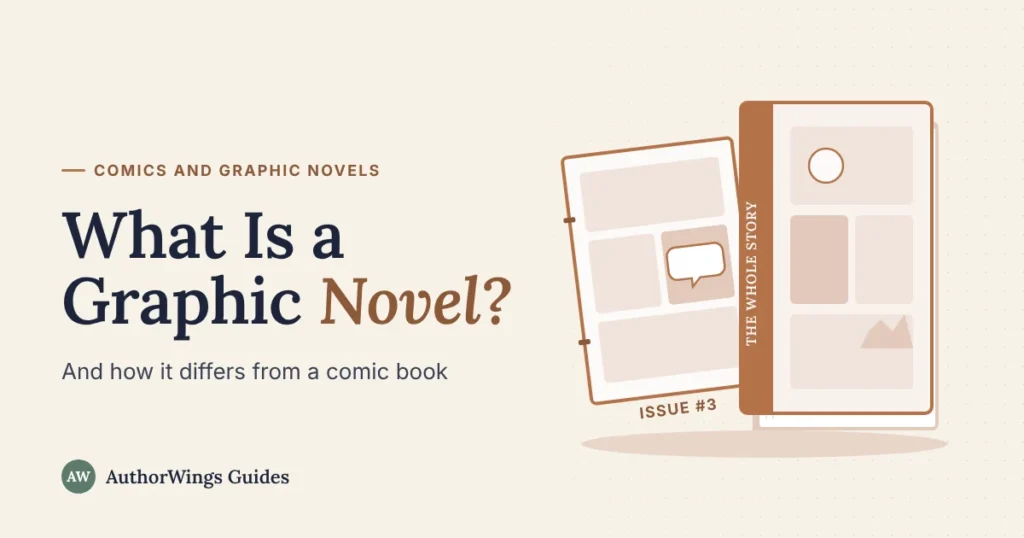
A comic book is a chapter, and a graphic novel is the whole book. Most comic book issues are short, stapled installments that continue a story across many months. A graphic novel tells its full story between two covers.
Three things usually set them apart:
- Completeness. A comic issue often ends on a cliffhanger. A graphic novel has a beginning, middle, and end.
- Format. Issues are thin and stapled. Graphic novels are bound like any other book, often with heavier paper.
- Release. Issues arrive one at a time. A graphic novel comes out all at once.
Comic book issue
One chapter at a time
- StoryPart of an ongoing story, often ending on a cliffhanger
- FormatThin and stapled, like a magazine
- ReleaseOne issue at a time, often monthly
Graphic novel
The whole story in one book
- StoryComplete, with a beginning, middle, and end
- FormatBound like any other book
- ReleasePublished once, all at once
The line isn’t always sharp. Some writers and artists use “comic” for everything, and many popular graphic novels started life as single issues. When a publisher gathers those issues into one book, the result is usually called a collected edition or trade paperback.
Is it a graphic novel? A 4-question check
If you’re unsure what to call a book, ask these four questions. A graphic novel answers yes to all four.
- Does it tell one complete story, with an ending?
- Is it bound as a book, not stapled?
- Is the story told mainly through panels, pictures, and words together?
- Can you read the whole story in this one volume, without hunting down earlier issues?
A book that answers “no” to question 1 or 4 is probably a collected edition of an ongoing series.
How is a graphic novel different from a novel?
A novel tells its story in words alone. A graphic novel splits the work between words and pictures.
In a prose novel, the writer describes a character’s face, a room, or a fight scene. In a graphic novel, the art shows those things, and the words carry mostly dialogue, captions, and sound effects. That’s why a graphic novel script reads more like a screenplay than a manuscript. See a sample page in our guide on how to write a graphic novel. The artist decides how each moment looks, and the layout of the panels controls how fast the reader moves.
Types of graphic novels
- Original graphic novel (OGN): written and drawn as one complete book, never released as issues first.
- Collected edition: a run of comic issues bound together, often called a trade paperback.
- Graphic memoir and nonfiction: true stories, history, and biography told in panels.
- Adaptations: classic novels, plays, or films retold as graphic novels.
- Manga volumes: Japanese-style comics, usually read right to left and collected in numbered volumes. See manga vs graphic novel.
- Webcomics in print: stories first published online, then gathered into a printed book.
A short history of the graphic novel
- 1964: Richard Kyle uses the term “graphic novel” in a comics fan newsletter.
- 1978: Will Eisner’s A Contract with God puts “graphic novel” on its cover and brings the term into wider use.
- 1986 to 1987: Maus, The Dark Knight Returns, and Watchmen reach mainstream readers and critics.
- 1992: Maus, Art Spiegelman’s story of his father’s survival of the Holocaust, receives a special Pulitzer Prize award.
- 2001: Bookstores begin shelving “graphic novels” as their own category.
Graphic novel examples by age
Graphic novels now cover every age group, from early readers to adults. These well-known titles show what each stage looks like, with the ages their publishers list. Want to make your own? Browse our comic and graphic novel ideas by age.
| Reader | Ages | Examples | Why they work |
|---|---|---|---|
| Early readers | 6 to 9 | Narwhal and Jelly series, Ben Clanton | Short chapters, few words per panel, lots of humor |
| Young middle grade | 7 to 10 | Dog Man series, Dav Pilkey | Fast pacing and silly action that keep newer readers turning pages |
| Middle grade | 8 to 12 | Smile, Raina Telgemeier; New Kid, Jerry Craft | School and friendship stories told with real feeling. New Kid was the first graphic novel to win the Newbery Medal, in 2020. |
| Young adult | 12 to 17 | American Born Chinese, Gene Luen Yang | Identity and growing up, with layered storylines. It was the first graphic novel to win the Printz Award. |
| Adult | Adult | Maus, Art Spiegelman; Persepolis, Marjane Satrapi | History, memoir, and serious themes told through art |
If you’re writing for young readers, our guide to children’s book types and ages explains the word counts and themes each age group expects.
Common myths about graphic novels
- “They’re only for kids.” Graphic novels are written for every age. Maus and Persepolis are taught in colleges.
- “They’re all about superheroes.” Superheroes are one genre among many. Memoir, history, romance, horror, and science fiction all thrive in the format.
- “They’re always fiction.” Graphic memoir and nonfiction are some of the format’s best-known books.
- “They don’t count as real reading.” Readers still follow plot, character, and theme, and they also read the art. For reluctant readers, a graphic novel is often the book that gets them reading.
When to get help
If you have a story that wants to be told in panels, start with how to make a comic book or graphic novel. The art is usually the biggest part of the work. Many authors write the script and work with an illustrator who handles the pages, from character design to lettering. If you’d like to try a few pages first, our free graphic novel templates give you print-ready pages and panel layouts.
You can see what finished pages look like in our graphic novel sample pages, and the same service page explains how to self-publish a comic book or graphic novel once the art is done.
Comic and graphic novel illustration
Turn your script into graphic novel pages
One illustrator draws your whole book from character sheets you approve, with lettering in every page price. You own all the art at delivery.
- Black-and-white page: $199, or $169 from 24 pages
- Full-color page: $249, or $219 from 24 pages
- Character sheets: free on books of 24 pages or more
Frequently asked questions
Is a comic book a graphic novel?
Not usually. A comic book is normally a short, stapled issue that tells one part of a longer story. A graphic novel is a bound book with a complete story. When several comic issues are bound together, the book is called a collected edition, and many stores shelve it beside graphic novels.
Is a graphic novel fiction or nonfiction?
It can be either. “Graphic novel” describes the format, and the content can be anything. Many graphic novels are fiction, from fantasy to romance, but the format also covers memoir, history, biography, and journalism. Maus and Persepolis are true stories, even though libraries often shelve them with graphic novels.
Are graphic novels only for kids?
No. There are graphic novels for every age, from early readers around age 6 to adults. Some of the format’s most celebrated books, such as Maus and Watchmen, were written for adults and deal with war, history, and politics. Publishers list an age range for each title, so check it before you buy.
Do graphic novels count as reading?
Yes. Reading a graphic novel means following plot, character, and theme while also reading the pictures, which takes its own skill. Teachers and librarians use graphic novels to build confidence in reluctant readers, and many readers move from graphic novels to prose books, or read both.
AuthorWings editorial team
The AuthorWings editorial team writes and updates our guides for first-time authors. Every post is read and edited by a person on our team before it is published.