Home / Guides / Children's Books
What Is a Chapter Book? Ages, Length and How to Write One
 By AuthorWings editorial team
9 min read
By AuthorWings editorial team
9 min read
Short answer
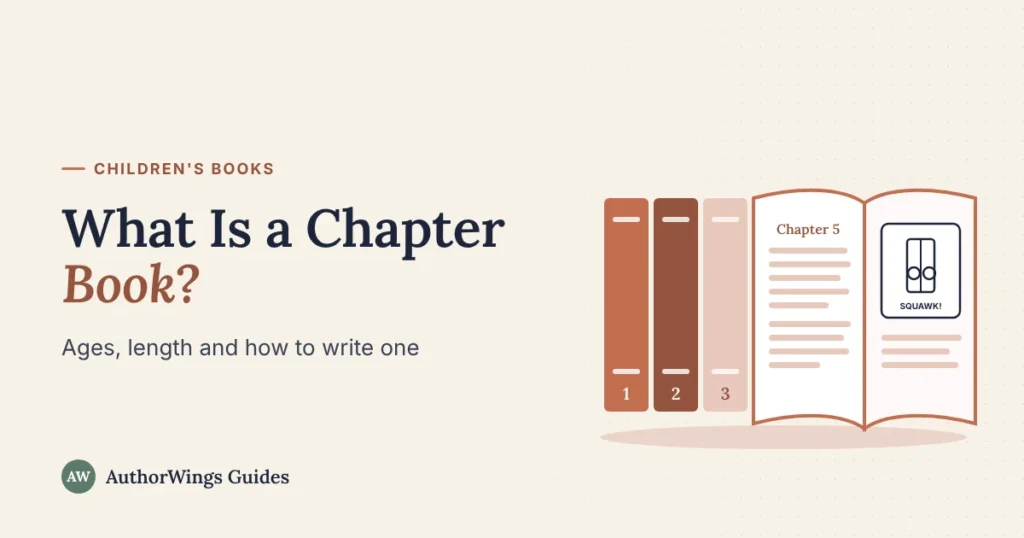
A chapter book is an illustrated story for children of about 7 to 10 who can read on their own. The text carries the story, split into short chapters, with art every few pages, often in black and white. Chapter books usually run 5,000 to 12,000 words and sit between early readers and middle grade novels.
For many children, a chapter book is the first “real” book they finish alone. That’s why the form has its own rules: chapters short enough to finish before bed, a cast small enough to remember and an ending on every chapter that makes a child want the next one. If you’re writing one, a children’s book editing pass can check those things before you publish.
This guide explains what a chapter book is, shows how its chapters work, and walks through writing one. For every age group side by side, see each type of children’s book in our main guide.
What makes a book a chapter book
A chapter book is defined by how it’s read, not only by its length. Five things mark the form:
- Short chapters. A child can finish one in a sitting and stop at a natural break.
- The text carries the story. Pictures help with pacing and mood, but the words do the telling.
- Art every few pages. Spot illustrations at chapter openings and scene breaks, often in black and white, give a new reader a rest. Early chapter books often use full color.
- A main character the reader’s age or a little older. Seven-year-olds like reading about eight- and nine-year-olds.
- Room for a series. Many chapter books are built so the same characters can return in book two, three and ten.
Length usually runs 5,000 to 12,000 words in 6 to 12 chapters. Some books sold as chapter books are shorter, especially early chapter books for newer readers.
Chapter book vs early reader vs middle grade
A chapter book is the middle step. It asks more of a reader than an early reader, and less than a novel.
| Early reader | Chapter book | Middle grade | |
|---|---|---|---|
| Reader | About 5 to 8, just learning to read alone | About 7 to 10, reading alone with growing stamina | About 8 to 12, reading full novels |
| Pictures | On many pages, often in color | Every few pages, often black and white | Usually few or none, though some are heavily illustrated |
| Story | One simple problem, very short scenes | One clear problem, short chapters with hooks | Full plot with subplots and higher stakes |
| Words | Controlled vocabulary a new reader can decode | Everyday words, short sentences, some stretch words | The full range of the age |
In between sits the early chapter book: shorter chapters, more art and simpler words, for children moving up from early readers. Scholastic’s Branches line, for example, describes itself as early chapter books for newly independent readers, with illustrations on every page.
Chapter book examples to study
Read a few before you plan your own. Each one teaches something different.
| Book | Publisher, first year | What to study |
|---|---|---|
| Flat Stanley, Jeff Brown | Harper & Row, 1964 | A single funny premise that carries a whole book |
| Magic Tree House: Dinosaurs Before Dark, Mary Pope Osborne | Random House, 1992 | A series engine: the tree house sends the same two children to a new time and place each book |
| Mercy Watson to the Rescue, Kate DiCamillo | Candlewick, 2005 | An early chapter book: very short chapters and lots of color art |
| Ivy + Bean, Annie Barrows | Chronicle Books, 2006 | Two very different friends, and a voice that sounds like a real kid |
| Owl Diaries: Eva’s Treetop Festival, Rebecca Elliott | Scholastic (Branches), 2015 | A diary format with art on every page, for newer readers |
How the chapters work: a sample plan
The fastest way to understand a chapter book is to see its chapters laid out. Each chapter does one job and ends on a reason to turn the page.
Sample chapter plan
Eight chapters, eight endings
The Parrot on Floor 9, book 1 of an invented series, “Ollie Ortega, Elevator Kid” (made up for this guide). Ollie, 8, lives on the 12th floor of an old apartment building. In each book, the old elevator stops by itself on a floor where a neighbor needs help.
- Chapter 1New question
Ollie keeps a notebook of who lives on every floor. Meet the building and his best friend June.
Ends onThe elevator stops on floor 9 by itself.
ArtOpener: Ollie with his building notebook
- Chapter 2Clue
On floor 9, Mrs. Petrov’s parrot has escaped.
Ends onOllie finds a green feather inside the elevator.
ArtSpot: the feather
- Chapter 3Clue
Ollie and June search floor by floor. Someone heard the parrot say one word.
Ends onThe word is “lunch!”
ArtOpener: the two friends on the stairs
- Chapter 4False lead
They try the lobby cafe. The cook’s whistle sounds just like a bird.
Ends onIt was only the cook. A false lead.
ArtSpot: the whistling cook
- Chapter 5Cliffhanger
Riding back up, the elevator jams between floors.
Ends onThey hear squawking from the vent above.
ArtFull page: two kids in a stuck elevator
- Chapter 6Setback
The building super frees them. They plan a trap with a snack.
Ends onThe parrot won’t come down.
ArtSpot: a cracker on a broom
- Chapter 7Problem solved
Ollie notices the parrot copies the elevator bell, and rings the rhythm.
Ends onThe parrot lands on his head.
ArtOpener: parrot on Ollie’s head
- Chapter 8Next book
Mrs. Petrov gets her parrot back and thanks them.
Ends onA note slides under Ollie’s door: “Floor 4. Help.”
ArtSpot: the note
Notice what each ending does: a new question, a clue, a false lead, a cliffhanger. The last chapter solves this book’s problem and opens the next one.
How to write a chapter book
Writing a chapter book is mostly planning the chapters well. These six steps follow the form.
- Find the series engine. Ask what keeps bringing trouble to your character: a magic object, a job, a club, a building. Even if you write one book, an engine gives the story a shape.
- Keep the cast small. A main character, a best friend and two or three others is plenty for a seven-year-old to track. Give each one a habit or a saying that’s easy to remember.
- Plan chapters before you draft. Write one line per chapter: what happens and how it ends, like the plan above.
- Keep chapters short. A few pages each, so a child can finish one in a sitting.
- End every chapter on a hook. A question, a surprise or a clue. If a chapter ends on everyone going to sleep, move the ending to an earlier moment.
- Write for the reader, with room to stretch. Short sentences and everyday words, with an occasional new word the story explains. Read it aloud to check the rhythm.
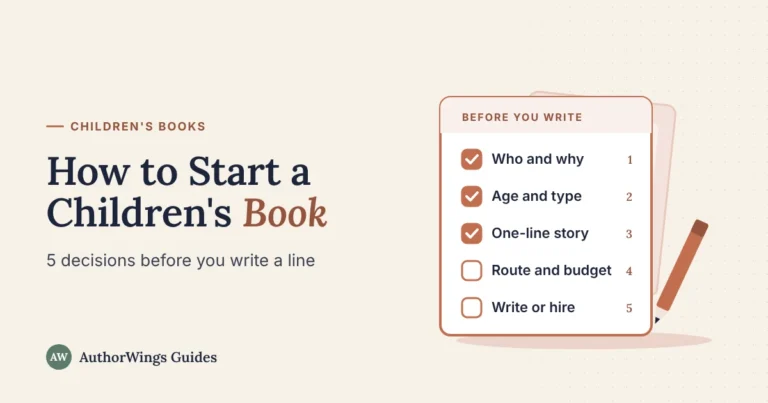
Need an idea first? Our list of children’s book ideas has a section for early readers and chapter books, and our guide on how to start a children’s book covers the decisions to make before you draft.
How a chapter book is published
Chapter books are published differently from picture books. Self-published chapter books often launch in paperback, with spot art placed in the text rather than full-color spreads, so they’re laid out like a short novel instead of a picture book. Black-and-white art also keeps the printing cost down.
If you self-publish, the costs are lower than for a picture book because the art is lighter. At AuthorWings, a 10,000-word chapter book costs $2,019 to publish as text only, or $2,753 with 8 line illustrations, at our published prices (as of October 2026). The line art itself comes from a children’s book illustrator, from $99 for a spot illustration. To see each cost line by line, look at how to self publish a children’s book with us.
When to get help
The problems we see in chapter book drafts are usually structural rather than in the sentences: chapters that run long, endings that don’t pull, a middle that sags. That’s what an editor reads for.
A chapter book edit from our children’s book editors costs $999 for up to 12,000 words. It checks chapter endings, pacing and vocabulary for the age. A critique with notes only is $399. If you’d rather have the book written for you, children’s book ghostwriting covers a 10,000-word chapter book for $6,799, illustrations included. Every word written by a human writer.
Children’s book editing
Is every chapter ending pulling its weight?
A children’s book editor reads your chapter book for pacing, chapter hooks and vocabulary for the age, with tracked changes, margin notes and an editorial letter.
- $999 Chapter book edit, up to 12,000 words
- $399 Critique, notes only
- $6,799 Written for you, 10,000 words with illustrations
Frequently asked questions
Is a chapter book the same as a novel?
Not quite. A chapter book is shorter and simpler than a novel, with art every few pages and one clear problem. Middle grade books are the first true novels for children, with subplots and higher stakes. Middle grade is written for about 8 to 12, so many readers start it around 8 or 9.
Do chapter books need illustrations?
Usually, yes. Spot art at chapter openings and scene breaks, often in black and white, gives a new reader a rest and helps them picture the story. Early chapter books use more art, sometimes on every page. As readers get older, the art thins out, and many middle grade novels have little or none.
How many chapters does a chapter book have?
Usually 6 to 12, each a few pages long. The number matters less than the length of each chapter: a child should be able to finish one in a sitting. Plan one job per chapter, and end each one on a reason to keep reading.
Can I write a chapter book for my own child?
Yes, and it’s a good way to test one. Read each chapter aloud at bedtime and watch where your child asks for “one more.” Those endings are probably working. If you later want to publish it, an editor who doesn’t know your child can tell you how it’s likely to read to other children.
Related reading
- How to write a children’s book: the 9 steps, with a free template
- How to start a children’s book: 5 decisions before you write
- Children’s book ideas: 50 story starters by age
AuthorWings editorial team
The AuthorWings editorial team writes and updates our guides for first-time authors. Every post is read and edited by a person on our team before it is published.