Home / Guides / Children's Books
How Many Pages Should a Children’s Book Be? (By Type)
 By AuthorWings editorial team
7 min read
By AuthorWings editorial team
7 min read
Short answer
A picture book is usually 32 pages, and sometimes 24, 40 or 48. A board book runs about 12 to 24 printed pages, an early reader about 32 to 64 and a chapter book about 48 to 128. Middle grade and young adult novels are set by word count instead. Self-publishing adds its own minimums.
Page count shapes a children’s book in ways that are easy to miss. It sets how many spreads the story gets, how many pictures the picture book illustration needs and, when you self-publish, which print options you can use. This guide gives the typical printed page counts for each type, explains why picture books come in 32 pages, and lists the page rules for self-publishing.
Looking for word counts instead? Our main guide sets them out by age range and category.
Children’s book page counts by type
These are typical printed page counts, the pages in the finished book, not in your manuscript.
| Type | Reader age (about) | Typical printed pages | What sets the length |
|---|---|---|---|
| Board book | 0 to 3 | 12 to 24, on 6 to 12 board leaves | The thick boards. See what a board book is |
| Picture book | 3 to 7 | 32 (sometimes 24, 40 or 48) | Printing signatures and about 14 story spreads |
| Wordless picture book | 3 to 7 and up | Usually 32 | The number of beats. See wordless picture books |
| Early reader | 5 to 8 | About 32 to 64 | Reading level and short chapters |
| Chapter book | 7 to 10 | About 48 to 128 | Word count and art. See what a chapter book is |
| Middle grade | 8 to 12 | Set by word count | Trim size, type size and word count |
| Young adult | 12 to 18 | Set by word count | Trim size, type size and word count |
Ranges vary by publisher and series, so check recent books in your category before you decide.
Why picture books are 32 pages
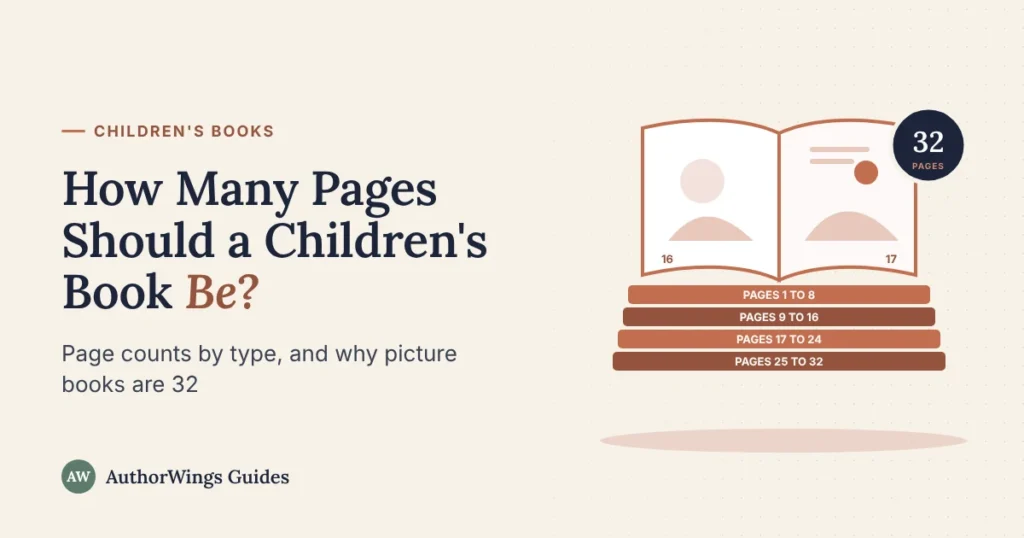
Picture books are printed on large sheets that are folded and cut into groups of pages called signatures. A signature is usually 8 or 16 pages, so picture books usually come in steps of 8: 24, 32, 40 or 48 pages. Thirty-two pages, two 16-page signatures or four 8-page ones, became the standard because it gives enough room for a story at a cost publishers can work with.
Picture book page counts
How signatures make a picture book
Each block is one signature, a printed sheet folded into 8 or 16 pages. Bars are drawn to the same scale, up to 48 pages.
- 24 pages
3 signatures of 8
- 32 pagesThe standard
2 signatures of 16, or 4 of 8
- 40 pages
5 signatures of 8
- 48 pages
3 signatures of 16, or 6 of 8
Not all 32 pages hold the story. The title page, copyright page and dedication take a few, which leaves about 14 spreads (two facing pages) for the story in a book with separate endpapers. A self-ended book, where the first and last pages become the endpapers, has a little less. Our guide shows how to plan the 32 pages, spread by spread.
Printed pages vs manuscript pages
A common mix-up is counting manuscript pages. A picture book manuscript is a few typed pages of text, often under 600 words for fiction, but it becomes a 32-page printed book once the art is added. A chapter book manuscript is longer than the printed book feels, because the type in a children’s book is larger and the art takes space.
When you plan, count printed pages for picture books and early readers, and count words for chapter books and longer novels.
Page minimums when you self-publish
Self-publishing platforms set their own page rules, and they matter most for short books.
| Format | Page count allowed | What it means for a children’s book |
|---|---|---|
| KDP paperback, black ink or premium color | 24 minimum | A 24 or 32-page picture book works in premium color |
| KDP paperback, standard color | 72 minimum | Too many pages for a picture book; use premium color |
| KDP hardcover | 75 minimum | A 32-page picture book can’t be a KDP hardcover |
| IngramSpark hardcover | 18 minimum | The usual route for a 32-page hardcover picture book. Spine text needs 48 pages or more, so a 32-page spine stays blank |
| Board book | Not printed by KDP or IngramSpark | Usually needs an offset printer and a print run |
KDP figures are from KDP’s print options page and IngramSpark figures from its help center, as of October 2026. Our guide to publishing a children’s book explains the hardcover route through IngramSpark.
If you self-publish with us, picture book formatting lays out picture books for KDP and IngramSpark, with up to 32 pages included and 48 pages at most, and our Global publishing tier adds the IngramSpark hardcover. See every option on how to self publish a children’s book.
How to choose the page count for your book
- Pick the type first. The type sets the range: board book, picture book, early reader or chapter book.
- Count your story beats. For a picture book, aim for about 14 spreads with one job each. Fewer beats can fit 24 pages; more may need 40.
- Use steps of 8 for picture books. Print on demand only needs an even page count, but steps of 8 keep your book ready for offset printing or a traditional publisher later. If you’re submitting to a publisher, plan for 32.
- Check the print options. If you want a hardcover, a 32-page book goes through IngramSpark, not KDP.
When to get help
Page count decides how many illustrations you pay for. A 32-page picture book usually needs a cover plus about 13 to 15 spread illustrations (often 14), or more single-page pieces if the pages are illustrated separately. The Picture Book Package from our illustrators covers up to 16 illustrations for $2,595, with cover art and formatting included.
Picture book illustration
Know your page count? Plan the art.
One illustrator draws your whole book from a spread-by-spread plan, and you approve sketches before any color.
- $2,595 Picture Book Package, up to 16 illustrations
- $3,495 Full Book Package, up to 24 illustrations
- Cover art and formatting included in both
Frequently asked questions
Can a picture book be 24 or 40 pages?
Yes. Picture books usually come in steps of 8 pages because of how they’re printed, so 24, 40 and 48 pages all exist alongside the usual 32. A 24-page book suits a short story or a young audience. A 40 or 48-page book suits longer stories and some non-fiction. Choose the length the story needs, then round to the nearest step of 8. If you’re submitting to a traditional publisher, plan for 32.
Do endpapers and the cover count as pages?
The cover doesn’t. Endpapers depend on the book: in a hardcover with separate endpapers, those sheets glued inside the covers aren’t counted in the 32. In a self-ended book, the first and last pages of the 32 become the endpapers. In a print-on-demand book, every page you upload counts, including the title and copyright pages, and the printer may add a blank or barcode page at the end.
How many illustrations does a 32-page picture book need?
Usually a cover plus about 13 to 15 spread illustrations (often 14), sometimes with a few small spot pieces. If the pages are illustrated separately instead of as spreads, the count goes up. Plan the illustrations from your spread map first, then price them as a package or one by one.
Is a 32-page picture book too short for a hardcover?
Not for IngramSpark, whose hardcovers start at 18 pages. It is too short for a KDP hardcover, which needs at least 75 pages (as of October 2026). A common setup is the paperback on Amazon and the hardcover through IngramSpark, which lists the hardcover for bookstores and libraries to order, depending on the discount and returns settings you choose.
Related reading
- How to write a children’s book: the 9 steps, with a free template
- What is a board book?: what it is, who it’s for and how it’s made
- What is a chapter book?: ages, length and a sample chapter plan
AuthorWings editorial team
The AuthorWings editorial team writes and updates our guides for first-time authors. Every post is read and edited by a person on our team before it is published.