Home / Guides / Children's Books
What Makes a Good Children’s Book? 9 Things Kids and Parents Love
 By AuthorWings editorial team
10 min read
By AuthorWings editorial team
10 min read
Short answer
A good children’s book gives a child a problem they recognize and lets the child in the story solve it. It’s fun to read aloud, its page turns make children guess, and its pictures show what the words leave out. It also holds up the 50th time a parent reads it.
Every children’s book has two readers. The child decides whether it gets read again, and the adult buys it, reads it aloud and has to like it too. This guide sets out nine qualities that good children’s books share, each with a well-known example and a quick test, then shows how “good” changes by age. If you’ve written one, the scorecard below and a round of children’s book editing can show where your draft stands.
Who a children’s book is really for
A children’s book has to please a child and an adult at the same time, and they don’t want quite the same things. In Scholastic’s Kids & Family Reading Report, in the most recent edition to ask this question (the 7th edition, published in 2019), 52% of children aged 6 to 17 said they want books that make them laugh, the top answer. Parents’ top answers included books that make their child think and feel (51%) and books that help their child imagine and understand other people’s lives (48%). Newer data from the report’s 8th edition, released by Scholastic in August 2024, shows 79% of parents of children aged 5 and under have used children’s books to support their parenting. Their top uses: helping children understand feelings and emotions (54%) and exploring their interests (47%).
The best children’s books do both: the child laughs, and the parent sees something worth reading again.
9 things that make a children’s book good
1. A problem a child knows
Good children’s books start with a problem a child has felt: bedtime, a lost toy, a new sibling, a first day. In Llama Llama Red Pajama by Anna Dewdney, Baby Llama is in bed, Mama is downstairs on the phone, and he gets more and more upset until she comes back. Children who have called for a parent at bedtime will recognize it.
Quick test: Can you name the child’s problem in one short sentence? Our list of children’s book ideas starts every idea from a problem like this.
2. The child solves it, not an adult
Children want to see someone their size make things right. In Where the Wild Things Are by Maurice Sendak, Max tames the wild things himself and decides for himself when to go home. No grown-up steps in to fix it.
Quick test: Who makes the key choice at the climax? If it’s a parent or teacher, rewrite it so the child does.
3. It makes them laugh
Humor is what children in Scholastic’s survey asked for most. In Don’t Let the Pigeon Drive the Bus! by Mo Willems, the pigeon pleads with the reader, and the book invites children to shout back “No!” Being in on the joke is part of the fun.
Quick test: Mark every place a child might laugh. A picture book with none needs another reason to be read again.
4. It sounds good read aloud
Picture books are usually read aloud, so they need to sound good. We’re Going on a Bear Hunt by Michael Rosen, illustrated by Helen Oxenbury, repeats one pattern at every obstacle, so by the second time children join in. Rhythm, repetition and rhyme help, but only when they sound natural.
Quick test: Read it aloud, tired, at the end of the day. Every place you stumble needs work. A children’s book ghostwriter writes to this test from the first draft.
5. Page turns that make them guess
A page turn is a small reveal. In The Monster at the End of This Book by Jon Stone, illustrated by Michael Smollin, Grover begs the reader not to turn the page, and the reader turns it anyway. The suspense comes from the page turn itself.
Quick test: Look at the last line of each spread. Does it make a child want to see what happens next? The number of spreads you have depends on your page count.
6. Pictures that tell what the words don’t
In a good picture book, the words and the art each do half the work. In Rosie’s Walk by Pat Hutchins, the text follows a hen on a walk around the farm and never mentions the fox behind her. Children see the fox, and the joke is theirs. The Caldecott Medal judges picture books in part on how well the pictures show plot, theme, characters, setting, mood or information.
Quick test: Cross out every word that describes what the picture already shows. A book with good picture book illustration needs fewer words. For how to do this, see words and pictures in our main guide, and wordless picture books for books where the pictures tell all of it.
7. Characters children see themselves in, and others
Children look for themselves in books, and they also learn about people who aren’t like them. The Snowy Day by Ezra Jack Keats (1962) won the 1963 Caldecott Medal and was one of the first full-color picture books with a Black child as its main character. In the same Scholastic survey, 45% of children aged 9 to 17 said they wish more books included diversity.
Quick test: Would a child who isn’t like you see themselves in your cast, or at least in the background?
8. A message the story earns
A good children’s book can carry a message, but the story carries it, not a speech at the end. If the last page explains the lesson, the story didn’t do its job. Former literary agent and editor Mary Kole warns against this kind of moralizing: the writer’s job is to tell a story, not to teach.
Quick test: Delete the moral. Does the reader still feel it?
9. It holds up to the 50th reading
Children ask for the same book again and again, and the repetition can help them learn. In a small 2011 study by Jessica Horst and colleagues at the University of Sussex, three-year-olds who heard the same story several times remembered more of the new words when tested a few days later than children who heard three different stories with the same words. A good book rewards that repetition with details a child notices on the tenth reading and a rhythm a parent doesn’t tire of.
Quick test: Is there something new to find on the fifth reading, and would you still enjoy reading it aloud?
How “good” changes by age
The nine qualities hold at every age, but what matters most changes as children grow. See each type of children’s book for how to write them.
| Type | Reader age (about) | What makes it good at this age | Example to study |
|---|---|---|---|
| Board book | 0 to 3 | One idea per page, bold pictures, something to point at, lift or name. See what a board book is | Dear Zoo, Rod Campbell |
| Picture book | 3 to 7 | A child’s problem, page turns that reveal, pictures that add to the words | Where the Wild Things Are, Maurice Sendak |
| Early reader | 5 to 8 | Words a new reader can work out alone, short sentences, humor, pictures that help with the words | Elephant & Piggie series, Mo Willems |
| Chapter book | 7 to 10 | Short chapters that end on a hook, a voice that sounds like a real kid, room for a series. See what a chapter book is | Magic Tree House series, Mary Pope Osborne |
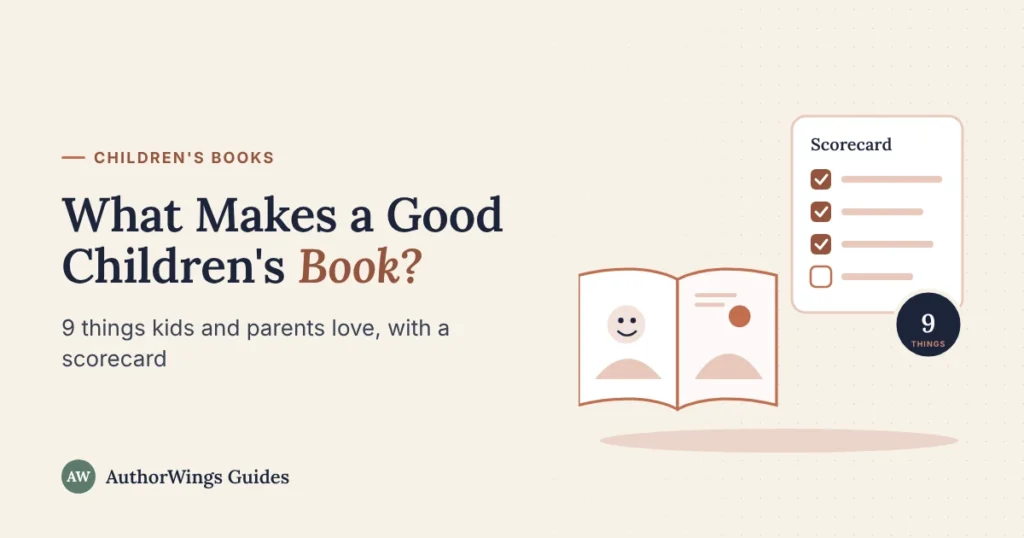
Good children’s book scorecard
Try it on your manuscript
Good children’s book scorecard
Score your manuscript, or any book on the shelf. Tick each yes; the total counts itself.
out of 9
- 8 or 9: ready for a professional read.
- 5 to 7: revise the “no” answers first.
- 4 or fewer: go back to the story’s problem and who solves it.
What kids notice vs what parents notice
| Children notice | Parents notice |
|---|---|
| The funny parts, and being in on the joke | Whether it sounds good read aloud at bedtime |
| A character who feels like them | Whether the words fit their child’s age |
| Guessing what comes after the page turn | Whether the message comes through without a lecture |
| Lines they can join in on | Whether they’ll still like it on the 50th reading |
| Small details hidden in the pictures | Whether the pictures are worth looking at twice |
When to get help
It’s hard to score your own book honestly. A children’s book editor reads it as a stranger would, out loud, against the nine qualities above. A critique with written notes on a picture book or board book of up to 1,000 words costs $249, and a full picture book edit costs $599. A rhyming picture book edit, with the meter checked beat by beat, costs $749. Get the story right before you pay for art or self publish a children’s book.
Children’s book editing
Find out what your book does well, and what it doesn’t
A children’s book editor reads your manuscript aloud for the problem, the page turns, the words for the age and the read-aloud rhythm, and shows every change.
- $599 Picture book edit, up to 1,000 words
- $249 Critique, notes only
- $749 Rhyming picture book edit
Frequently asked questions
What do kids look for in a book?
Most of all, books that make them laugh: 52% of children aged 6 to 17 said so in Scholastic’s 2019 Kids & Family Reading Report, the latest edition to ask. They also want books that take them to places and worlds they’ve never been (40%). And they like choosing: 89% said their favorite books are ones they picked out themselves. Let children choose sometimes, even when the choice surprises you.
Why do children want the same book again and again?
Repetition helps them learn. They know what’s coming, so they can join in and predict, and research suggests it helps: in one small study, three-year-olds remembered more new words from one story read several times than from three different stories (Horst and colleagues, 2011). A book worth rereading gives them something new to notice each time.
Does a good children’s book have to rhyme?
No. Where the Wild Things Are and many other classics are written in prose. Rhyme works when the meter is steady and every rhyme word is the one the story needs. When a rhyme forces an odd word or a wobbly beat, rhythmic prose usually reads better aloud.
Which awards point to good children’s books?
In the US, the American Library Association gives the Caldecott Medal for picture book illustration, the Newbery Medal for the most distinguished contribution to American literature for children, the Theodor Seuss Geisel Award for books for beginning readers, and the Coretta Scott King Book Awards for African American authors and illustrators. Winners and honor books are a useful list to read before you write.
How do I know if my children’s book is good?
Score it on the nine questions in the scorecard, then read it aloud to children who don’t know you and watch where they lean in or drift. For a stranger’s honest view, a critique from a children’s book editor costs $249 for a picture book.
Related reading
- How to write a children’s book: the 9 steps, with a free template
- How to start a children’s book: 5 decisions before you write
- Children’s book ideas: 50 story starters by age
AuthorWings editorial team
The AuthorWings editorial team writes and updates our guides for first-time authors. Every post is read and edited by a person on our team before it is published.