Home / Guides / Children's Books
Picture Book With No Words: How to Write a Wordless One
 By AuthorWings editorial team
12 min read
By AuthorWings editorial team
12 min read
Short answer
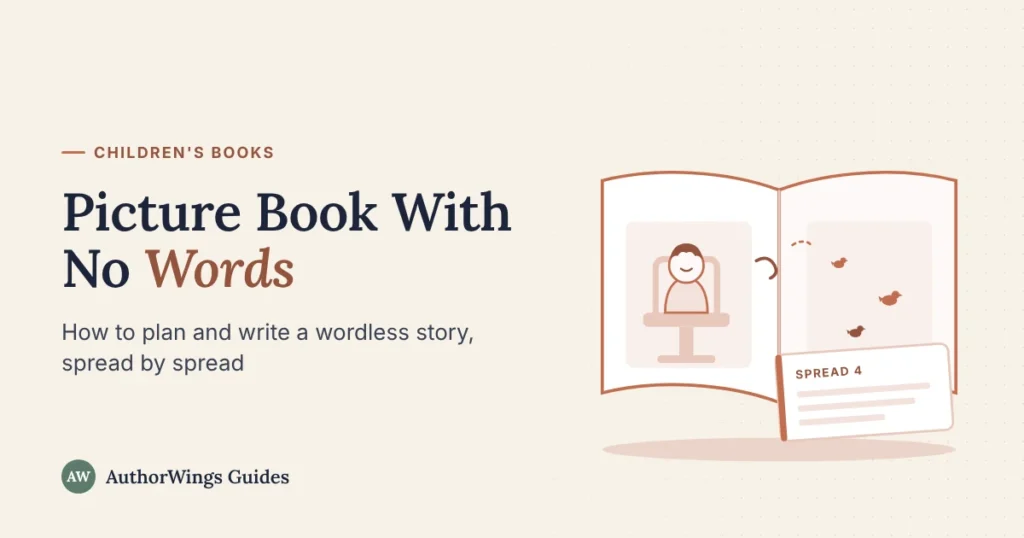
A picture book with no words, also called a wordless picture book, tells its whole story in pictures. Many use the standard 32-page shape with about 14 spreads. To write one, plan the story spread by spread, then write a visual script: one short note per spread saying what the reader sees and what the page turn reveals.
Writing a wordless book is still writing. You choose the problem, the beats, the order and the surprise. The difference is that every beat has to be something an illustrator can draw and a child can read without help. If you plan to hire an artist, your script becomes the brief for your picture book illustration.
This guide covers the wordless part only. For the general steps of writing for children, see our guide on how to write a children’s book.
Does your story work without words?
A story works without words when every important moment can be shown, not explained. Run it through these five questions.
| Question | Works without words | Needs words |
|---|---|---|
| Can every key action be drawn? | A curl falls and turns into a bird | She remembers last summer |
| Do the feelings show on faces and bodies? | Eyes squeezed shut, then a grin | He feels torn about the move |
| Does cause and effect read from one spread to the next? | The clippers buzz, the boy flinches | The plan only makes sense if explained |
| Can a child see the problem by spread 2? | A boy hides behind his dad at the barbershop door | The problem is a rule or a secret |
| Can a child retell the ending from the last picture? | The bird’s nest is made of his curls | The ending is a lesson stated out loud |
If one or two answers land in the right column, you don’t have to give up on the idea. Many books are nearly wordless instead. Tuesday by David Wiesner (Clarion, 1991) uses only a few time stamps, and the American Library Association (ALA) describes The Lion & the Mouse by Jerry Pinkney (Little, Brown) as virtually wordless. Both won the Caldecott Medal (1992 and 2010).
Still looking for an idea? Start with 50 children’s book ideas by age and pick one built on something a child can do, not something a child thinks.
Wordless picture books worth studying
Read three or four of these before you plan your own. Each one shows a technique you can borrow.
| Book | What to study |
|---|---|
| A Boy, a Dog and a Frog, Mercer Mayer (Dial, 1967) | A simple chase you can follow with no words at all. One of the early books in the form |
| Tuesday, David Wiesner (Clarion, 1991) | How a few time stamps carry a whole night. Caldecott Medal, 1992 |
| The Lion & the Mouse, Jerry Pinkney (Little, Brown, 2009) | A fable told through faces and close-ups. Caldecott Medal, 2010 |
| Wave, Suzy Lee (Chronicle Books, 2008) | Using the gutter, the fold between the pages. The girl stays on the left page and the sea on the right, until the wave crosses over |
| Journey, Aaron Becker (Candlewick, 2013) | A red drawing that opens a door to another world and drives the plot. Caldecott Honor, 2014 |
Notice that every book above was written and drawn by one person. Many well-known wordless books are, but it’s not a rule: Moon Bear (Frances Lincoln, 2024) was written by Clare Helen Welsh and illustrated by Carolina T. Godina, and reviewers describe it as almost wordless.
Plan the page turns when the pictures tell the story
In a wordless book, the page turn does the job a sentence would do. Plan the spreads before you write any notes. Our guide covers the 32-page plan for any picture book; these six moves carry the extra weight when there’s no text.
- Show the problem by spread 2. Body language has to set it up: a child hiding, a broken toy, an empty chair.
- Hold each answer for the next spread. End a spread on a question, such as scissors about to snip, and answer it after the turn.
- Give the reader one anchor. A bird, a color or an object that appears early and returns at the end ties the book together, like the red drawings in Journey.
- Let the reader know more than the character. A detail behind the hero, or a change only the reader sees, keeps a child looking closely.
- Show time passing. Light through a window, a calendar, a change of clothes or a season replaces “the next morning.”
- Save the full spread for the big moment. Picture size changes how a reader responds. In a lecture for The Horn Book, David Wiesner said the size of a picture, and of a character in it, affects how the reader responds to that character.
Sample spread plan
One story, 14 spreads, no words
The Curl Birds, a sample story invented for this guide: a boy is scared of his first haircut.
- Answer after the page turn
- Anchor: the sparrow
- Full spread, big moment
- Spread 1Anchor
Tam and his dad walk to a barbershop. A sparrow sits on the barber pole. Tam pulls his hood over his curls.
- Spread 2Problem
Inside: a huge chair, mirrors, buzzing clippers. Tam hides behind Dad.
- Spread 3Question
The barber lifts Tam onto the seat. Cape on. Tam squeezes his eyes shut as the scissors open.
- Spread 4RevealAfter the page turn
The first curl falls and becomes a tiny bird in midair. Tam opens one eye.
- Spread 5Reader knows more
More snips, more birds. The barber and Dad don’t notice them.
- Spread 6Build
Birds perch on the mirror, the comb jar and Dad’s newspaper. Tam giggles.
- Spread 7Setback
The clippers come close to his ear. Tam tenses. A bird lands on the clippers and he relaxes.
- Spread 8Big moment
Full spread: birds swirl around the shop and Tam laughs with his arms out.
- Spread 9Question
The barber starts to turn the chair toward the mirror.
- Spread 10RevealAfter the page turn
Tam sees his new haircut. The birds are gone, and only curls lie on the floor.
- Spread 11Change
Tam touches his head. A small smile. Dad gives a thumbs up.
- Spread 12Anchor returns
Outside, the sparrow hops after a curl blowing out the door.
- Spread 13Time passing
Days later, a different shirt and rain on the window: the sparrow builds a nest with the curls in Tam’s window box.
- Spread 14Ending
Tam, hair a little longer, watches the chicks and points to the barbershop card on the fridge.
How to write the visual script
A wordless manuscript is a visual script. In a book with text, publishers want few art notes, so the illustrator has room (Step 6 of our guide explains when to add them). In a wordless book the notes are the story, so they’re expected. One author of a nearly wordless picture book says the manuscript ends up looking like a collection of detailed illustration notes.
Write it in this order:
- A two-line summary at the top. Who the character is, what the problem is and how it ends, so the reader of your script knows where it’s going.
- One block per spread. Number it and write what we see, what changes and what the page turn should reveal.
- Story, not style. Describe action and feeling. Leave colors, clothes and camera angles to the illustrator unless the plot needs them, like the anchor.
- A note that it’s a guide. You can add a line at the top saying the notes are suggestions for the illustrator. If you prefer a grid, put the spread number on the left and the action on the right.
Here are spreads 3 and 4 of the sample story as script:
SPREAD 3
We see: The barber lifts Tam onto a booster seat and snaps the cape around his neck. Dad sits behind, reading. Tam squeezes his eyes shut. The scissors open near one curl.
Page turn: What happens on the first snip?
SPREAD 4
We see: The first curl falls, and halfway to the floor it becomes a small brown bird. Tam opens one eye. Nobody else looks up.
Change: Fear turns to curiosity.
Keep each block short. If you need a paragraph to describe one spread, the spread is probably doing two jobs, and the reader will miss one of them.
Submitting vs self-publishing a wordless book
What you send depends on how you’ll publish.
Sending it to agents and publishers. Writers who don’t draw send the visual script, the same way they’d send a text manuscript. Writers who also illustrate often send a dummy, a rough copy of the book with sketches, and one or two finished pieces. If you draw, our guide on how to illustrate a children’s book shows how to build one.
Self-publishing. Your script becomes the illustrator’s brief. Ask for rough sketches of every spread before any color, then test them on a child who hasn’t heard the story. If they can tell you what happens, it’s a good sign the pictures are telling the story. Make sure your contract gives you full rights to the artwork in writing, because in a wordless book the art is the whole book.
Thinking of AI art instead? Check what KDP, publishers and copyright allow for AI art first. If you’d rather have a team handle it, you can self publish a children’s book with us; that page shows every cost from art to a live listing.
Words you still need. A wordless book still has a title, a children’s book cover, a copyright page and back cover copy. The ebook needs a fixed layout, so each spread stays exactly as drawn; picture book formatting handles that. Store listings need words too: Amazon KDP (Amazon’s publishing platform) asks for a book description that sums up the plot, theme or idea (as of October 2026). Libraries file these books under the subject heading “Stories without words,” and parents may search for “wordless picture books,” so use both phrases in your description and keywords.
Mistakes that make a wordless book hard to follow
- Time jumps with no clue. If a scene moves to the next day, show it with light, clothes or weather.
- A character who changes from page to page. A different hairstyle on spread 9 reads as a different child. A character sheet before the art prevents it.
- Detail that hides the action. Extra things to find reward a second read, but the main action should read at a glance.
- A plot that depends on dialogue. If two characters have to talk for the story to make sense, add a few words or change the plot.
- An ending that needs explaining. The last spread should show the change, not imply it.
- Notes about style instead of story. “Soft watercolors” doesn’t help a reader of your script follow the plot.
When to get help
You can plan and write a wordless book on your own. The hard part comes next: finding an illustrator who can carry a story with no text to lean on.
At AuthorWings, our illustrators draw from spread-by-spread notes like the ones above, and you approve every sketch before color. The Picture Book Package is $2,595 for up to 16 illustrations, with cover art and formatting included. If you’d like a children’s book editor to turn your draft into a spread map and art notes first, that’s $199, and free when we illustrate the book.
Have the idea but not the time? Children’s book ghostwriting writes the visual script and includes the illustrations, from $3,999. Every word written by a human writer.
Picture book illustration
Have a wordless story ready to draw?
Send us your visual script. A human illustrator draws every spread from your notes, and you approve sketches before any color.
- $2,595 Picture Book Package, up to 16 illustrations, cover art and formatting included
- $199 Spread map and art notes from a children’s book editor, free when we illustrate
- From $3,999 Children’s book ghostwriting with illustrations. Every word written by a human writer
Frequently asked questions
How long is a wordless picture book?
Plan it like any picture book: 32 pages with about 14 story spreads, unless your publisher or printer asks for something else. Without a word count, the number of beats sets the length. If a spread doesn’t add a new beat, cut it or merge it with the one before. A wordless book doesn’t need to be longer just because there are no words to carry it.
Can you get a wordless picture book published if you don’t draw?
Yes, but it’s harder than with a text manuscript, because an editor has to imagine every picture from your notes. Many well-known wordless books are by author-illustrators, but not all: Moon Bear (Frances Lincoln, 2024) was written by Clare Helen Welsh and illustrated by Carolina T. Godina. A clear visual script with one block per spread gives your story a better chance.
Can a wordless picture book have a few words or sound words?
Yes. Some books called wordless use a handful of words. Tuesday by David Wiesner uses a few time stamps, and the ALA describes The Lion & the Mouse by Jerry Pinkney as virtually wordless. Sound words, signs and time stamps can help a reader follow the story. Keep them few, so the pictures still carry the plot.
Are wordless picture books good for young children?
They can be. In a study in the Journal of Child Language (2023, online 2021), 36 parents read a wordless book or a book with text at home with children aged 3.5 to 5.5. The wordless book led to more back-and-forth talk, and the children said more. Parents reading the book with text used a wider range of words and more complex sentences while telling the story. Both kinds of book have a place.
Related reading
- How to write a children’s book: the 9 steps, with a free template
- How to illustrate a children’s book: for authors who draw their own picture book
- Children’s book ideas: 50 story starters by age
AuthorWings editorial team
The AuthorWings editorial team writes and updates our guides for first-time authors. Every post is read and edited by a person on our team before it is published.