Home / Guides / Writing a Book
How to Write a Non-Fiction Book in 8 Steps
 By AuthorWings editorial team
10 min read
Short answer
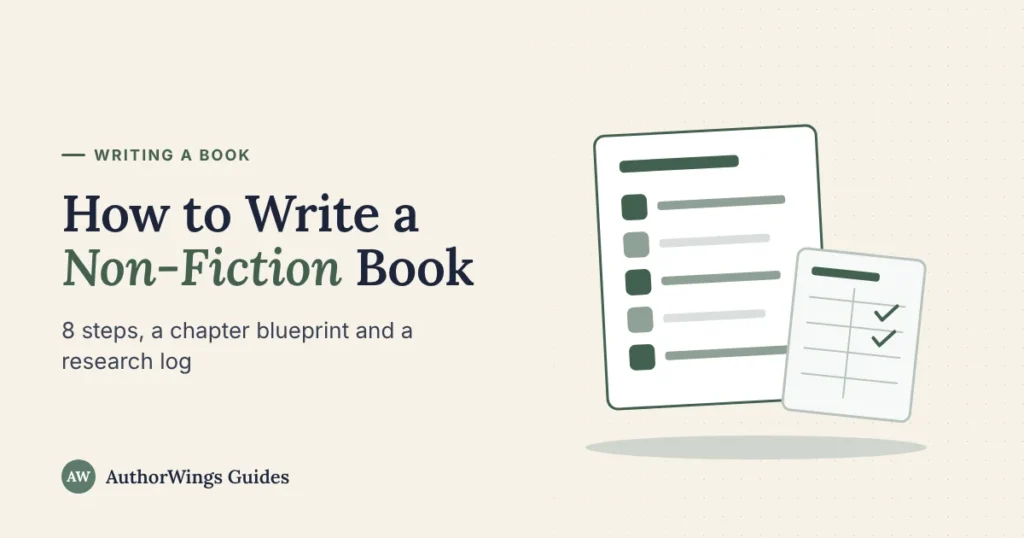
To write a non-fiction book, decide what kind of book it is and who it’s for, write a one-sentence promise, plan chapters around your reader’s questions, and keep a research log from day one. Draft one chapter at a time with a repeatable chapter structure, then fact-check, clear permissions and revise before an editor sees it.
Non-fiction readers pick up a book to learn something, solve a problem or understand a story that really happened, so every chapter has to deliver. This guide takes you from choosing the kind of book to a fact-checked draft, with one invented book worked through as an example. It also covers the parts of non-fiction that are easy to skip: tracking sources, quoting other writers and writing about real people. If you know your subject but can’t find the time, a business book ghostwriter can write the book in your voice from interviews with you.
Step 1: Choose the kind of non-fiction you’re writing
Non-fiction covers very different books, and each kind has its own shape. Decide which one yours is before you plan anything.
| Kind of book | What readers want | Typical structure | Example topic |
|---|---|---|---|
| How-to | To do something by the end | Steps in order, from start to result | Restoring a vintage sewing machine |
| Big idea or business | A new way to think about a problem | Problem, idea, evidence, how to apply it | Managing the person who used to manage you |
| Narrative non-fiction | A true story told like a novel | Scenes in time order, with research woven in | The family business that lasted three generations |
| History or biography | To understand a person, place or period | Time order, or themes within a period | The mill that built your town |
| Reference or guide | To look things up | Sections readers can dip into | A year-round guide to birdwatching from your window |
Writing your own life story? That’s a memoir, which works more like narrative non-fiction; see how to write a memoir.
Step 2: Name your reader and your promise
Write one sentence on who the book is for, and one on what they’ll know or be able to do by the end. Our guide to writing a book shows how to write that one-sentence promise.
Then check the promise against three things:
- Is it specific? “A guide to leadership” is too wide. “How to manage the person who used to manage you” is a book.
- Can you deliver it? List what you know from experience and what you’d need to research.
- Do readers already buy books like it? Find three recent books on the topic and note what yours does differently.
Step 3: Plan the chapters around your reader’s questions
Write down every question your reader would ask about the topic, in the order they’d ask it. Group related questions, and each group becomes a chapter. Ten to fifteen chapters is a common range for a full-length book.
Order the chapters to suit the kind of book you chose in Step 1. For a how-to or big-idea book, that’s the problem first, then the ideas or steps, then the result. For the full method, with a worked example, see how to outline a non-fiction book.
If you plan to pitch a traditional publisher, you’ll sell the book on this plan, usually before it’s written, with a book proposal.
Step 4: Set up your research system
Non-fiction stands on its facts, and the easiest time to track them is while you write. Keep one research log for the whole book.
| Claim or fact | Source | Where in the source | Date checked | Used in chapter |
|---|---|---|---|---|
| A statistic, date, name or quote | Book, article, report or interview | Page, section or timestamp | When you confirmed it | Chapter number |
Habits that save weeks later:
- Prefer primary sources. Go to the original study, record or interview, and use articles about it only to find the original.
- Save a copy. Keep the PDF, a screenshot or the archived link, since web pages change.
- Record interviews, with permission, and note who said what and when.
- Flag permissions. Mark any long quote, poem, song lyric or image you may need permission for, and ask the rights holder early, since replies can take weeks or months.
- Mark your own experience. Note which claims come from what you’ve seen yourself, so readers can tell your experience from your research.
Step 5: Use a chapter blueprint
A repeatable chapter structure keeps a how-to or big-idea book clear, and it makes drafting faster because you never face a blank page. One common blueprint has six parts:
- The problem. What’s going wrong for the reader, in their terms.
- A story. A short, real or clearly invented example of that problem.
- The idea. Your answer, in a sentence or two.
- The steps. How to apply it, in order.
- An example. The idea at work, ideally with a result.
- The takeaway. One line to remember, and a bridge to the next chapter.
Worked example. Chapter 3 of an invented book, Managing the Person Who Used to Manage You (one of our 30 book ideas):
| Part | Chapter 3: Your first one-on-one meeting |
|---|---|
| The problem | Your first one-on-one with your old boss feels awkward, and both of you avoid the real subject. |
| A story | Priya (invented), newly promoted, cancels the meeting twice, and her former manager starts telling the team she’s avoiding him. |
| The idea | Name the change in the first five minutes, then ask for their help on one specific thing. |
| The steps | Schedule 30 minutes; name the change in the first five minutes; ask what they’d keep and what they’d change; ask for their help on one specific thing; book the next meeting before you leave. |
| An example | Priya’s second attempt: she names it, asks for help with the quarterly plan, and the tension drops. |
| The takeaway | Saying the awkward thing early makes the next meetings easier. Next: setting expectations without pulling rank. |
Narrative non-fiction works differently: build chapters around scenes, as a novel does, and weave the research into the story. For chapter length, see our guide to chapter length; non-fiction chapters often run about 4,000 words.
Step 6: Write the first draft
Write one chapter at a time from your outline and blueprint until the draft is done.
- Don’t stop to research. If a fact is missing, type [TK] (an editor’s mark for “to come”), add it to your research log and keep writing.
- Write or rewrite the introduction last, when you know what the book delivers.
- Set a pace. At 500 words a session, five sessions a week, a 45,000-word book takes about 18 weeks to draft; see how long it takes for the whole timeline.
Step 7: Handle quotes, real people and permissions
Non-fiction often quotes other writers and describes real people, so a few rules matter. This is general information, not legal advice.
- You can report facts and ideas. Copyright protects the way something is written. It doesn’t protect the facts or ideas in it, so you can report what a study found in your own words, with a citation.
- Short quotes can be fair use. In the US, quoting a short passage for comment or criticism can be fair use, but there’s no word count that’s automatically safe. Rules differ outside the US. Quote only what you need, and credit the source; credit alone doesn’t replace permission.
- Get permission for more. Long passages, song lyrics, poems and photos usually need written permission from the rights holder, and so can charts or illustrations reproduced exactly as published. Ask early, because replies can take weeks or months.
- Real people. Stick to what you can support, and keep opinion clearly marked as opinion. An opinion that implies a false fact can still be defamatory. Changing names and identifying details helps protect privacy, though it may not be enough if readers can still tell who the person is, and for sensitive stories it’s worth asking people for their consent.
- Cite consistently. US book publishers commonly follow The Chicago Manual of Style, whose notes-and-bibliography system is widely used in history and other humanities books. Your research log gives you the notes as you go.
If a book makes serious claims about real people or businesses, ask a publishing lawyer to read it before you publish.
Step 8: Fact-check and revise
Before anyone else reads the draft, fact-check it against your research log: every number, date, name, quote and source. Then revise in this order:
- Structure. Does every chapter deliver part of your promise, in an order that builds?
- Clarity. Could your reader follow each step without asking you a question?
- Examples. Does every main idea have one?
- Readers. Ask two or three people from your target audience to read it and say where they got lost.
Then the professional edits come in their usual order: a developmental edit for structure, a line edit for flow, a copy edit for grammar and consistency, and a proofread.
When to get help
You can write a non-fiction book on your own. Help makes sense when you know the subject but the writing isn’t happening, or when you need an expert view of the structure.
- You know the subject but not the time. A non-fiction ghostwriter writes the book in your voice from interviews with you. Non-fiction ghostwriting is 55¢ a word, from 20,000 words, with all four EFA editing levels included. Every word written by a human writer. 100% of the rights transfer to you on final payment.
- Your draft needs a structural read. A developmental editor reads the whole manuscript and sends an 8 to 20 page editorial letter with chapter notes. For non-fiction it’s $450 for the first 10,000 words, then $0.045 a word.
- Not sure what your pages need? A $49 sample edit of up to 1,000 words tells you, and the $49 comes off your edit if you book within 60 days.
Non-fiction ghostwriting
Your expertise, written as a book
A non-fiction ghostwriter turns interviews with you into a finished book in your voice. Your name goes on the cover.
- 55¢ a word, from 20,000 words
- Includes all four EFA editing levels
- Every word written by a human writer
Non-fiction writing questions authors ask
How long is a non-fiction book?
Many full-length non-fiction books run 40,000 to 70,000 words, and short guides 15,000 to 30,000. Business, self-help and how-to books often sit toward the lower end of the full-length range, while narrative non-fiction and history sit near the top or beyond it. Pick a length that delivers your promise without padding, then divide it by your chapters to get a target per chapter. Writing self-help? See how to write a self-help book for the method and exercises.
Do I need to be an expert to write non-fiction?
You need to know the subject well enough to deliver your promise, and to be honest about where your knowledge comes from. Many non-fiction authors write from their work and practice, with no academic background in the subject. If you’re writing outside your experience, lean on interviews and primary sources, credit them clearly, and ask an expert to read your key chapters.
Do I need permission to quote other books?
Short quotes used for comment or criticism can count as fair use under US law, but no word count is automatically safe, and rules differ in other countries. Longer passages, poems, song lyrics and images usually need written permission from the rights holder. Quote only what you need and credit the source. This is general information, not legal advice.
Should I write the introduction first or last?
Write a rough introduction first if it helps you start, but plan to rewrite it last. By the end of the draft, you’ll know exactly what the book delivers, which examples work and what the reader will gain. A strong introduction states the problem, makes the promise and tells the reader how the book is organized.
AuthorWings editorial team
The AuthorWings editorial team writes and updates our guides for first-time authors. Every post is read and edited by a person on our team before it is published.