Home / Guides / Writing a Book
How Many Words Are in a Chapter? Chapter Length by Genre
 By AuthorWings editorial team
9 min read
Short answer
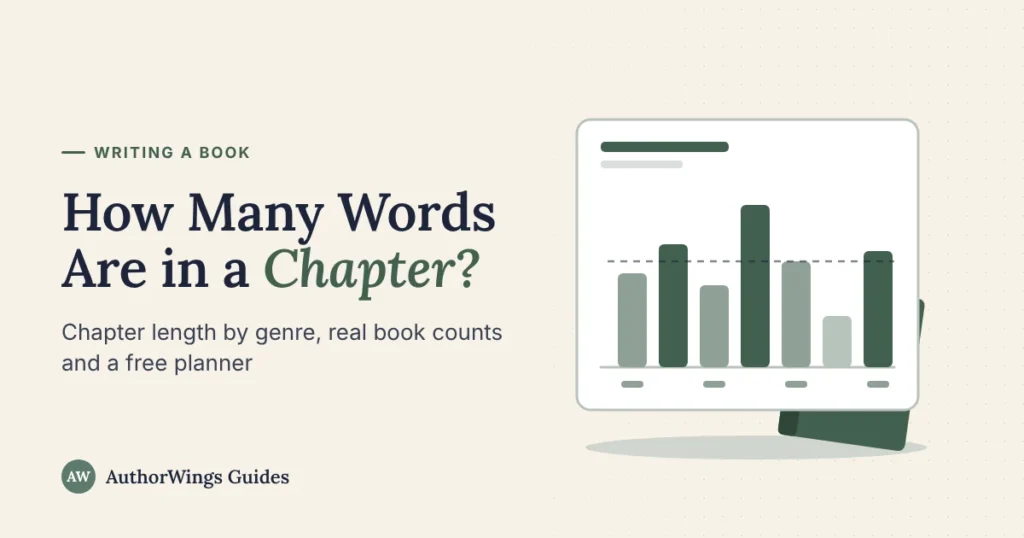
A novel chapter usually runs 2,000 to 4,000 words. Thrillers run shorter, epic fantasy longer, and non-fiction chapters often run about 4,000 words. When we counted 14 classic novels, 10 of them averaged roughly 2,000 to 4,000 words a chapter. End a chapter when its scene or point is done, whatever the count.
Chapter length is a guide with no fixed rule. Genre sets the usual range, pacing decides where a chapter ends, and readers rarely count the words. This guide gives the common ranges by genre, word counts we measured in 14 classic novels, a words-to-pages conversion, and a planner that checks the chapters you’ve already written. If your chapters drag or end in the wrong places, that’s a structure question, and developmental editing is the edit that deals with it.
How many words are in a chapter on average?
Common advice for adult fiction is 2,000 to 4,000 words a chapter. For non-fiction, about 4,000 words is the usual figure for a typical chapter.
That middle of roughly 2,000 to 4,000 words is about 7 to 16 printed pages. It’s long enough for a full scene or a complete idea, and short enough to read in one sitting. Plenty of good books sit outside it, which the counts further down show.
Chapter length by genre
Genre changes the range because it changes the pace readers expect. Fast genres use short chapters to keep pages turning, and genres built on a world or an argument give each chapter more room.
| Genre | Common range | Why |
|---|---|---|
| Thriller, mystery and suspense | 1,000 to 3,000 words, sometimes under 1,000 | Short chapters and cliffhangers keep the pace high |
| Romance | About 2,000 to 3,000 words | Chapters often follow one scene or one point of view |
| Science fiction | About 3,000 to 4,000 words | Room for the world without slowing the plot |
| Fantasy | Often 4,000 to 8,000 words for epic fantasy, shorter otherwise | Epic fantasy needs space for worlds and many characters |
| Literary fiction | 3,000 to 5,000 words | Character and voice carry the chapter more than plot |
| Young adult | Usually within the range of its genre, often 2,000 to 4,000 words | YA follows the pace of its genre, such as YA fantasy or YA romance |
| Non-fiction (business, self-help, how-to) | About 4,000 words | One main idea per chapter, with examples |
Ranges as of October 2026, based on common advice from writing experts and editors. They describe market practice, with no fixed rule. Writing for younger readers? See middle grade and young adult word counts and chapter books for young readers.
Memoir chapters are often built around scenes, as novel chapters are, so the fiction ranges are a useful guide alongside the non-fiction one.
What real books do: we counted 14 classics
To see real chapter lengths, we counted the words in every chapter of 14 classic novels, using the public-domain texts on Project Gutenberg.
| Book | Genre | Chapters | Total words | Average | Median | Shortest | Longest |
|---|---|---|---|---|---|---|---|
| Moby-Dick | Adventure | 135 | 212,038 | 1,571 | 1,211 | 47 | 8,117 |
| Pride and Prejudice | Romance | 61 | 122,891 | 2,015 | 1,842 | 678 | 5,212 |
| Treasure Island | Adventure | 34 | 68,704 | 2,021 | 1,994 | 1,497 | 2,966 |
| The Time Machine | Science fiction | 16 | 32,698 | 2,044 | 2,065 | 488 | 4,225 |
| Alice’s Adventures in Wonderland | Children’s fantasy | 12 | 26,700 | 2,225 | 2,172 | 1,718 | 2,670 |
| The War of the Worlds | Science fiction | 27 | 60,419 | 2,238 | 1,963 | 841 | 5,598 |
| Frankenstein | Gothic horror | 28 | 75,218 | 2,686 | 2,605 | 300 | 8,268 |
| The Picture of Dorian Gray | Literary | 20 | 79,309 | 3,965 | 3,768 | 1,809 | 7,444 |
| The Hound of the Baskervilles | Mystery | 15 | 59,528 | 3,969 | 3,873 | 2,295 | 6,677 |
| Little Women | Family | 47 | 186,588 | 3,970 | 4,067 | 1,925 | 7,338 |
| The Thirty-Nine Steps | Thriller | 10 | 41,259 | 4,126 | 4,287 | 2,539 | 6,191 |
| Jane Eyre | Romance | 38 | 187,657 | 4,938 | 4,393 | 1,840 | 11,310 |
| The Great Gatsby | Literary | 9 | 48,675 | 5,408 | 5,276 | 4,077 | 8,846 |
| Dracula | Gothic horror | 27 | 162,071 | 6,003 | 5,886 | 3,612 | 8,003 |
How we counted (October 2026): Project Gutenberg plain-text editions, chapter text only, without titles, front matter or back matter. Frankenstein’s four opening letters count as chapters. Other editions will differ by a few words.
What the counts show:
- The middle holds. 10 of the 14 books averaged roughly 2,000 to 4,000 words a chapter (2,015 to 4,126), close to the range writing experts give today.
- Length varies inside one book. In 12 of the 14, the longest chapter is at least twice the shortest. Moby-Dick runs from 47 words (chapter 122, “Midnight Aloft”) to 8,117.
- Long chapters can pull the average up. Moby-Dick’s average is 1,571 words, but half its chapters are 1,211 words or shorter. The median, the middle chapter, is often a better picture of a “typical” chapter.
These are classics, written for readers of their time. Thriller and mystery guidance today points to shorter chapters than The Thirty-Nine Steps or The Hound of the Baskervilles use, so check recent books in your genre too.
How many pages is a chapter?
A printed page holds roughly 250 to 300 words in a typical 6 x 9 inch novel set in 11- to 12-point type. The exact number depends on the trim size, font, font size and line spacing, and smaller trims such as 5 x 8 hold fewer words a page.
| Chapter length | Printed pages (250 to 300 words a page) |
|---|---|
| 1,000 words | About 3 to 4 pages |
| 2,000 words | About 7 to 8 pages |
| 3,000 words | About 10 to 12 pages |
| 4,000 words | About 13 to 16 pages |
| 5,000 words | About 17 to 20 pages |
A double-spaced manuscript page in 12-point type is usually estimated at about 250 words, so a 3,000-word chapter is about 12 manuscript pages.
How many chapters should a book have?
Divide your book’s target length by your chapter length. First set a word-count target for the whole book, then pick a chapter length from your genre’s range.
- An 80,000-word novel with 3,000-word chapters has about 27 chapters.
- A 90,000-word thriller with 1,500-word chapters has about 60.
- A 50,000-word non-fiction book with 4,000-word chapters has about 12 or 13.
The number is a starting point for your chapter-by-chapter outline. Your material decides the final count: a story with many short scenes ends up with more chapters, and a non-fiction book usually needs one chapter per main idea.
Chapter length planner and checker
Free tool
Chapter length planner and checker
One per line, or separated by spaces. Numbers can include commas, such as 3,200.
When to end a chapter, and how to split a long one
End a chapter when its job is done: a scene has turned, a question is open, or a non-fiction idea is complete. Good places to stop:
- On a turn. Something changes: a secret comes out, a plan fails, a decision is made. Big ones become the turning points of your plot.
- On an open question. The reader wants to know what happens next. A line of dialogue that leaves something unsaid works well here.
- On a change of time or place. The next scene starts somewhere new, so a new chapter is a natural reset.
- In non-fiction, after the takeaway. The reader has the idea, an example and what to do with it.
A scene break (a blank line or a symbol) is enough for a small shift inside a chapter. Use a new chapter for a bigger one.
Worked example: splitting a 9,000-word chapter. Chapter 7 of our invented mystery, Ten Days in Kestrel Bay, has three scenes:
- Mara searches the harbor office after hours (2,000 words).
- Pell, the harbormaster, catches her and lies about the dock log (3,200 words).
- That night, someone wrecks her boat (3,800 words).
At 9,000 words it’s three times the book’s typical 3,000-word chapter. The split: chapter 7 becomes scenes 1 and 2 (5,200 words) and ends on Pell’s lie, an open question. Chapter 8 opens that night, a change of time, with the wrecked boat (3,800 words). At 5,200 words chapter 7 is still long, but it’s one continuous sequence in one place, and both chapters now fall within half to twice the book’s typical length. Chapter 7 ends on an open question, chapter 8 on a turn, and neither needed a word cut.
To find long chapters fast, select each chapter in Word or Google Docs to see its word count (or the per-chapter counts in book writing software), then paste the counts into the checker above.
Do chapters have to be the same length?
No. In our count, Pride and Prejudice runs from 678 words to 5,212, and Jane Eyre from 1,840 to 11,310. Uneven chapters are normal in published books. What readers notice is a chapter that drags.
Use length on purpose:
- Short chapters speed things up. A run of short chapters near the climax makes the pages turn faster.
- Longer chapters slow down. They suit big set pieces, reflection and complex non-fiction ideas.
- Check the outliers. A chapter far longer than the rest often holds two scenes or two ideas, and a very short one may be a beat that belongs in the next chapter.
When to get help
You can plan and check chapter length on your own. Help makes sense when you can’t tell whether a chapter is too long, or why the middle of the book sags.
- You want your structure and pacing fixed. A developmental edit reads the whole manuscript and covers where chapters start, end and drag, with an 8 to 20 page editorial letter and chapter notes. For fiction it’s $330 for the first 10,000 words, then $0.033 a word, so $2,640 for 80,000 words. Non-fiction is $450, then $0.045 a word.
- You want the diagnosis and will revise yourself. An editorial assessment gives you the same letter without notes in the manuscript, for $180 for the first 10,000 words, then $0.018 a word. The fee is credited toward a full edit booked within 60 days.
- Not sure? A $49 sample edit of up to 1,000 words tells you which edit your draft needs, and the $49 comes off your edit if you book within 60 days.
Developmental editing
Chapters that keep readers turning pages
An editor reads your whole manuscript for structure and pacing, including where chapters start, end and drag. One lead editor handles the edit.
- Developmental edit for fiction from $330
- Editorial assessment from $180
- $49 sample edit first
Chapter length questions writers ask
How long should the first chapter of a book be?
There’s no separate rule for first chapters. Many run about the same length as the rest of the book, or a little shorter, because the opening has to earn the reader’s attention quickly. Aim for your typical chapter length, open close to the moment something changes, and end the chapter on a reason to turn the page.
Can a chapter be one page long?
Yes. Short chapters are a common tool for pace and emphasis. In our count of Moby-Dick, the shortest chapter is just 47 words, and Frankenstein’s third letter is about 300 words. A one-page chapter works when it lands a single strong moment. If every chapter is that short, check that each one still does a full job.
How many words is a short chapter?
A chapter under about 1,500 words, or five or six printed pages, usually reads as short. Thrillers often use them to keep the pace up, and other genres use them for a single scene or a moment that needs space around it. Short is fine as long as the chapter has a clear purpose and ends with a reason to keep reading.
Should non-fiction chapters be longer than fiction chapters?
Often, yes. Non-fiction chapters typically run about 4,000 words, because each one has to present an idea, support it with examples and show the reader what to do. Novel chapters often run 2,000 to 4,000 words. The better test for non-fiction is one main idea per chapter: if a chapter holds two, split it.
AuthorWings editorial team
The AuthorWings editorial team writes and updates our guides for first-time authors. Every post is read and edited by a person on our team before it is published.