Short answer
A beta reader is someone who reads your finished draft before publication and tells you how it felt as a reader: where they were gripped, bored or confused. Beta readers read like your future audience, not like editors. They usually see a revised draft, after alpha readers and before a professional edit, and authors often use three to five.
The name comes from software, where beta testers try a product before release. Beta readers do the same for books: they find out how the story or argument works for a real reader while you can still change it. This guide explains what beta readers do, how they differ from alpha readers and editors, when to use them, and what to ask, with a questionnaire you can copy. AuthorWings can also recruit genre readers for you as test readers (beta read).
What beta readers do, and what they don’t
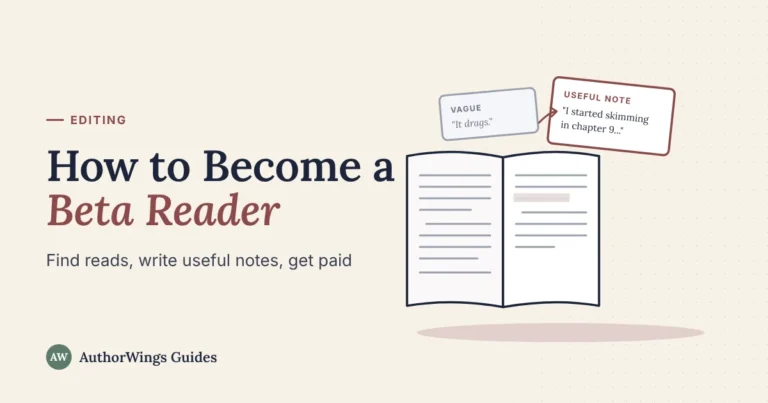
Beta readers report their experience of reading your book. They don’t fix it.
Beta readers tell you
- Where they lost interest or skimmed
- What confused them
- Which characters, chapters or ideas worked
- Whether the ending felt worth it
- What they’d tell a friend the book is about
Beta readers don’t
- Edit your sentences or fix grammar
- Rewrite scenes or restructure chapters
- Proofread
- Give the expert diagnosis a developmental editor does
Their value is that they read like customers. They can tell you exactly where a problem is, even when they can’t tell you why.
Alpha readers vs beta readers (and other early readers)
Alpha readers see your book early, often before it’s finished; beta readers see a complete, revised draft. Several other readers also see a book before publication, and each does a different job.
| Reader | When | Draft | What they give you | Usually |
|---|---|---|---|---|
| Alpha reader | During or right after the first draft | Unrevised, sometimes unfinished | Big reactions: does the idea and story work at all? | A trusted friend or writer |
| Critique partner | Any time, often chapter by chapter | Drafts in progress | Craft notes from a writer’s view, often swapped | Another writer, who swaps work rather than being paid |
| Beta reader | After you’ve revised at least once | Complete | A reader’s experience: pace, clarity, characters, ending | Readers of your genre, free or paid |
| Sensitivity reader | After revision, before editing ends | Complete | Notes on how you portray an identity, culture or experience they know firsthand | A paid specialist |
| Editor | After beta feedback and your changes | Complete, revised | Expert diagnosis and fixes, at one of four levels | A paid professional |
| ARC reader | Usually months before release | Pre-publication, often uncorrected | Early reviews and word of mouth | Reviewers and readers |
If you’re unsure where editing fits after beta readers, our guide to editing vs proofreading explains the levels.
When to use beta readers
Use beta readers once the draft is complete and you’ve revised it yourself at least once. Earlier than that, they’ll report problems you already know about.
A common order: finish the draft, rest it, revise, send it to beta readers, revise again, and only then pay for editing. Feedback before a developmental edit means the editor works on a stronger draft, and you may find you need a lighter edit. Our guide to what a manuscript is shows each stage from draft to book.
Still mid-draft? Beta readers can wait. First finish the draft.
How many beta readers you need
Many guides suggest three to five beta readers for a first round. With fewer than three, you can’t tell one reader’s taste from a real problem; with many more, the feedback becomes hard to manage.
The point of several readers is the pattern. One reader disliking a scene is a note. Three readers flagging the same chapter is a problem to fix. Some authors run a second, smaller round after revising.
Beta reader questionnaire builder
Specific questions get useful answers, and “Did you like it?” gets polite ones. Pick your book type and copy the questions into an email or form for your readers. The first five come from the feedback step in our book-writing guide.
Beta reader questions
- Where did you lose interest or skim?
- What confused you?
- Which part did you like most, and why?
- Did the ending (or the last chapter) feel worth the read?
- What would you tell a friend this book is about?
- Did the first chapter make you want to keep reading? Where did you decide?
- Which character did you care about most, and who didn’t you believe?
- Was there a point where you guessed the ending?
- Did any scene feel too long or too short?
- Was there a moment that pulled you out of the story?
Give readers a clear deadline, and ask them to note where in the book each reaction happened. For a children’s book, ask the adult who read it with a child.
Finding beta readers, free or paid
Most beta readers are volunteers: readers of your genre from writing groups, book clubs, reader communities or your mailing list, or writers who swap manuscripts with you. Our book-writing guide covers getting feedback from beta readers, including where to look and how to sort the feedback. Want to read for other authors yourself? See how to become a beta reader.
If you’d rather not recruit and manage readers yourself, paid services do it for you. At AuthorWings, beta reader coordination is $599 for 5 readers or $849 for 8. We recruit vetted readers in your genre, run a structured questionnaire on pacing, character, plot and ending, and turn the answers into one summary.
Protecting your manuscript when you share it
Your manuscript is protected by US copyright from the moment you write it down, shared or not. Still, a little care keeps drafts from traveling.
- Share a PDF or a view-only link rather than an editable file.
- Send it only to people you’ve chosen, not to a public group.
- Agree in writing, even in an email: the deadline, that they won’t share or post the text or paste it into AI tools, and that they’ll delete it when they’re done.
- For a book you haven’t announced, or readers you don’t know, some authors ask for a short NDA.
Our book-writing guide has more on protecting your work.
When to get help
Beta readers tell you where the reading experience breaks. When they agree something’s wrong but you can’t see how to fix it, that’s the moment for a professional.
- Want readers but not the recruiting? Beta reader coordination: $599 for 5 readers, $849 for 8.
- Readers flagged structure, pacing or character problems? An editorial assessment gives you an 8 to 20 page letter on the whole manuscript: $180, then $0.018 a word ($1,260 for 70,000 words), credited toward a full edit booked within 60 days.
Test readers and editing
Real readers, then the right edit
We recruit vetted beta readers in your genre and turn their answers into one clear summary. When you’re ready to edit, one lead editor handles the edit, with a fresh proofreader for the final check.
- 5 readers $599
- 8 readers $849
- Editorial assessment from $180
Frequently asked questions
Should you pay beta readers?
You don’t have to. Many beta readers are volunteers, such as fellow writers who swap manuscripts or fans who enjoy reading early. Paying makes sense when you need readers in a specific genre or age group quickly, or want structured answers you can compare. Either way, thank your readers, and consider naming them in your acknowledgments.
Can friends and family be beta readers?
They can, but they’re often too kind to be useful, and they may not read your genre. If you ask them, give them specific questions and tell them honest answers help most. For your main round, look for readers who would buy a book like yours, so their reactions match your real audience.
How long should beta readers get?
Give a clear deadline. Many authors give about four to six weeks for a full-length novel, and less for a short book. Ask readers to tell you early if they can’t finish; whether and where someone stops reading is useful feedback too.
Do beta readers need to sign an NDA?
Not usually. Many authors skip formal NDAs with volunteer beta readers and rely on a short written note covering the deadline, not sharing the file and deleting it afterward. Some use an NDA when readers are strangers or the book hasn’t been announced. Your work is protected by copyright either way.
Related reading
AuthorWings editorial team
The AuthorWings editorial team writes and updates our guides for first-time authors. Every post is read and edited by a person on our team before it is published.