Short answer
To become a book editor, learn one editing level well (copy editing or proofreading is the usual start), study The Chicago Manual of Style, and build three or four sample edits that show your changes. Then either apply for editorial assistant jobs at publishers or take freelance work from authors. A degree helps for in-house jobs; freelancers are hired mostly on their samples.
Book editing has two doors: a staff job at a publisher, or freelance work for authors and publishers. This guide covers both, with the skills each edit level needs, training worth your time, a portfolio checklist, a short editing test to try, current pay data and a 12-month plan. Once you have three years of experience, you can join our specialist network and get matched with authors.
Two routes into book editing: in-house or freelance
In-house editors work on staff at a publisher; freelance editors work for themselves and edit for many clients. Most people start on one route, and some move between them.
| In-house | Freelance | |
|---|---|---|
| First job | Editorial assistant, production or managing editorial assistant | Proofreading or copy editing for authors or small presses |
| How you’re hired | Application, editing test, interviews | Sample edits, a test edit, referrals |
| What you do early on | Read submissions, support senior editors, handle schedules | Edit manuscripts, keep a style sheet, deliver on deadline |
| Where | Often the publisher’s office; all five of the largest US publishers have their US headquarters in New York | Anywhere, usually from home |
| Pay | Salary and benefits | Per project or per word, set by you or the client |
| Path up | Assistant editor, associate editor, editor (titles vary by house) | More levels (line, developmental), a genre specialty, repeat clients |
The in-house route can lead to acquiring editor: the person who finds and champions books, usually with sign-off from the publisher or an acquisitions meeting. The freelance route leads to editing the books themselves, at every level.
Skills you need, by editing level
Every editor needs a sharp eye and clear notes, but each level asks for different skills. Many freelancers start with one level and add others later. Our book editing page shows the four editing levels on a sample page. For what each level involves and what the author gets back, see what a book editor does.
| Level | What you need to be good at |
|---|---|
| Proofreading | Spotting typos, missing words and layout errors on final pages without rewriting |
| Copy editing | Grammar, punctuation, usage and consistency; keeping a style sheet; knowing Chicago style |
| Line editing | Sentence rhythm, word choice and voice; improving prose without making it yours |
| Developmental editing | Structure, pacing, character and argument; writing a clear editorial letter |
For the difference between the final check and everything before it, see editing vs proofreading. Fiction editors also need dialogue conventions down cold; our guide to dialogue rules covers the punctuation copy editors fix most.
Beyond the page, editors need to work in Word’s tracked changes and comments, meet deadlines, and give honest notes kindly. Authors remember how feedback felt as much as what it said.
Training and certificates
You don’t need a specific degree to edit books, but you do need training in the rules. The US Bureau of Labor Statistics lists a bachelor’s degree as the typical entry level for editors, often in English, journalism or communications, and publishers usually ask for one for in-house jobs.
- The style guides. US book publishers commonly follow The Chicago Manual of Style (18th edition, 2024) and Merriam-Webster for spelling. Read the grammar, punctuation and numbers chapters first.
- Certificate programs. University continuing-education programs, such as the Certificate Program in Editing from UChicago Professional Education and the Online Copyediting Certificate from UC San Diego Extended Studies, teach the rules with graded exercises.
- Professional groups. ACES: The Society for Editing offers on-demand training and an Editors for Hire directory where members can list their services. The Editorial Freelancers Association offers classes, webinars and a searchable member directory.
- Practice with feedback. Editing on your own builds speed; editing with a mentor or course builds judgment.
Build a portfolio of sample edits
Clients and publishers hire editors on what their edits look like, so your portfolio is a set of before-and-after samples. Each one should show your changes and your reasoning.
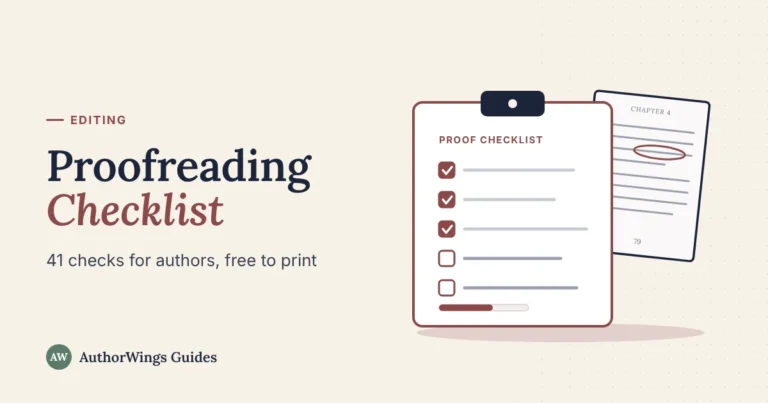
Editing portfolio checklist
- 3 or 4 sample edits of 1,000 to 2,000 words each, in Word with tracked changes and comments
- At least one sample in the genre you most want to edit
- The same pages before and after, so a client sees what changed
- A style sheet for one sample: spellings, names, numbers, hyphenation
- For developmental work, a short sample editorial letter
- Text you have the right to edit and share: your own writing, public-domain text, or pages a writer agreed to let you use
- Files in standard manuscript format, so they look like real jobs
- A one-page list of what you offer, the genres you edit and how you work
Never share client work without written permission, even after the book is out.
Try a mini editing test
Many publishers and agencies ask applicants to take an editing test, and some set a time limit. Try these six. Each sentence has one main problem: pick the fix, then read why.
Mini editing test
- “The publisher, who’s office is in Brooklyn, sent the contract on Monday.” Fix: Change “who’s” to “whose”. “Who’s” means “who is.” The possessive is “whose.”
- “Each of the editors have their own style sheet.” Fix: Change “have” to “has”. When “each” is the subject, it takes a singular verb, so “has.”
- “She lay the manuscript on the desk and went home.” Fix: Change “lay” to “laid”. “Laid” is the past tense of “lay” (to put something down). “Lay” on its own is the past tense of “lie” (to recline).
- “Walking into the office, the manuscript fell off her desk.” Fix: Start with “As she walked into the office,”. As written, the manuscript is the one walking. That’s a dangling modifier; make the person the one walking.
- “The edit was due Friday, she finished it on Thursday.” Fix: Replace the comma with a period or a semicolon. Two complete sentences joined by only a comma, with no conjunction, make a comma splice.
- Chapter 3 says Mara’s eyes are green. Chapter 9 says: “Mara blinked her blue eyes.” Fix: Query the author and record the answer in the style sheet. Catching inconsistencies is the copy editor’s job, but the author decides. A query and a style sheet entry keep the whole book consistent.
Where first editing work comes from
First work comes from different places on each route, and most beginners use more than one.
In-house
- Editorial assistant listings on publishers’ career pages and publishing job boards
- Internships, which many editors describe as their way in, and intensive summer courses such as the Columbia Publishing Course
- Bookselling, library or literary magazine work, which shows you know books and readers
Freelance
- Authors you already know: writing groups, critique partners, workshop classmates
- Member directories of professional groups, once your samples are ready
- Small presses and packagers that hire freelance proofreaders and copy editors
- Specialist networks that match editors with authors and handle the clients for you
- Referrals from your first clients, which become your main source over time
Start with shorter jobs: a proofread, a short story, a novella. Finished jobs and happy clients lead to longer ones.
How much book editors earn
The US Bureau of Labor Statistics put the median pay for editors at $77,920 a year in May 2025. The lowest 10% earned under $41,250 and the highest 10% over $153,700. These figures cover all editors, including newspapers, magazines and websites, not only books.
| Measure | Figure |
|---|---|
| Median pay | $77,920 a year ($37.46 an hour) |
| Lowest 10% | Under $41,250 |
| Highest 10% | Over $153,700 |
| Jobs (2025) | About 105,000 |
| Self-employed | 9% |
| Outlook, 2025 to 2035 | A 1% decline, with about 7,900 openings a year as editors leave the field |
Freelance income depends on how many hours you fill, the levels you offer and your genre, so it varies more than a salary. Many freelancers combine levels or keep another job until their client list is steady.
A 12-month plan to your first paid edits
A year of steady practice can take you from learning the rules to paid work. The plan assumes 5 to 10 hours a week.
| Months | Focus | Done when |
|---|---|---|
| 1 to 2 | Learn the rules: a course module, plus the Chicago chapters on grammar, punctuation and numbers | You can explain why each change is right |
| 3 to 4 | Practice on public-domain chapters and your own writing; time yourself | You edit 1,000 words at a steady pace with few misses |
| 5 to 6 | Build 3 or 4 sample edits, a style sheet and, if you want developmental work, a sample letter | Your portfolio checklist is complete |
| 7 to 8 | Join a professional group, set up a simple site or profile, tell writers you know | You have somewhere to send people |
| 9 to 10 | Take short paid jobs: proofreads, short stories, small presses | Two or three finished jobs |
| 11 to 12 | Ask for testimonials and referrals; pick a genre to specialize in | Repeat or referred clients |
On the in-house route, apply for editorial assistant jobs from about month 5, once your basics and samples are ready, and expect an editing test.
Join the AuthorWings specialist network
When you have three years of professional experience, you can apply to edit for AuthorWings authors. We manage the contract, the client and every handoff, so your time goes into the edit.
For experienced editors
Edit books without chasing clients
Approved specialists get a profile authors can request by name, and our team matches you to projects that fit your genre. Editors apply with edited sample pages and published titles they’ve edited. Familiarity with The Chicago Manual of Style is preferred.
- 3+ years of experience
- Free to apply
- Reply within 5 business days
Frequently asked questions
Do you need a degree to be a book editor?
Not always. Publishers usually ask for a bachelor’s degree for in-house jobs, and the US Bureau of Labor Statistics lists one as the typical entry level for editors. Freelance clients care more about your sample edits and references. Training in grammar and Chicago style matters on both routes, whether it comes from a degree, a certificate or self-study with feedback.
Can you become a book editor with no experience?
You can start without paid experience, but not without practice. Build sample edits on public-domain text or a writer friend’s pages, take a course with graded exercises, and start with short jobs such as proofreads. Many editors also gain experience in related roles, such as editorial assistant, bookseller or literary magazine reader, before editing books full time.
Will AI replace book editors?
AI tools can catch some spelling and grammar slips, but book editing depends on judgment: whether a scene works, whether a character is consistent, whether a change keeps the author’s voice. Many authors and publishers want a person to make those calls. Learn the tools that help your speed, and focus your skills on the work they can’t do well.
How long does it take to become a book editor?
Many people reach paid freelance work in about a year of steady practice, starting with proofreading or copy editing. In-house, an editorial assistant often spends a few years before becoming an assistant or associate editor. Developmental editing takes longest to learn, because it depends on reading and editing many books.
Related reading

AuthorWings editorial team
The AuthorWings editorial team writes and updates our guides for first-time authors. Every post is read and edited by a person on our team before it is published.