
Home › How to Write a Book
How to Write a Book, Step by Step
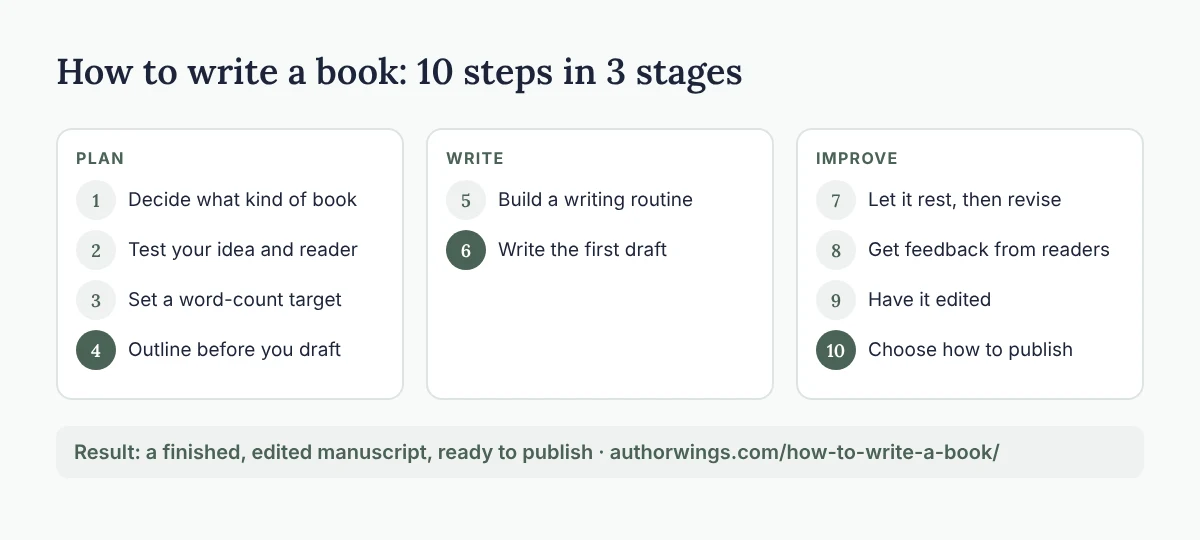
To write a book, decide what kind of book it is and who it’s for, set a word-count target, and outline the chapters. Then write a little on a fixed schedule until the first draft is done. Rest, revise, get feedback, and have it edited. A first book usually takes several months.
This guide is for first-time authors writing any kind of book: a novel, a non-fiction book, a memoir, or a children’s book. It walks through the 10 steps in order, with word counts, a sample outline, real editing prices, and a free template you can download without signing up.
Before you start: what you need and the words you’ll hear
You need three things to write a book: a place to type, a set time to write, and a clear idea of what the book is for.
A free word processor such as Google Docs or Microsoft Word is enough for a whole book. Save a copy somewhere other than your computer, such as a cloud folder, every time you write. Fancy writing software can wait until you know what you need.
Publishing uses a few terms that can confuse new authors. Here they are in plain English.
- Manuscript
- Your book before it’s published. Once it’s published, it’s a book.
- First draft
- The first complete version, start to finish. It’s meant to be rough.
- Beta reader
- A reader who tries your draft before publication and tells you how it felt. Also called a test reader.
- Developmental edit
- An edit of the big picture: structure, pacing, characters, or argument.
- Line edit and copy edit
- A line edit improves your sentences. A copy edit fixes grammar, spelling, and consistency.
- Proofread
- The last check for typos, done on the final text just before publishing.
Step 1: Decide what kind of book you’re writing
Start by naming your book’s category, because each kind of book follows different rules for length, structure, and readers.
If you aren’t sure, ask yourself where your book would sit in a bookstore. That shelf is your category.
Novel or other fiction
Story, characters, and a plot that builds to a climax. See fiction vs non-fiction below.
Non-fiction
A promise to the reader, such as a skill, an answer, or an argument, delivered chapter by chapter.
Memoir
One true story built around a turning point. Our guide shows how to write a memoir step by step.
Children’s book
Age decides everything, from word count to pictures. Read how to write a children’s book.
Writing your whole life story for your family is different from a memoir. Our guide on how to write a book about your life covers that.
Narrow it down to a genre
Once you know the category, go one level further. Fiction splits into genres such as mystery, romance, fantasy, science fiction, thriller, and literary fiction. Non-fiction splits into types such as self-help, business, how-to, history, and health.
Your genre tells you what readers expect before they open the book. A mystery reader expects a crime and a solution. A self-help reader expects a clear method and a result. Meet those expectations first, then surprise readers inside them.
Mistake to avoid: mixing two kinds of book without choosing which one leads. Half memoir and half self-help can work, but only if you decide which one is the frame and which one supports it.
Step 2: Test your idea and name your reader
A book idea is ready when you can say in one sentence who the book is for and what it gives them.
Where good book ideas come from
- What you know. Your work, your skills, or a subject people ask you about.
- What you’ve lived. An experience that changed you or that others are going through now.
- Questions you keep hearing. If friends, clients, or readers ask you the same thing, a book can answer it.
- A story you can’t stop thinking about. A character, a place, or a “what if” that keeps coming back.
You don’t need a completely original idea. Readers buy familiar topics told from a fresh angle, by a voice they trust.
Write your one-sentence promise
Try this sentence: “My book is a ___ (kind of book) for ___ (reader) who want ___. By the end, they will ___.”
Example: “My book is a practical guide for new beekeepers who want healthy hives in their first year. By the end, they will know what to do each month.”
Then run three quick checks:
- Readers exist. Find three recent books like yours in an online bookstore. If similar books sell, readers want the topic.
- Your angle is clear. Write down what your book does that those three don’t.
- You can sustain it. List 10 to 15 chapter ideas. If you can’t, the idea may suit an article better than a book.
Picture one reader
Write a short note about the person you’re writing for: their age, their situation, what they already know, and what they want. Every time you’re unsure whether something belongs in the book, ask whether that reader needs it.
Give the book a working title now. It keeps you focused, and you can change it later. Our free book title generator can help you brainstorm one.
Mistake to avoid: waiting for the perfect idea before you start. Test a good idea with the three checks, then commit to it for the length of one draft.
Step 3: Set a word-count target
Pick a target length from the typical range for your kind of book, because length decides how long you’ll write and what editing will cost.
| Kind of book | Typical length | Notes |
|---|---|---|
| Board book | 100 to 200 words | Ages 0 to 3, usually 12 to 24 printed pages on 6 to 12 board leaves |
| Picture book | 400 to 800 words | Ages 3 to 7, usually 32 pages |
| Early reader | 1,000 to 2,500 words | Ages 5 to 8 |
| Chapter book | 5,000 to 12,000 words | Ages 7 to 10 |
| Middle grade | 25,000 to 50,000 words | Ages 8 to 12 |
| Young adult | 50,000 to 90,000 words | Ages 12 to 18 |
| Short non-fiction guide | 15,000 to 30,000 words | A focused guide or first business book |
| Non-fiction book | 40,000 to 70,000 words | Business, self-help, and how-to often fall here |
| Memoir | 60,000 to 80,000 words | One story from your life |
| Novel | 70,000 to 90,000 words | Debut adult fiction |
Typical ranges as of October 2026, based on published guidance from editors, agents, and publishers. Ranges vary by genre and publisher.
How to choose your number
For a first book, aim for the middle of your range. If you plan to approach agents, a debut far above the range is harder to sell, because it costs more to edit and print.
A first book doesn’t need to be long. A finished 30,000-word book helps readers more than an unfinished 90,000-word one. One printed page holds roughly 250 to 300 words, so 60,000 words makes a book of about 200 to 240 pages.
Once you have a total, divide it by your number of chapters. A 60,000-word book with 20 chapters gives you a target of about 3,000 words a chapter, which is easier to aim for than the whole book.
Mistake to avoid: padding chapters to hit a number. The target is a guide. If the book says everything it needs to at 52,000 words, it’s done.
Step 4: Outline before you draft
An outline is a list of your chapters with one line about what happens or what the reader learns in each. It keeps you from stalling in the middle.
Your outline doesn’t need to be detailed. Start with the beginning, the middle, and the end, then fill in the chapters between them. There’s no set number of chapters. Your material decides it.
A non-fiction outline example
Sample outline: The First-Year Hive, an invented non-fiction book
Promise: a new beekeeper keeps a healthy hive through its first year.
- Why your first year decides everything (the problem)
- Choosing a hive and a spot for it
- Getting your bees home safely
- Spring: the first inspections
- Summer: space, swarms, and water
- Autumn: honey, and what to leave for the bees
- Winter: keeping the colony alive
- Your year-two plan (the result)
A novel outline example
A novel outline follows the story’s turning points. Five are enough to start.
| Story point | Ten Days in Kestrel Bay, an invented mystery |
|---|---|
| Setup | A ferry captain returns to her island town for her father’s funeral. |
| Inciting incident | She finds his logbook, with the last ten days torn out. |
| Rising stakes | Each person she asks lies about where they were, and someone wrecks her boat. |
| Climax | A storm traps her on the water with the one person who knows the truth. |
| Resolution | She learns why her father hid the pages, and decides whether to stay. |
Plotter or discovery writer?
Some writers plan every chapter before drafting. Others, often called discovery writers, find the story as they write. Both finish books. If you’re a discovery writer, still write down your ending and two or three key moments, so you know where you’re heading when the middle gets hard.
Expect your outline to change as you write. Treat it as a map you can redraw.
Mistake to avoid: outlining forever. When every chapter has one clear line, start writing. More planning won’t replace a draft.
Step 5: Build a writing routine you can keep
Books get finished through small, regular sessions, so set a daily word target you can hit even on a busy day.
Find your time and place
Choose a time and protect it the way you’d protect a meeting. Early mornings, lunch breaks, and the hour after the kids are in bed all work. What matters is that it’s the same time most days, so writing becomes a habit rather than a decision.
Write in the same place when you can, and remove the easiest distractions: put your phone in another room, turn off notifications, and keep one document open.
Pick a pace
| Words a day | Writing days | At 5 days a week |
|---|---|---|
| 250 (about one page) | 320 days | 64 weeks, about 15 months |
| 500 | 160 days | 32 weeks, about 7 months |
| 1,000 | 80 days | 16 weeks, about 4 months |
Worked example for an 80,000-word first draft. Revision and editing come after these dates.
Track your words
Write your word count down after every session, in a notebook or the tracker in our free template. Seeing the total grow is a good reason to keep going. If a blank page freezes you, try a timed sprint: set a timer for 25 minutes and write without stopping until it rings.
Missing a day is normal. Missing a week is when drafts stall, so restart with a smaller target.
If you want someone to keep you on schedule, a book coach reads your pages as you write, sets deadlines, and helps you fix problems before the draft is done.
Mistake to avoid: waiting for long, free days to write, because they rarely come. Twenty focused minutes most days beats one lost Saturday a month.
Step 6: Write the first draft without editing
Write the whole first draft before you fix anything, because editing as you go can stop a first book from ever getting finished.
The goal of a first draft is to get the whole book down. If you don’t know a fact or a name, type [TK] (an editor’s mark for “to come”) and keep going. Write chapters out of order if one is calling to you. Keep a separate notes file for ideas that belong elsewhere.
How to start writing your first chapter
Open close to the moment something changes. In fiction, that’s the day your main character’s normal life is disturbed. In non-fiction, it’s the reader’s problem, shown in a short example they’ll recognize. Background can come later, in small doses, once the reader cares.
Don’t try to write the perfect opening now. Many writers rewrite their first chapter last, once they know how the book ends. Write a rough version and move on to chapter two.
Stuck? Five ways to get moving
- Lower the target. Write 100 words today. Starting is the hard part.
- Skip ahead. Write a scene or chapter you’re excited about.
- Talk it out. Record yourself explaining the chapter, then type it up.
- Go back to the outline. Being stuck often means the next chapter isn’t clear yet.
- Tell someone your deadline. A friend, a writing group, or a coach who checks in keeps you honest.
Getting through the middle
Many writers lose energy somewhere past the halfway point, when the excitement of starting has faded and the end still feels far away. Expect it. Reread your one-sentence promise, look at your word tracker to see how far you’ve come, and write the next chapter in your outline as well as you can today.
Mistake to avoid: stopping to research mid-sentence. Type [TK], keep writing, and look things up in one batch at the end of the session.
Step 7: Let it rest, then revise
Put the finished draft away for two to four weeks, then revise from the biggest problems down to the smallest.
Time away lets you read the draft like a stranger would. When you come back, read it in as few sittings as you can and take notes, without fixing anything. Then revise in this order:
- Structure. Does every chapter serve the book’s promise or story? Cut, merge, or move chapters.
- Chapters and scenes. Does each one start late, end strong, and move things forward?
- Sentences. Only now, smooth the wording. Polishing a chapter you later cut wastes hours.
A self-editing checklist
- Cut anything you’ve said twice.
- Give every chapter one clear purpose you can name in a sentence.
- Fill every [TK] and check every fact, date, and name.
- Search for filler words such as “just,” “really,” and “very,” and cut most of them.
- Read the key chapters aloud. Where you stumble, the reader will too.
- Keep names, spellings, and terms the same from start to finish.
Many authors do two or three rounds of revision before anyone else reads the book.
Mistake to avoid: deleting what you cut. Move cut scenes and sections to a separate file. You may want a line or an idea from them later.
Step 8: Get feedback from beta readers
Give your revised draft to three to five people who read books like yours, and ask them specific questions.
Where to find beta readers
Friends and family are kind, which makes them weak critics. Look for readers of your genre in local or online writing groups, book clubs, reader communities, or a paid service. Swapping manuscripts with another writer works well too: you read theirs, they read yours.
Five questions to ask every reader
- Where did you lose interest or skim?
- What confused you?
- Which part did you like most, and why?
- Did the ending (or the last chapter) feel worth the read?
- What would you tell a friend this book is about?
How to use what they tell you
Read all the feedback, then wait a day before you change anything. Look for patterns. If one reader dislikes something, note it. If three readers say the same thing, fix it. Readers are good at telling you where a problem is and less reliable at telling you how to fix it, so the fix is your call.
AuthorWings can recruit genre readers for you: test readers cost $599 for 5 readers or $849 for 8, with one summary of their answers.
Mistake to avoid: asking “Did you like it?” Many people will say yes. Specific questions get useful answers.
Step 9: Have it professionally edited, in the right order
Professional editing happens in four levels, from the big picture down to typos, and you buy them in this order, skipping any your book doesn’t need.
Self-editing comes first, always. A professional editor then sees what you can’t: the gap in your argument, the character whose choices don’t add up, the error you’ve read past ten times. Here’s the order, with AuthorWings prices as an example of what each costs.
- Developmental editStructure, pacing, characters or argument. $330 up to 10,000 words, then $0.033 a word (fiction). An 80,000-word novel: $2,640.
- Line editClarity, flow, and voice, sentence by sentence. $310 up to 10,000 words, then $0.031 a word. 80,000 words: $2,480.
- Copy editGrammar, spelling, punctuation, and consistency. $240 up to 10,000 words, then $0.024 a word. 80,000 words: $1,920.
- ProofreadA final typo check on the finished text. $160 up to 10,000 words, then $0.016 a word. 80,000 words: $1,280.
AuthorWings prices as of October 2026. Above 10,000 words, the per-word rate applies to the whole manuscript.
A strong draft may only need a copy edit and a proofread. If you’re unsure, an editorial assessment ($180 up to 10,000 words) gives you a written report on what your manuscript needs before you buy a full edit. Compare every level on our book editing services page, with rates for fiction, nonfiction and memoir.
How to choose an editor
- Genre experience. Ask what books like yours they’ve edited.
- A sample edit. A few edited pages show you how they work before you commit.
- A written scope and price. You should know which level of edit you’re buying, the total, and the delivery date before work starts.
Mistake to avoid: buying a proofread before the structure is fixed. Big changes bring new typos, so you’d pay to proofread twice.
Step 10: Choose how to publish
You can query literary agents for a traditional publishing deal, or self-publish and keep control of the book and its rights.
Traditional publishers pay for editing, design, and printing, and pay you royalties, but getting an agent can take months or years. Self-publishing is faster, and you keep more of each sale, but you pay for editing, design, and setup yourself. For non-fiction, many traditional publishers buy the book from a proposal before it’s fully written.
Whichever route you choose, a finished book needs more than the text: a cover that fits its genre, an interior laid out for print and ebook, and a book description that tells readers why to buy it. Self-published authors arrange these themselves. AuthorWings offers book cover design and book formatting when you reach that stage.
Compare the money and timelines in self-publishing vs traditional publishing, then follow our guide on how to get a book published for each route, step by step.
Writing fiction vs non-fiction: what changes
The 10 steps are the same for both, but fiction runs on story and non-fiction runs on a promise to the reader.
Four basics of writing fiction
- A character who wants something. Give your main character a clear goal by the end of the first chapters, and a reason it matters to them.
- Something in the way. Conflict drives the story. Each chapter should make the goal harder to reach or change what it costs.
- One point of view at a time. Choose whose eyes the reader sees through, and stay there within a scene.
- Scenes for key moments. Show key moments as they happen, with action and dialogue, instead of reporting them afterward.
Four basics of writing non-fiction
- A clear promise. State in the introduction what the reader will know or be able to do by the end.
- A logical order. Arrange chapters so each one builds on the last, from problem to method to result.
- Examples and stories. Explain each idea, then show it with a real or clearly invented example.
- Checked facts. Keep a source list as you write, and check every number, date, and quote before you send the book out.
One difference matters when you look for a publisher: traditional publishers usually want a finished novel, but often buy non-fiction from a proposal and sample chapters. For help built around your genre, see our fiction and non-fiction writing services.
How to write a book with no experience: where to start
Yes, you can write a book with no experience. Every published author once wrote a first book.
Experience helps, but finishing matters more, and finishing is a habit you can build. If you want to write a book and don’t know where to start, do this in your first week:
- Read like a writer. Pick three books like the one you want to write and notice how they open, how long the chapters are, and how they end.
- Write your one-sentence promise from Step 2.
- List your chapters, even roughly.
- Write 500 words of any chapter. Not the first one, if that feels too heavy.
- Book a weekly writing time in your calendar for the next month.
Should you write a book at all? If you have a story or knowledge that readers want and you can give it a few hours a week, yes. If you have the story but not the time, you can still get it on paper with help (see getting help below).
Protecting your work while you write
Your writing is protected by copyright as soon as you write it down, so you don’t need to register anything before you share a draft.
The US Copyright Office says a work is protected “the moment it is created and fixed in a tangible form.” Registration is optional, but in the US you must register before you can sue someone for copying your book. Many authors register when they publish. AuthorWings can file it for you with our copyright registration add-on.
Keep dated backups of every draft, and share full manuscripts only with readers and professionals you trust.
Copyright Office guidance checked October 2026. This is general information, not legal advice.
Free book writing template
Our free book writing template walks you through Steps 2 to 8 on paper, and you can download it without signing up.
What’s inside (7 pages)
- Your one-sentence book promise and reader profile
- A word-count target and pace planner
- A 24-row chapter outline grid
- A weekly word tracker
- A revision checklist and five questions for beta readers
Writing a children’s book? Use our free children’s book template instead, which is laid out by page and spread.
Write it yourself, with a coach, or with a ghostwriter
The right choice depends on your time, your budget, and how much of the writing you want to do yourself.
| Write it yourself | With a book coach | With a ghostwriter | |
|---|---|---|---|
| Who writes | You | You | A professional writer, in your voice |
| Best for | You have time, patience, and a steady routine | You want deadlines, feedback, and an expert reading your pages | You have the story or expertise but little time |
| Your time | Many hours a week | Many hours a week, plus calls | Interviews and chapter reviews |
| Cost | $0 to write, plus editing | From $849, or a $399 trial session | From $6,600 (fiction, 20,000 words) |
About writer selection: Standard pricing assigns the best available writer for your genre. Named Specialists, including professionals with bestselling titles to their name, work to their own schedules, so their pricing and start dates are confirmed on your consultation call.
Finish your book with a coach
From $849
A coach reads your pages every two weeks, sets your next deadline, and answers questions between calls. Not sure yet? Try one session for $399.
See book coachingGet your draft edited
From $160
All four editing levels, from developmental edit to proofread, priced by word count.
See editing servicesHave it written for you
From $6,600
Talk through your book in interviews, and a professional writer drafts it in your voice.
See ghostwriting packagesPrices as of October 2026. Flexible, milestone-based payments, set out in your agreement before work starts.
How to write a book: FAQs
Can AI write a book?
AI tools can produce text, but a book written by AI comes with limits. As of October 2026, Amazon KDP requires you to declare AI-generated text, images, or translations when you publish. The US Copyright Office says purely AI-generated material can’t be copyrighted, so only the parts you wrote yourself are protected. At AuthorWings, people write and edit every client book, as our AI policy explains.
How many words is a book?
It depends on the kind of book. A picture book runs 400 to 800 words, many non-fiction books run 40,000 to 70,000 words, and a debut novel usually runs 70,000 to 90,000 words. Pick a target from the range for your category, then write to that. The word-count table in Step 3 lists every common type.
Can I write a book with no experience?
Yes. Much of what makes a book work can be learned while you write it: a clear idea, an outline, a steady routine, and honest feedback. Start with a one-sentence promise, a rough chapter list, and 500 words a session. Feedback from beta readers or a book coach fills in what experience would have taught you.
How much does it cost to write a book?
Writing a book yourself costs nothing but time. The real costs come after the draft: editing, test readers, cover design, and publishing. At AuthorWings, a copy edit starts at $240 for up to 10,000 words and test readers cost $599 for 5 readers. Coaching starts at $849, or $399 for a single trial session, and ghostwriting starts at $6,600 for a 20,000-word novel.
Is writing fiction different from writing non-fiction?
The steps are the same: plan, draft, revise, and edit. Fiction is built on a character, a goal, and rising tension. Non-fiction is built on a promise to the reader, delivered chapter by chapter with facts and examples. Traditional publishers usually want a finished novel, but often buy non-fiction from a proposal and sample chapters.
