Home / Guides / Children's Books
How to Become a Children’s Book Illustrator: Skills, Pay and Clients
 By AuthorWings editorial team
9 min read
By AuthorWings editorial team
9 min read
Short answer
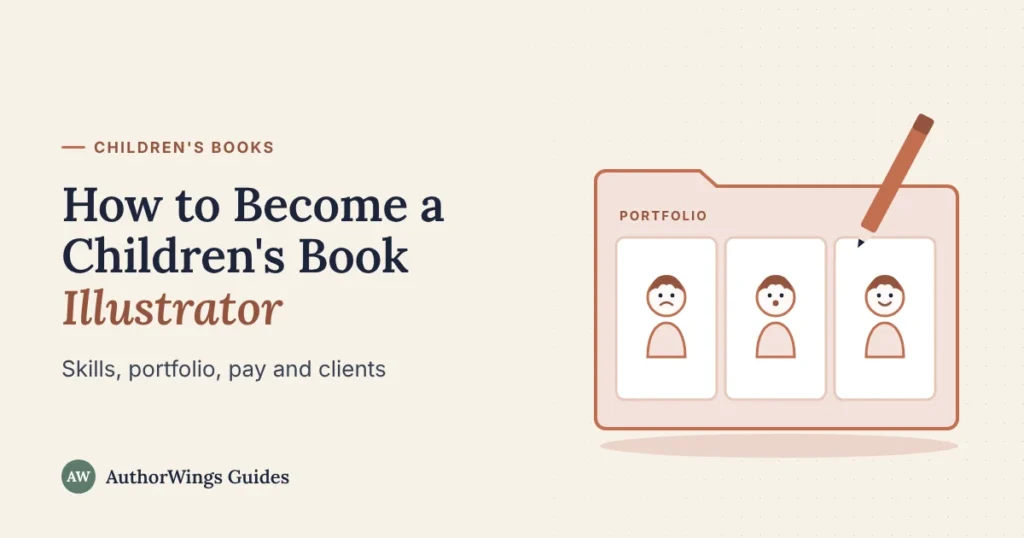
To become a children’s book illustrator, you don’t need a degree. You need a consistent style, strong drawings of children and a focused portfolio of about 10 to 20 pieces that shows one character across several scenes. Then you find work through three routes: publishers (directly or through an agent), self-publishing authors, and specialist networks.
Children’s book illustration is usually freelance work. Publishers, agents and authors decide on your portfolio, so the portfolio is the job application. This guide covers the skills, the portfolio, the three ways in, what the work pays (with sources), and what to check before you sign. If you have 3+ years of professional experience and published or print-ready work, you can also join our specialist network and get matched with authors.
Drawing comics instead? See how to become a comic book artist.
What a children’s book illustrator does
A children’s book illustrator draws the pictures that carry a story alongside the words. The work changes with the age of the reader:
- Board books for babies and toddlers: bold shapes, high contrast, one idea per page. See what a board book is.
- Picture books for about ages 3 to 7: full-color spreads that tell half the story, sometimes all of it, as in wordless picture books.
- Chapter books for about ages 7 to 10: spot art and chapter openers, often in black and white. See what a chapter book is.
- Covers for every age, including middle grade and young adult novels with little or no interior art.
Some illustrators focus on one or two of these, because each asks for a different kind of portfolio.
Skills you need
The core skill is drawing the same character, the same way, in many situations. Beyond that, children’s book work asks for:
- Children who look and move like children. Figure drawing of kids, from toddlers to ten-year-olds, comes up in almost every brief.
- Storytelling across pages. A picture book is read one page turn at a time, so each spread has to move the story and leave room for the next.
- Space for words. Text sits on the art or beside it, so compositions need quiet areas the designer can use.
- A consistent style. Publishers and authors hire a look they can predict for 32 pages. Our page on children’s book illustration styles shows the range authors ask for.
- Print-ready files. 300 DPI at print size, bleed on edges that reach the trim, and layers kept separate for changes.
For the full process of illustrating a book, from character sheet to print files, see our guide on how to illustrate a children’s book.
Build a children’s book portfolio
Your portfolio is the first thing anyone hiring you will see. Keep it focused: SCBWI’s portfolio showcase asks for 10 to 15 images, and a website portfolio can hold a few more. Every piece should be at the level you want to be hired for.
Portfolio checklist
10 things a picture book portfolio should show
- About 10 to 20 of your best piecesAll in the style you want to be hired for
- One character in at least three scenesWith different emotions, to prove consistency
- Children of different ages, in motionFrom toddlers to ten-year-olds
- Three or four spreads from one storyTo show how you handle page turns
- A double-page spread with room for textClear, quiet space the designer can use
- A cover with room for the titleReadable at thumbnail size
- Black-and-white spot art or a chapter openerIf you want chapter book work
- Thumbnails or a rough dummyTo show how you plan a whole book
- A varied cast of charactersDifferent children, families and places
- Files ready at 300 DPI at print sizeWith bleed and separate layers
Leave out anything you don’t want to be asked to draw again. One clear style with a story behind it shows more than many styles with none.
Three ways to find work
Children’s book illustrators usually find paid work through one of three routes. Each one pays differently and treats the rights differently.
| Route | Who hires you | How you’re usually paid | Who usually owns the art |
|---|---|---|---|
| Trade publishers | An art director or editor, sometimes through an agent | An advance against royalties; picture book royalties are often split with the author | Often you keep the copyright and license rights to the publisher, but some contracts assign it. Check the contract |
| Self-publishing authors | The author directly, or through a marketplace | A flat fee per illustration or per book | Authors often ask for a written copyright transfer; agree it in the contract |
| Specialist networks and agencies | The network, which matches you with authors | A project fee agreed before work starts | Set out in the agreement |
Publishers and agents. Publishers choose the illustrator for a book, so they find you through your portfolio, an agent, a portfolio review or a mailing. An agent can open doors and handle contracts; some illustrators work without one. The Society of Children’s Book Writers and Illustrators (SCBWI) runs portfolio showcases and events where publishing professionals, including art directors, see work.
Self-publishing authors. Self-published picture books need illustrators too, and authors find them online, through marketplaces and through services. These jobs can start faster than trade work, but you deal with the client, the brief and the payment terms yourself. Authors who hire through a service usually expect a character sheet, a sample spread and set revision rounds, like the full-book picture book packages on our illustration page.
Specialist networks. A network like ours brings you the projects and manages the client. At AuthorWings, specialists are independent professionals: we manage the contract, the client, and every handoff, and you’re matched with authors in your genre.
How much children’s book illustrators earn
Pay depends on the route more than anything else, and there’s no official US rate card for children’s book art (the Graphic Artists Guild Handbook gives pricing guidance). Here’s how each route pays.
| Route | How the pay works |
|---|---|
| Trade publishers | An advance against royalties, paid in stages. Picture book royalties are typically split equally between the author and the illustrator |
| Self-publishing authors | A flat fee per illustration or per book, agreed before work starts, with any copyright transfer priced in |
| Specialist networks | A project fee agreed upfront, with the network handling the client and the contract |
For a sense of yearly income, the US Bureau of Labor Statistics reports a median of $55,490 for fine artists, including illustrators (May 2025). The BLS also reports that about 58% of craft and fine artists are self-employed, so income varies widely with how much work they take on. Use these as a sense of scale, not a promise of income.
What to check before you sign
Read every agreement before you start drawing. Four things matter most for illustrators:
- The fee and the schedule. A flat fee or an advance, and when each part is paid. Payments tied to stages (sketches, finals) protect both sides.
- Who owns the copyright. Under US law, a commissioned illustration can be a “work made for hire” only if it falls into a listed category, such as a supplementary work, and both sides sign a written agreement that says so (US Copyright Office, Circular 30). Otherwise you own the copyright unless you transfer it in writing (17 U.S.C. 204). Price a full transfer accordingly.
- Revisions. How many rounds are included at sketch and color stage, and what extra rounds cost.
- Credit and samples. Whether your name goes on the cover and whether you can show the work in your portfolio.
For how authors see the same questions, our illustration page compares who owns the artwork across different ways of hiring. Clients may also ask whether you use AI; see what KDP, publishers and copyright allow for AI art.
When to get help
Finding clients takes time that could go into drawing. If you have at least three years of professional experience and a portfolio of published or print-ready illustrations, a specialist network can do the client side for you.
Careers at AuthorWings
Illustrate books without chasing clients
Join our specialist network as an independent book illustrator. We manage the contract, the client, and every handoff, and you focus on the art. Fully remote, free to apply, and we reply within five business days.
- 3+ years of professional experience
- Portfolio of published or print-ready illustrations
- Remote work, open to illustrators worldwide
Frequently asked questions
Do you need a degree to be a children’s book illustrator?
No. Publishers and authors hire on the strength of your portfolio. A degree in illustration can help you learn faster and build contacts, and the US Bureau of Labor Statistics says a bachelor’s degree is common for craft and fine artists. You can also learn through courses, critique groups and practice.
Do you need an agent to illustrate children’s books?
Not always. An agent can introduce you to publishers and handle contracts, which helps with trade work. Some illustrators find publishers directly through portfolio reviews and mailings, and work with self-publishing authors needs no agent at all. If you want trade work later, it can be easier to find an agent once you have a strong portfolio and some published books.
Can you illustrate children’s books digitally?
Yes. Publishers and printers work from digital files either way, and the US Bureau of Labor Statistics notes that illustrators increasingly use computers. Some illustrators paint by hand and scan, others work fully digitally. What matters is a consistent style and print-ready files: 300 DPI at the final size, with bleed and separate layers.
How long does it take to illustrate a picture book?
It depends on your style and the number of spreads, so time yourself. Finish one spread from sketch to final color, then multiply by the number of spreads plus the cover, and add time for changes. Our guide on how to illustrate a children’s book walks through this with a worked example.
Related reading
- How to illustrate a children’s book: from character sheet to print files
- How to become a comic book artist: skills, portfolio and page rates
- Can you illustrate a children’s book with AI?: what KDP, publishers and copyright allow
AuthorWings editorial team
The AuthorWings editorial team writes and updates our guides for first-time authors. Every post is read and edited by a person on our team before it is published.