Home / Guides / Publishing
ISBN-10 vs ISBN-13: Differences and How to Convert
 By AuthorWings editorial team
Updated
6 min read
Short answer
ISBN-13 replaced ISBN-10 on 1 January 2007, and agencies now issue only 13-digit ISBNs. Every ISBN-13 starting 978 has a matching ISBN-10: the same nine middle digits, without 978, and a different check digit. ISBN-13s starting 979 have no 10-digit form. Use the ISBN-13 on your book and everywhere you list it.
If you’re publishing now, the ISBN you get will have 13 digits, so this guide matters mostly when you meet an older 10-digit number. It shows how the two formats differ and how to convert between them. For what each part of the number means, see our guide to what an ISBN is, and if you’d like your ISBN handled for you, we can get your ISBN registered in your name.
Why ISBNs went from 10 to 13 digits
The ISBN system needed more capacity as the number of publishers and books grew. The revised ISO standard, ISO 2108:2005, extended the ISBN to 13 digits, and since 1 January 2007 national agencies have issued only 13-digit ISBNs. The 13-digit form is also the number the EAN-13 barcode on a book carries.
The change added a 978 prefix in front of each old number and recalculated the check digit, so existing ISBN-10s became 978 ISBN-13s, and the 979 prefix opened a new range of numbers. In November 2019 the International ISBN Agency announced that the US ISBN agency, run by Bowker, would start assigning 979 ISBNs in early 2020 to increase the supply of some ISBN block sizes.
ISBN-10 vs ISBN-13 side by side
| ISBN-10 | ISBN-13 | |
|---|---|---|
| Length | 10 digits | 13 digits |
| Used for | Books numbered before 2007, and as an older form of any 978 ISBN | Every ISBN issued since 1 January 2007 |
| Prefix | None | 978 or 979 |
| Example | 92-95055-12-8 | 978-92-95055-12-4 |
| Check digit method | Modulus 11, weights 10 down to 2 | Modulus 10, weights 1 and 3 |
| Can the last character be X? | Yes, X stands for 10 | No, digits only |
| Matches the barcode number | No | Yes, the EAN-13 barcode carries the ISBN-13 |
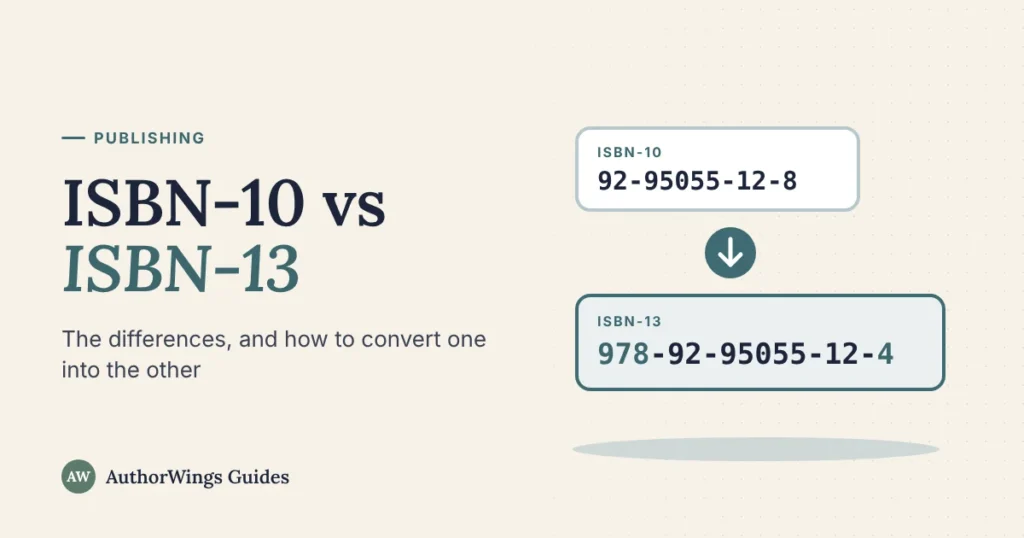
The example is the ISBN of the ISBN Users’ Manual, 978-92-95055-12-4, and the 10-digit form you get by converting it (the manual, from 2017, was only ever given the 13-digit number). The middle digits, 92-95055-12, are the same in each; only the prefix and the check digit change.
How to convert an ISBN-10 to an ISBN-13
Every ISBN-10 has a matching ISBN-13 starting 978. To find it:
- Drop the last character of the ISBN-10 (its check digit). 92-95055-12-8 becomes 929505512.
- Put 978 in front. That gives 978929505512.
- Work out the new check digit. Multiply the 12 digits by 1, 3, 1, 3 and so on, starting with 1, and add them up: the total is 126. Subtract the last digit of the total (6) from 10, so the check digit is 4. If the total ends in 0, the check digit is 0.
The result is 978-92-95055-12-4. The last digit usually changes, because the two formats calculate their check digits differently, so you can’t just add 978 in front. For real use, the ISBN Users’ Manual advises publishers not to calculate check digits by hand, so use a converter like the one below and check the result against your agency’s records.
Free tool
ISBN-10 and ISBN-13 converter
Type an ISBN-10 or ISBN-13, with or without hyphens or spaces. It checks the number and shows the other form.
Valid means the number is correctly formed. It doesn’t show whether the ISBN has been assigned to a book. Results are shown without hyphens, because where they go depends on the publisher’s number range.
Converting an ISBN-13 back to ISBN-10
Only ISBN-13s that start 978 can be turned back into ISBN-10s.
- Drop the 978 and the last digit. 978-92-95055-12-4 becomes 929505512.
- Multiply the 9 digits by 10, 9, 8 and so on down to 2, and add them up. Here that’s 9×10 + 2×9 + 9×8 + 5×7 + 0×6 + 5×5 + 5×4 + 1×3 + 2×2 = 267.
- Find the check digit: divide by 11 and subtract the remainder from 11. 267 divided by 11 leaves 3, and 11 minus 3 is 8. If the answer is 10, the check digit is X; if it’s 11, the check digit is 0. For example, 978-0-8044-2957-3 becomes 0-8044-2957-X.
The result is 92-95055-12-8. A 979 ISBN-13 has no 10-digit form, so there’s nothing to convert.
Which one should authors use?
Use the ISBN-13. The International ISBN Agency says old 10-digit ISBNs “should no longer be quoted.” The ISBN you buy or get free from a platform today is a 13-digit number, and it’s the one that goes on your copyright page, in your barcode and in your listings. Our guide to free ISBNs by platform shows which services give you one.
You’ll still meet ISBN-10s on books published before 2007 and in some older catalogs and listings. They identify the same book as the matching 978 ISBN-13, so convert them rather than treating them as a second number.
When to get help
An ISBN takes a few minutes to buy, but the details have to match on every platform. Our Online Stores tier ($549) can use Amazon’s free ISBN or your own, and the Global tier ($999) registers your own ISBN for every format. To do it yourself, follow our self-publishing steps.
Publishing add-on
Want your ISBN set up in your name?
We register it with your country’s agency and enter it on every platform, so you’re listed as the publisher.
- Your own ISBN, $30 plus the agency fee, on the Amazon tier
- Global, $999: your own ISBN for every format included
ISBN-10 and ISBN-13 questions
Is an ISBN-10 still valid?
An ISBN-10 still identifies the book it was given to, but agencies stopped issuing them on 1 January 2007, and the International ISBN Agency says they should no longer be quoted. Every ISBN-10 has a matching ISBN-13 starting 978, which you can work out by adding 978 to the first nine digits and recalculating the check digit.
Why do some books show both numbers?
Books numbered before 2007 had an ISBN-10, and when the system moved to 13 digits, each one gained a matching 978 ISBN-13. Between 2005 and 2007, publishers were encouraged to supply both forms during the changeover, and some books, catalogs and listings still show both. They are the same ISBN written two ways, not two different numbers.
Why does an ISBN-10 end in X?
The ISBN-10 check digit is worked out with modulus 11, so it can come out as 10. Because only one character fits, 10 is written as X. ISBN-13s use modulus 10, so their check digit is always 0 to 9 and never X.
Do I need to buy an ISBN-10 as well?
No. Agencies only issue 13-digit ISBNs now, and one ISBN-13 is all you need for each format of your book. If it starts with 978, it also has a 10-digit form you can work out, but you don’t buy or register that separately. See whether Amazon needs an ISBN for the Amazon rules.
Related reading: What is an ISBN? · ASIN vs ISBN · Self-publishing platforms compared · How to self-publish a book
AuthorWings editorial team
The AuthorWings editorial team writes and updates our guides for first-time authors. Every post is read and edited by a person on our team before it is published.