Home / Guides / Publishing
ISBN Meaning: What an ISBN Is and When You Need a New One
 By AuthorWings editorial team
Updated
8 min read
Short answer
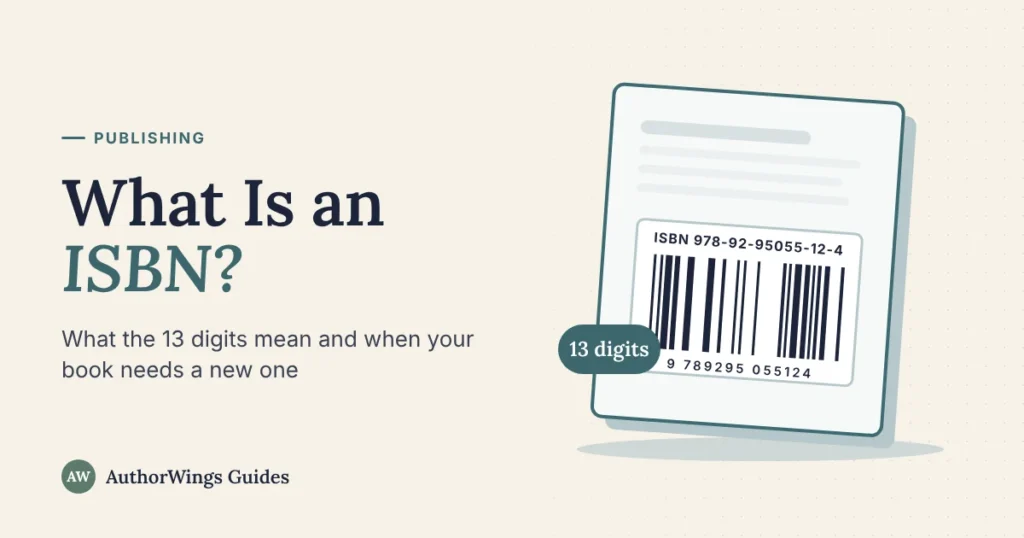
ISBN stands for International Standard Book Number. It’s a 13-digit number that identifies one edition of a book in one format, such as the paperback or the ebook. Stores, libraries and distributors use it to order the right version. An ISBN doesn’t give you copyright, and each format that has one needs its own number.
If you’re self-publishing, you’ll meet ISBNs when you set up your print book. This guide explains what each digit means, who issues them, and the changes that need a new number. Our ISBN service can register one in your name.
What an ISBN does, and what it doesn’t
An ISBN is an ID, not a right. It tells the book trade exactly which product you mean: this title, this edition, this format, from this publisher.
- It identifies: one edition in one format. The paperback and the hardcover of the same book have different ISBNs.
- It’s used for: ordering, stock and sales records. Shops scan it as a barcode, and many publishing and supply chain systems are built on it.
- It doesn’t protect your work: ISBN International says an ISBN gives no legal or copyright protection. Your copyright exists as soon as the book is written down.
- It doesn’t prove who owns the book: it records who published that edition. With a free KDP ISBN, for example, the imprint shows as “Independently published,” not your name.
The 13 digits, explained
Every ISBN issued since 1 January 2007 has 13 digits in five parts. Here’s the ISBN of the official ISBN Users’ Manual:
The five parts of an ISBN
978Prefix
92Group
95055Publisher
12Edition and format
4Check digit
| Part | In the example | What it means |
|---|---|---|
| Prefix | 978 | The prefix that lets the ISBN work as a barcode number. Every 13-digit ISBN currently starts 978 or 979 |
| Registration group | 92 | The country, region or language area. Up to 5 digits |
| Registrant | 95055 | The publisher or imprint. Up to 7 digits |
| Publication | 12 | This edition and format. Up to 6 digits |
| Check digit | 4 | Catches typing mistakes |
The middle three parts change length. A publisher expecting to publish many books gets a short registrant number and a long publication number, so it has room for more titles.
How the check digit works: multiply the first 12 digits by 1 and 3 in turn, add the results, and take the amount needed to reach the next multiple of 10. For the example, 9×1 + 7×3 + 8×1 + 9×3 + 2×1 + 9×3 + 5×1 + 0×3 + 5×1 + 5×3 + 1×1 + 2×3 = 126. The next multiple of 10 is 130, so the check digit is 4. If the total already ends in 0, the check digit is 0.
Free tool
Check an ISBN
Type an ISBN, with or without hyphens. The check runs in your browser and confirms the check digit.
Your result appears here.
A valid check digit means the number is typed correctly. It doesn’t show which book it belongs to or who owns it.
Who issues ISBNs
About 150 national and regional ISBN agencies issue them, according to the International ISBN Agency. You get yours from the agency where you, the publisher, are based, wherever your book is printed or sold.
| Where you’re based | Agency | Cost, as of October 2026 |
|---|---|---|
| United States | Bowker | $125 for one, $295 for ten |
| United Kingdom | Nielsen | £93 for one, £174 for ten (including VAT) |
| Canada | Library and Archives Canada (ISBN Canada) | Free for eligible publishers based in Canada, including self-publishing authors who live there (French-language publishers apply through BAnQ) |
| Australia | Thorpe-Bowker | Prices on the agency’s site |
A self-publishing author who gets an ISBN from their national agency is the publisher of record. You can publish under your own name or an imprint name you choose.
One ISBN for each format
Each format you sell separately needs its own ISBN. KDP says the same: each format, paperback vs hardcover, needs its own number.
| Format | Own ISBN? |
|---|---|
| Paperback | Yes |
| Hardcover | Yes, different from the paperback |
| Ebook | Optional on many platforms. If you assign one, it differs from the print ISBNs, and ebook files in different formats, such as EPUB and PDF, each get their own if they’re sold separately |
| Audiobook | Optional on many platforms. If you assign one, it differs from the others, and a downloadable audiobook is a different format from one on a CD |
A paperback, hardcover and ebook with your own ISBNs need three numbers. That’s where a block of ten can cost less than buying singles.
When you need a new ISBN, and when you don’t
You need a new ISBN when the book becomes a different product: a new title, edition, format or publisher. A new cover or price keeps the same number. These rules come from the ISBN Users’ Manual.
| Change | New ISBN? |
|---|---|
| New format (paperback to hardcover, PDF to EPUB) | Yes |
| New trim size (page dimensions) | Yes, though a small adjustment to fit a print-on-demand printer doesn’t need one |
| Significant changes to the text (a revised edition) | Yes |
| Fixing a few typos | No |
| New title | Yes |
| New subtitle | Usually, if the change is significant |
| New author name, such as a pen name | Yes |
| New publisher or imprint | Yes (for an imprint change alone, some agencies differ) |
| New language or translation | Yes |
| New cover design | No |
| New price | No |
| Unchanged reprint by the same publisher | No |
An ISBN is never reused. Once a number is assigned to a book, it stays with that edition, even after the book goes out of print.
Where the ISBN goes on your book
In a print book, the ISBN goes on the copyright page (or the foot of the title page if there’s no room) and on the lower part of the back cover, usually as an EAN-13 barcode with the ISBN printed above it. The manual asks for 9-point type or larger. On a jacketed hardcover it also goes on the back of the jacket. In an ebook, it goes on the title or copyright screen. Our copyright page template shows where it sits.
Get your ISBN before your files are final, because it goes into both the interior and the cover. On KDP, the ISBN, imprint and trim size can’t be changed after you publish; changing them means a new edition. Our guide to self-publishing a book shows where this fits in the steps.
Do you need an ISBN to self-publish?
For most paperbacks and hardcovers, yes: KDP requires one (low-content books such as journals are exempt), but it doesn’t have to be one you buy. KDP gives a free ISBN for print books that works only on KDP, and ebooks on Amazon don’t need one, because Amazon gives each ebook its own ID (an ASIN), which works only on Amazon. See whether Amazon needs an ISBN for the Amazon details, and free ISBNs by platform for the other services. Our guide to ASIN vs ISBN explains how the two differ.
When to get help
Buying an ISBN takes a few minutes. The decisions around it take longer: which formats, which imprint name, and making sure the details match on every platform, because KDP checks your imprint against the agency’s records and won’t publish if they don’t match.
Our Online Stores tier ($549) can use Amazon’s free ISBN or your own, and the Global tier ($999) registers your own for every format. On the Amazon tier, your own ISBN is a $30 add-on. You pay the agency fee directly, with no markup.
Publishing add-on
Want the ISBN set up in your name?
We register it with your country’s agency and enter it on every platform, so you’re listed as the publisher.
- Your own ISBN, $30 plus the agency fee, on the Amazon tier
- Global, $999: your own ISBN for every format included
ISBN questions authors ask
What does ISBN stand for?
ISBN stands for International Standard Book Number. It’s the 13-digit number that identifies one edition of a book in one format. Books published before 2007 used a 10-digit version. Every ISBN issued today has 13 digits, starts with 978 or 979 and ends with a check digit that catches typing mistakes.
Does an ISBN protect my copyright?
No. ISBN International says an ISBN gives no legal or copyright protection. It only identifies the book for the trade. In the US, your copyright exists as soon as you write the book down. Registering it with the US Copyright Office is a separate, voluntary step, and you need it before you can sue for infringement of a US work.
Can I reuse an ISBN or move it to another book?
Not to another book. An ISBN stays with the edition it was first assigned to, even after it goes out of print. An ISBN you bought stays with that edition on any platform. A free KDP ISBN works only on KDP, so the same book sold elsewhere needs its own ISBN, as our guide to moving a book to IngramSpark explains.
Does a new cover need a new ISBN?
No. The ISBN Users’ Manual says a change to the cover design or color, or to the price, doesn’t need a new ISBN. A new title, a new format, a new publisher or significant changes to the text do. Fixing a few typos keeps the same ISBN.
Related reading: How to self-publish a book · Self-publishing platforms compared · Amazon KDP vs IngramSpark
AuthorWings editorial team
The AuthorWings editorial team writes and updates our guides for first-time authors. Every post is read and edited by a person on our team before it is published.