Home / Guides / Publishing
What Is Print on Demand for Books? How It Works and Costs
 By AuthorWings editorial team
Updated
10 min read
Short answer
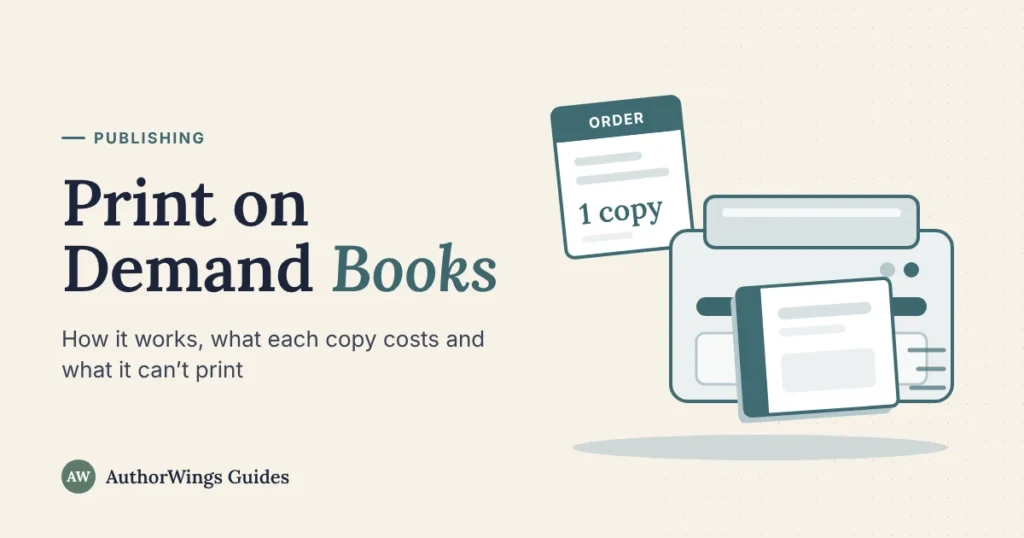
Print on demand (POD) means a book is printed, bound and shipped only after someone orders it. There’s no print run, no minimum order and no stock to store. The print cost comes out of each sale. A black-and-white 300-page paperback (6 x 9 inches) costs $4.60 to print on Amazon KDP’s US store, as of October 2026.
Amazon KDP (Amazon’s publishing platform) and IngramSpark are two widely used print-on-demand services, and both are free to join. This guide explains what happens after a reader clicks Buy, what each copy costs, what POD can’t print and how to check the quality. If you’d rather hand the setup over, our print on demand book publishing service checks and test-uploads your files for both.
How print on demand works, from order to doorstep
Your book waits as a file on the printer’s system until an order comes in. Then a digital press prints that one copy.
- You upload two files: a print-ready interior PDF and a cover, then check the digital preview and, ideally, a printed proof.
- A reader orders the book from a store, or you order copies for yourself.
- The printer prints the pages on a digital press. Digital presses need no printing plates, so printing a single copy is practical.
- The cover is printed and bound to the pages: glued for a paperback, cased for a hardcover.
- The book ships to the reader. The store keeps its share, the printer keeps the print cost and you’re paid the rest as your royalty.
One order, one copy
1. Order
A reader buys the book
2. Your files
Pulled from the printer’s system
3. Digital press
Prints that one copy
4. Bind
Cover added, glued or cased
5. Ship
Sent to the reader
Where $14.99 goes: a 300-page paperback sold on Amazon.com
- Amazon’s share (40%): $6.00
- Printing: $4.60
- Your royalty: $4.39
Speed varies by service and order. Ingram says its printer, Lightning Source, prints and ships most book orders within 48 hours. Copies you order yourself from IngramSpark usually print in 3 to 5 business days for a paperback and 7 to 10 for a hardcover on economy service (rush is faster, for a 30% surcharge), plus shipping, per its 2026 rate card.
What each copy costs to print
A black-and-white 6 x 9 inch paperback of 200 to 300 pages costs $3.40 to $5.71 to print, depending on the service. For books of this length, both services use the same formula: a fixed cost per book plus a cost per page.
| Book (black and white, 6 x 9 in, white paper) | Amazon KDP | IngramSpark |
|---|---|---|
| 200-page paperback | $3.40 | $4.25 |
| 300-page paperback | $4.60 | $5.71 |
| 300-page hardcover | $9.25 | $9.27, or $12.17 with a dust jacket |
KDP Amazon.com rates (regular trim) and IngramSpark’s 2026 US list rates, as of October 2026. IngramSpark also takes a 1.875% fee, based on the list price, on each sale through its network. Color costs more: a KDP standard color paperback is $1.00 plus $0.0255 a page (72 to 600 pages), and premium color is $1.00 plus $0.065 a page (42 pages and up).
You don’t pay this up front. When a copy sells, the print cost comes out of the sale. You pay it yourself only when you order copies: KDP author copies cost the print cost for each copy, plus shipping. For every Amazon print and royalty figure, see what Amazon charges to print.
Print on demand vs a print run
Print on demand costs more per copy but nothing up front. A print run (offset printing, where hundreds or thousands of copies are printed at once) costs less per copy, but you pay for every copy before you sell one.
| Print on demand | Print run (offset) | |
|---|---|---|
| Up-front cost | None | The whole run, before printing |
| Cost per copy | Higher, set by the rate card | Lower, and it falls as the run grows |
| Stock | None | You store and ship copies, or pay a distributor |
| Fixing a typo | Upload a new file. IngramSpark revisions have been free since February 2026 | Copies already printed keep the error |
| Formats | Standard paperbacks and hardcovers | Almost any format, finish or binding |
| Suits | Books with unknown or modest demand | Known demand, bulk sales and special formats |
There’s no single copy count where a print run becomes cheaper. It depends on size, color and paper, so ask a printer to quote the same book you priced on a POD calculator. POD gets cheaper in bulk too: on copies you order yourself, IngramSpark takes 2% off the print cost on orders of 100 copies, rising to 35% off orders of 10,000 or more. Cookbooks and photo books often need a printer’s quote instead.
Quick check
Print on demand or a print run?
Answer the questions to see which route fits your book.
An offset or specialty printer. KDP and IngramSpark don’t list these formats, so ask a printer for a quote. Need coil or stapled binding instead? Lulu prints those on demand.
Get an offset quote and compare. With firm demand and room to store copies, a print run may cost less per copy. Price the same book on a POD calculator first so you compare like with like.
Print on demand, or a print run with a fulfillment service. A run only pays off if someone stores and ships the copies, so add those costs to any printer’s quote before you compare.
Print on demand. With no firm demand yet, POD avoids paying for copies before they sell. You can still order a batch later for events.
What print on demand can’t print, or prints with limits
KDP and IngramSpark print standard paperbacks and hardcovers. Board pages and special cover effects need an offset or specialty printer, and coil or stapled binding needs a service such as Lulu.
| Feature | Amazon KDP | IngramSpark | What to do |
|---|---|---|---|
| Board books | Not listed | Not listed | An offset run. See why board books need an offset run |
| Coil or stapled (saddle stitch) binding | Coil not allowed; stapled not listed | Not listed | Lulu prints both on demand |
| Dust jacket | Not available (printed hardcover only) | Only on trims up to 6.14 x 9.21 in | Larger books use a printed hardcover. See hardcover picture books |
| Foil, embossing, cut-outs | Not listed (gloss or matte cover) | Not listed (gloss or matte, cloth cover on some sizes) | An offset or specialty printer |
| Very short books | 24 pages (paperback; 72 for standard color), 75 (hardcover) | 18 pages | Add front and back matter, or choose a different format |
| Large pages | Paperback up to 8.5 in wide, hardcover up to 8.25 x 11 in | Up to 8.5 x 11 in, plus 11 x 8.5 in landscape, color only (up to 400 pages) | Check every KDP trim size before your illustrator starts |
From KDP’s print options and hardcover pages, IngramSpark’s user guide and 2026 rate card, and Lulu’s product page, as of October 2026.
Print quality: what to expect and how to check a proof
A POD paperback is a glued-spine book with a gloss or matte cover. Check color and photo pages most closely, and expect small paper differences: KDP says paper weight can vary by printing location.
Order a proof (a test copy) and check these six things before you publish:
- Margins: no words lost in the fold of the spine.
- Spine: the title is centered and doesn’t wrap onto the front or back. KDP prints spine text only on books of more than 79 pages.
- Color and photos: compare them with your screen, because printed colors can look different from your screen.
- Images: sharp, not pixelated (300 dpi files at the printed size).
- Pages: page numbers, headers and blank pages are where you expect.
- Cover edges: nothing important sits close to the trim.
KDP proofs carry a “Not for Resale” watermark. For copies you’ll sell or give away, order author copies after the book is live.
Where print-on-demand books are sold
KDP prints the copies Amazon sells of your KDP edition. IngramSpark makes the same book available to over 45,000 retailers, libraries, universities and educators, according to its 2026 rate card. Bookstores can order a POD book, but being orderable isn’t the same as being on the shelf.
Many authors use both: KDP for Amazon and IngramSpark for everyone else. Our guide to KDP or IngramSpark explains how to split them, and print cost by platform covers other services.
When to get help
Print on demand is free to set up yourself. The time goes into the files: page size, bleed, spine width and cover templates, which differ between KDP and IngramSpark. Each print edition also needs an ISBN, so see what an ISBN is before you set up.
If you’d rather not, our Online Stores tier ($549) sets up your Amazon paperback and four more ebook stores. The Global tier ($999) adds hardcover, bookstores and libraries through IngramSpark. Every account is opened in your name, and printed proofs are paid by you directly, with no markup. To do it all yourself, follow our full self-publishing steps.
Publishing setup
Ready to print on demand?
We check and test-upload your files for KDP and IngramSpark, with every account in your name.
- Online Stores, $549: Amazon paperback plus four more ebook stores
- Global, $999: adds hardcover, bookstores and libraries
Print on demand books: FAQs
Can any book be printed on demand?
Standard paperbacks and hardcovers can, in black and white or color. KDP prints paperbacks of 24 pages up to 828, depending on ink, paper and trim, and hardcovers of 75 to 550. IngramSpark starts at 18 pages. Board books, foil or embossed covers, and dust jackets wider than 6.14 inches need an offset or specialty printer. Lulu prints coil and stapled books on demand.
Can you make money with print on demand?
Yes, if the price leaves room after printing. On Amazon, a 300-page paperback at $14.99 earns 60% of the price (the rate at $9.99 and up) minus $4.60 for printing, about $4.39 a copy. Bookstore sales pay less: IngramSpark recommends a 55% wholesale discount, and below 53% many US bookstores won’t order a book. POD removes the risk of unsold stock, but it doesn’t create readers, so marketing still decides sales.
How much does a 300-page book cost to print?
A black-and-white 300-page paperback at 6 x 9 inches costs $4.60 on Amazon KDP and $5.71 on IngramSpark, as of October 2026. A 300-page hardcover costs $9.25 on KDP and $9.27 on IngramSpark, or $12.17 with a dust jacket. For a paperback, color costs about one and a half to two times as much (standard color) and about four times as much (premium color). The cost comes out of each sale, or you pay it for copies you order.
Is a print-on-demand book as good as a bookstore book?
A POD paperback is a glued-spine book with a gloss or matte cover. Check color and photo pages most closely, and expect small paper differences, which KDP says can vary by printing location. Order a proof to see your own book before it goes on sale, and check the margins, spine and colors.
Do traditional publishers use print on demand?
Yes, publishers use it too. Ingram’s Lightning Source offers print on demand to publishers, printing copies only as orders arrive, and pitches it for backlist (older) titles so every title stays in print. IngramSpark is Ingram’s service for self-publishers and prints through the same Lightning Source network.
Related reading: Amazon KDP vs IngramSpark · Self-publishing platforms compared · What is a board book? · How to self-publish a hardcover children’s book
AuthorWings editorial team
The AuthorWings editorial team writes and updates our guides for first-time authors. Every post is read and edited by a person on our team before it is published.