Home / Guides / Publishing
What Is a Vanity Press? Red Flags Before You Sign
 By AuthorWings editorial team
9 min read
Short answer
A vanity press is a company that calls itself a publisher but makes its money from authors, not readers. It charges you to publish, or makes you buy copies or services as a condition of publishing. Many take a share of your royalties too. It’s legal, but often overpriced, and it isn’t the same as self-publishing.
If a company has offered to publish your book for a fee, this guide shows how to tell what it really is, the tactics and contract terms to watch for, and what to do if you’ve already signed. Paying for help isn’t the problem: honest self-publishing services charge for work and leave you owning everything. The difference is in who controls the book afterwards.
Vanity press, hybrid, self-publishing service or traditional publisher?
| Vanity press | Hybrid publisher | Self-publishing service | Traditional publisher | |
|---|---|---|---|---|
| Who pays to publish | You, often plus required purchases | You, for part or all of production | You, for the work you choose | The publisher, and it usually pays you an advance |
| Chooses which books it publishes | No, it accepts nearly anyone who pays | Yes; vetting submissions is one of the IBPA criteria | No, it’s hired by you | Yes |
| Whose ISBN and imprint | Usually the company’s | The publisher’s | Yours, bought in your name | The publisher’s |
| Store accounts and sales reports | The company’s | The publisher’s | Yours | The publisher’s |
| Your royalties | A share, often worked out after its costs | A share, higher than standard rates | 100% of the store’s royalty, paid to you | A royalty share, credited against the advance; more is paid once it earns out |
| How it makes money | Mainly fees from authors | Fees from authors and book sales | Fees for the work | Book sales and rights sales |
| Leaving | Often hard or impossible | Set by the contract | Anytime, nothing to transfer | Set by the contract |
The Independent Book Publishers Association (IBPA) sets 11 criteria a legitimate hybrid publisher should meet, from vetting submissions to paying a higher-than-standard royalty. For how hybrid publishing compares with the other routes, see the third option: hybrid publishing.
How a vanity press makes its money
A traditional publisher pays to produce your book and earns money only when readers buy it. A vanity press earns its money from you, before a single copy sells. Writer Beware, the industry watchdog sponsored by the Science Fiction and Fantasy Writers Association, defines a vanity publisher as one that “charges a fee to produce a book, or requires the author to buy something as a condition of publication.”
The fee is often only the start. Vanity presses sell packages, then extras: marketing, reviews, book fairs, film pitches and more copies of your own book. Writer Beware notes that fees “can rise into the high five-figure range.” Because the money comes from authors, the press has little reason to sell your book to readers.
Not every vanity press is a scam. Some deliver what they promise, at a high price. Fraud is different: a scam takes money through lies, and the US Department of Justice has prosecuted operators who posed as literary agents and as staff of major publishers and film studios. In a May 2026 guilty plea, prosecutors said more than 800 authors, many of them seniors, lost over $48 million.
Signs you’re dealing with a vanity press
- It contacted you first, often with lavish praise for a book it hasn’t read. Writer Beware reports that 2026 scam emails use AI to personalize the flattery.
- Everyone is accepted. If author fees pay its bills, it can’t afford to turn writers away.
- It hides the fee behind friendly words, such as “partnership,” “co-op,” “joint venture” or “contributory.” Some claim they’re “investing” alongside you.
- The price appears only after a sales call, or keeps growing after you sign.
- It pressures you to decide fast, with “limited time only” offers.
- It promises results: bestseller lists, bookstore placement, a film deal or a set number of sales.
- It sells free things as features, such as uploading to online stores or a “free” ISBN in its own name.
- It claims “distribution to every bookstore.” Being listed in a wholesaler’s catalog doesn’t mean any store will order the book.
- It says it works with a major publisher or that agents send authors to it. Writer Beware notes that reputable literary agents and freelance editors don’t work with vanity publishers.
Contract clauses to check before you sign
Read the whole contract before you pay anything, and get every promise in writing. Look for these terms:
| Clause | What to look for | Why it matters |
|---|---|---|
| Fees | Every cost stated up front, including extras | Writer Beware warns of purchase requirements that never appear in the contract |
| Required purchases | Any rule that you buy copies or services | The Authors Guild says an author should never have to buy copies to get a contract |
| ISBN and imprint | Whose name is on the ISBN | An ISBN stays with the publisher named on it, so if the company owns it, you need a new one to leave |
| Royalties | Paid on list price, or on “net” after its costs | What’s deducted before the split decides what you actually get |
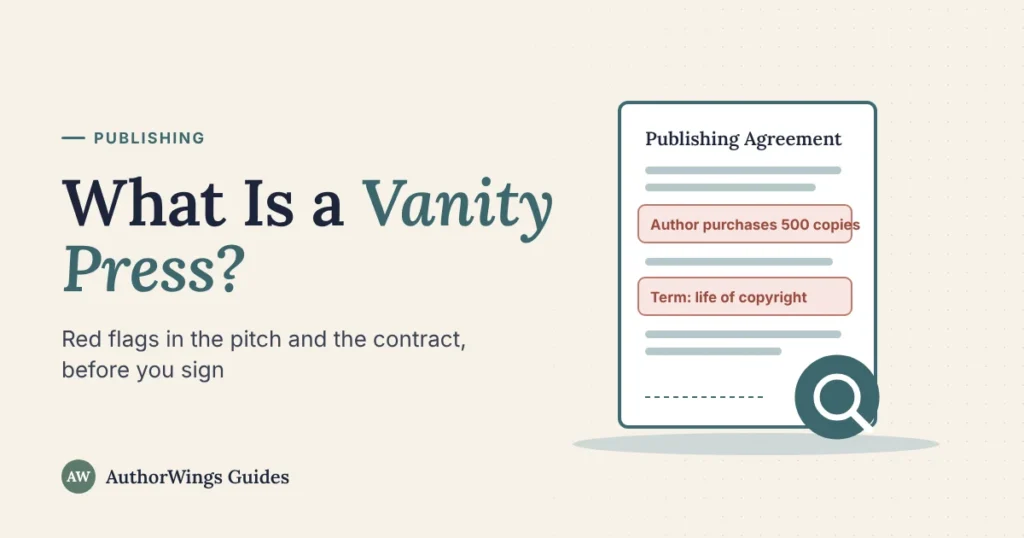
| Rights and term | How long the contract lasts and which rights it takes | Some contracts run for the life of the copyright and include film or audio rights |
| Ending the contract | Whether you can end it, how, and what happens to your files | Without a clear exit, you can be stuck if things go wrong |
| Files at the end | Whether you get the editable cover and interior files, not only PDFs | Without them, you pay again to republish |
Our guide to what an ISBN is explains why owning it matters. If anything is unclear, have a lawyer read it before you sign. If you’re an eligible Authors Guild member, it can answer specific questions about a contract and flag red flags. This is general information, not legal advice.
Is it a vanity press? A 10-question check
Free check
Is it a vanity press?
Answer 10 questions about the company that made you an offer. Your result appears when all 10 are answered.
1Did they contact you first, praising a book they haven’t read?
2Do they call themselves your publisher, yet accept almost every book that pays?
3Must you buy copies, marketing or extra packages as part of the deal?
4Did the full price appear only after a sales call, or grow after you signed?
5Do you pay fees and still get a royalty that’s unclear or no higher than a traditional publisher pays?
6Are they unable to show real sales or put you in touch with authors they’ve published?
7Did they promise sales, bestseller lists, bookstore placement or a film deal?
8Were you pushed to sign quickly?
9Is there no clear way to end the contract and get your rights back?
10Did they say they work with a major publisher, film studio or literary agent, or ask for an “agent” or film-pitch fee?
0 of 10 answered
If it calls itself a hybrid publisher, check it against the IBPA’s 11 criteria.
Posing as an agent, major publisher or film studio is a known scam tactic. Stop paying and report it to Writer Beware.
Warning signs you found:
A quick check, not legal advice. A company can pass and still be a poor fit, so read the whole contract before you pay.
What to do if you’ve already signed
- Stop paying for extras. Don’t buy more packages, marketing or copies while you work out your options.
- Read your contract for the exit. Look for a termination clause, an out-of-print clause and how much notice you must give.
- Ask in writing to end the contract and get your rights back, and keep copies of every message.
- Ask for your files, including the editable cover and interior files, not only PDFs.
- Plan for a new ISBN. If the ISBN was in the company’s name, it stays with that edition, and the International ISBN Agency says a new publisher must use its own.
- Get help. The Authors Guild offers contract help to eligible members, and you can report the company to Writer Beware.
Once your rights are back, you can republish under your own name. Print on demand means you never have to buy stock; see how print on demand works for books.
When to get help
You don’t need a vanity press to publish a professional book. The main self-publishing platforms are free to upload to, and you can hire only the help you need, with every account in your name. Our self-publishing packages start at $537 for cover, formatting and publishing, with 100% of your royalties and rights kept. For the full process, see how to get a book published.
Self-publishing services
Want to publish without giving up your rights?
We design, format and publish your book with every account, ISBN and royalty in your name.
- Publish-Ready packages, from $537: cover, formatting and publishing
- Publishing setup, from $249: for books with finished files
Vanity press questions authors ask
Is a vanity press a scam?
Not always. A vanity press is a legal business that charges authors to publish, and some deliver what they promise, at a high price. It becomes a scam when it takes money by deception: fake promises, hidden fees or books that never appear. Writer Beware says honest vanity publishers exist, but others use unethical or fraudulent practices.
What’s the difference between a vanity press and a hybrid publisher?
Both charge authors. A legitimate hybrid publisher chooses which books it takes, publishes to industry standards, pays a higher-than-standard royalty and meets the IBPA’s 11 criteria. A vanity press accepts nearly anyone who pays and earns from author fees rather than book sales. Some vanity presses call themselves hybrid, so check against the criteria.
Do real publishers ever charge authors?
Traditional publishers don’t: they cover production and usually pay an advance. Hybrid publishers and self-publishing services do charge, but for clearly stated work. The test is what you get for the money: who owns the ISBN, the accounts and the rights, and whether the fees and royalty terms are written into the contract.
How do I check if a publisher is legitimate?
Search the company name with “Writer Beware” and “complaints,” and check the Alliance of Independent Authors’ service ratings. Ask to speak with authors it has published, look up their books’ sales ranks, and read the full contract. Be wary if it contacted you first, accepts every book or asks you to pay to be published.
Related reading: How to get a book published · Self-publishing vs traditional publishing · What is print on demand?
AuthorWings editorial team
The AuthorWings editorial team writes and updates our guides for first-time authors. Every post is read and edited by a person on our team before it is published.