Home / Guides / Writing a Book
How to Write a Book Series: Plan, Series Bible and Order
 By AuthorWings editorial team
11 min read
Short answer
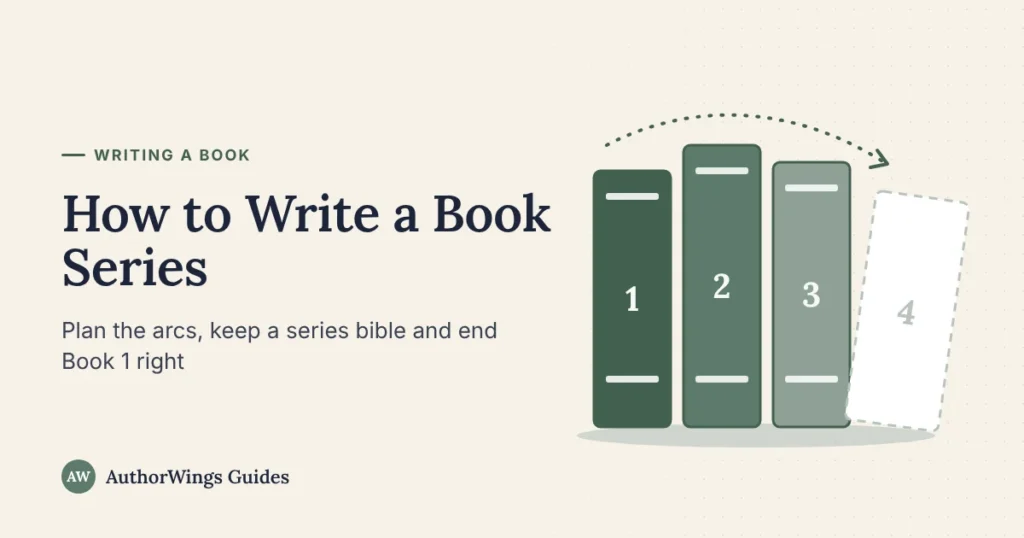
To write a book series, choose the series type and roughly how many books, then plan two questions: one big question for the whole series and a smaller one each book answers. Keep a series bible so details stay consistent, end Book 1 with its own question answered, and draft ahead if your schedule allows.
A series asks more of you than one novel does: a story that holds across several books, characters who keep changing, and details that still match three books later. This guide covers the planning that makes that work, with a worked three-book example and a free series bible template. If you’d rather have help writing the books, a fiction ghostwriter can draft one book or the rest of the series in your voice. New to fiction? Start with a novel outline example in our book guide.
Choose your series type
Series work in a few different ways, and the type shapes everything after it: how much each book can stand alone, how you end each one, and the order readers need.
| Series type | How it works | Can readers start anywhere? | Fits |
|---|---|---|---|
| Serial | One long story told across the books, with a plot that carries over | No, read in order | Epic fantasy, science fiction, some thrillers |
| Episodic | Same main character, a new self-contained story in each book | Usually | Mysteries, detective fiction, some thrillers |
| Linked standalones | Each book has new main characters in the same town, family or world | Yes | Romance, small-town fiction, family sagas |
| Hybrid | Each book solves its own problem while a larger story builds underneath | Best in order | Mysteries, urban fantasy, romantic suspense |
Stores label a series as ordered (read in sequence) or unordered (any order). Serial and hybrid series are usually ordered; episodic and linked series can be either.
Decide how many books
Pick a direction early, even if the final number comes later:
- A trilogy or fixed number suits a serial story with one ending. Plan the final book’s outcome before you write Book 1, so every book moves toward it.
- An open-ended series suits episodic and linked books. Plan Book 1 and a loose idea for the next two, and keep a list of future story ideas.
- Start with three. If you’re unsure, plan three books with one series question. You can extend an open-ended series later, but it’s hard to shorten a story built for seven.
There’s no rule on a minimum. A series is simply two or more books linked by story, characters or setting.
Plan two questions: one for the series, one for each book
Every book in a series needs its own question that it answers by the end. The series needs a bigger question that only the last book (or a final turn in an open-ended series) answers. Use five turning points to plot each book, then check it against this grid.
Worked example: an invented hybrid mystery series, The Kestrel Bay Mysteries, three books. Series question: who in Kestrel Bay paid to hide what happened to Mara’s father, and why?
| Book | The book’s question | How it ends | What changes in Mara | Series question moves |
|---|---|---|---|---|
| 1. Ten Days in Kestrel Bay | Why did her father tear the last ten days out of his logbook? | She learns why he hid the pages, and decides to stay in town | From trusting no one to letting someone help | She learns the harbormaster lied for someone else |
| 2. The Diver’s Mark | Who drowned the diver found in the harbor? | The killer is caught | From relying on the police chief to trusting her own judgment | The diver had copies of her father’s logbook |
| 3. Last Crossing | Who set the ferry fire? | The fire-setter is exposed, and she learns who paid for the cover-up and why | She chooses the truth over the people she’s grown close to | Answered |
Each book closes its own question, so a reader who picks up only Book 2 still gets a whole story. The series question moves forward in every book and is answered in the last one. Before you draft, outline each book one at a time, using the grid as the frame.
Build a series bible
A series bible is your record of every fact the books depend on. Start it while you plan Book 1, and update it at the end of each writing session, so that Book 3 still matches Book 1.
| Section | What to record | Example |
|---|---|---|
| Characters | Names, ages in each book, looks, voice, habits, relationships | Mara Quill, 38 in Book 1, 40 in Book 3; ferry captain on the mainland, home for her father’s funeral; left-handed; calls her father “Dad” in speech, “my father” in narration |
| Timeline | When each book happens, and key past events with dates | Book 1: October 2024; her father’s last ten days, torn from his logbook: late September 2024 |
| Places | Towns, streets, buildings, distances, what’s open when | Harbor office closes at 5; ferry to the mainland takes 40 minutes |
| Rules of the world | Laws, technology, magic, how the town or society works | No cell signal past the north point |
| Open threads | Every question, clue or promise not yet paid off, and the book that answers it | Who the harbormaster lied for: answered in Book 3 |
| Repeated details | Phrases, objects, running jokes, recurring minor characters | The harbormaster’s brass whistle |
| Book plan | Each book’s question, ending, target length and status | Book 2: The Diver’s Mark; 85,000 words; drafting |
| Book log | One line per chapter of each finished book, with the facts it adds | Book 2, chapter 6: Mara finishes repairing her father’s wrecked boat and renames it Second Look |
Series Bible Template (free)
Download the Word template- Series overview
- Book plan, one row per book
- Characters, with ages for each book
- Timeline and places
- Rules, repeated details and open threads
- Book log, one line per chapter
Every page has prompts and an example from the invented Kestrel Bay Mysteries. Free to use for your own series.
How to end Book 1
Book 1’s last chapter decides whether a reader buys Book 2, so write it as an ending first and a doorway second.
- Answer the book’s question in full. In Kestrel Bay terms: Mara knows why the pages are gone, even if she doesn’t yet know who paid. A reader who stops here should feel the book was complete.
- Leave the series question open, and make it visible. In the last chapter, give one new fact or turn that points to the bigger story, so readers know there’s more and why it matters.
- Choose between a cliffhanger and an open loop. A cliffhanger answers the book’s question, then ends on a new danger, and works when the next book is ready or close. An open loop resolves the action but leaves a question in the air, which is safer when the next book is a year away.
- Don’t hold back the ending for later. A reader who feels cheated by Book 1 has little reason to buy Book 2.
Write books 2 and up without a sequel slump
Book 2 sags when it replays Book 1 with a new victim. Each new book needs a reason to exist:
- Keep the promise, change the problem. Write down what every book repeats: the lead, the setting, the kind of case, the tone. That’s what readers come back for; everything else can change.
- Raise the stakes on the series question. Each book should cost the main character more, or bring them closer to the answer.
- Change the character. Use the “What changes in Mara” column of the grid as your model. A hero who ends every book the same person reads like a rerun.
- Give a new kind of problem. If Book 1 was a search, make Book 2 a race or a trap.
- Recap lightly. Remind readers of past events in a line or two, woven into the scene, for new readers and returning ones alike.
- Check the bible before you start. Read the open-threads list and the last book’s log before drafting.
Release order and timing
Some authors draft two or three books before releasing the first, so they can publish closer together and fix early books while the later ones take shape. Others release each book as it’s done. Both work. Pick by pace: if one book takes you over a year, write ahead.
| Approach | Upside | Downside |
|---|---|---|
| Write ahead, then release | You can change Book 1 to fit what Book 3 needs; shorter gaps between releases | Longer wait before any book comes out |
| Release as you go | Reader feedback early; Book 1 is out sooner | Book 1 is fixed before the later books exist; longer gaps |
If you release as you go, start drafting Book 2 before Book 1 comes out, so the gap stays short. When the books are ready, you can set up your series on Amazon so they link on one series page. For the business side, see how a series earns more and our notes on marketing a series.
Turning a standalone into a series
If readers want more from a book you wrote as a standalone, check four things before you plan Book 2:
- Who carries the next book? The same main character with a new goal, or a side character who takes the lead.
- What’s the new question? It has to be as strong as Book 1’s, without undoing its ending.
- What did Book 1 fix in place? List every fact about people, places and dates, and start a series bible from it.
- What can grow into a series question? Look for a loose end or a side story in Book 1 that could carry several books.
When to get help
Three 80,000-word books add up to 240,000 words. Help makes sense when the books are planned but the writing time isn’t there, or when Book 1 needs a structural check before you build on it.
- You want the books written. A fiction ghostwriter can write one book in a series or the rest of it, from your plan and in your voice. Fiction ghostwriting is 33¢ a word, from $6,600 for 20,000 words, with all four EFA editing levels included. Every word written by a human writer.
- You want Book 1 checked first. A developmental edit reads the whole manuscript for structure, with an 8 to 20 page editorial letter plus chapter notes. For fiction it’s $330 up to 10,000 words, then $0.033 a word.
Fiction ghostwriting
Your series, written book by book
A fiction ghostwriter writes from your series plan and in your voice, one book or the rest of the series. Your name goes on the cover.
- 33¢ a word, from 20,000 words
- Includes all four EFA editing levels
- Every word written by a human writer
Book series questions authors ask
How many books should be in a series?
There’s no set number. A serial story with one ending needs enough books to carry its series question, and a trilogy is an easy plan to start from. Episodic and linked series can run as long as readers want new stories. If you’re unsure, plan three books around one series question, and keep a list of ideas in case the series grows.
Should I finish the whole series before publishing Book 1?
Drafting ahead helps, though it’s optional. With two or three books drafted, you can fix Book 1 to fit what later books need, and release them closer together. If you publish Book 1 first, plan the series question, and for a series with a set ending the last book’s outcome, before release, so later books can still pay off what Book 1 set up.
Can a series have different main characters?
Yes. Linked series often give each book a new main character, such as a sibling, a friend or a new couple, in the same town or world. Readers come back for the setting and the recurring cast. Introduce the next lead as a side character in the book before, so readers already care about them when their book starts.
How long should each book in a series be?
Each book should fit its genre’s usual length, and books in one series are often similar in length, so readers know what to expect. A later book can run longer if the story needs it. Plan word counts in your series bible, and check each book’s length against your genre before you outline it.
AuthorWings editorial team
The AuthorWings editorial team writes and updates our guides for first-time authors. Every post is read and edited by a person on our team before it is published.