Short answer
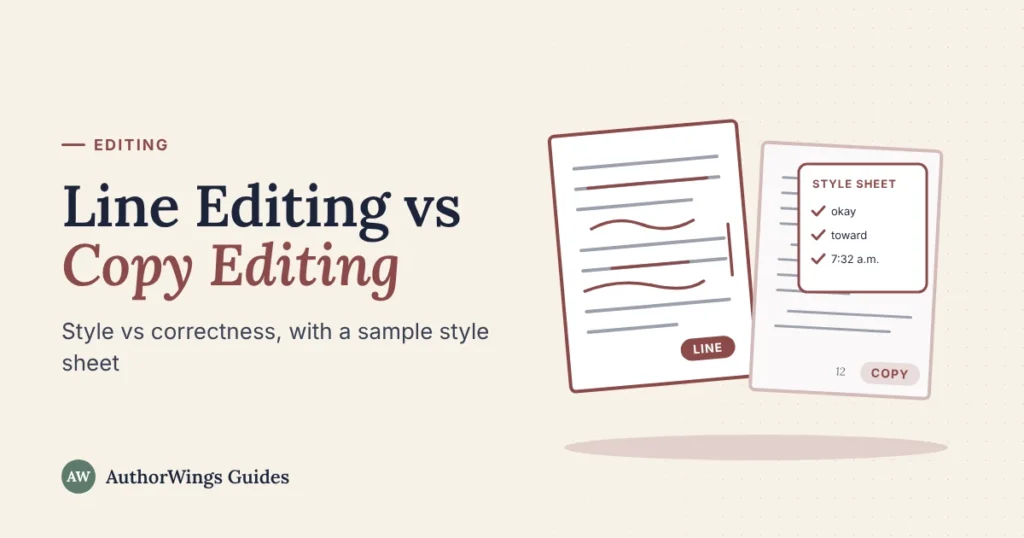
Line editing improves how your sentences read: rhythm, clarity, word choice and voice. Copy editing makes them correct and consistent: grammar, punctuation, spelling, and details such as names and dates, recorded in a style sheet. Line editing comes first, then copy editing. Many books need both, in that order.
Both edits work sentence by sentence, which is why authors mix them up. The difference is the question each one asks: a line editor asks “Is this the best way to say it?” and a copy editor asks “Is this right, and is it the same everywhere?” This guide compares the two, shows one passage going through both, and includes a sample style sheet. Our book editing services price each level separately, so you book only what your draft needs.
Line editing vs copy editing at a glance
Line editing is about style; copy editing is about correctness. The table compares them on a 70,000-word novel at AuthorWings fiction rates.
| Line editing | Copy editing | |
|---|---|---|
| The question it asks | Is this the best way to say it? | Is this right, and consistent? |
| What changes | Sentence rhythm, flow, word choice, clarity, repetition, voice | Grammar, punctuation, spelling, usage, capitalization, consistency |
| How much changes | A lot: many sentences are rewritten | Less: small fixes on most pages |
| What you get | Tracked changes, with comments explaining rewrites | Tracked changes, queries and a style sheet |
| Follows a style guide? | Not mainly | Yes, often The Chicago Manual of Style for US books, unless the publisher has a house style |
| Order | After a developmental edit, if you have one | After line editing |
| Time (AuthorWings) | 7 to 12 business days | 5 to 10 business days |
| Cost for 70,000 words (fiction) | $2,170 | $1,680 |
Our book editing page shows the four editing levels side by side on a sample page.
What a line editor changes
A line editor works on the writing itself, one sentence and paragraph at a time, while keeping your voice. Typical changes:
- Wordiness and repetition: cutting phrases that say the same thing twice.
- Rhythm: varying sentence length so the prose doesn’t plod or rush.
- Clarity: untangling sentences a reader has to read twice.
- Word choice: a sharper verb, a more exact noun, fewer filler words such as “very” and “really.”
- Voice and tone: keeping a character or narrator sounding like themselves from chapter to chapter.
- Flow between sentences: making each one lead into the next.
The Editorial Freelancers Association describes line editing as working at the sentence or paragraph level, mainly on language and style, though line editors also fix errors they find.
What a copy editor changes
A copy editor makes the text correct and consistent, and keeps a record of every decision. Typical changes:
- Grammar and usage: agreement, tense, dangling modifiers, commonly confused words.
- Punctuation: commas, quotation marks, hyphens and dashes, including dialogue punctuation.
- Spelling and capitalization: checked against a dictionary and style guide.
- Consistency: a character’s eye color, the spelling of a town, how numbers and times are written.
- Cross-references and queries: questions to you where only you know the answer, such as a date that doesn’t match an earlier chapter.
- The style sheet: a list of every spelling and style decision, so the whole book follows them.
The same passage, line edited and copy edited
Here’s one invented paragraph going through both edits. Deleted words are struck through, added words are underlined, and the notes are the editor’s comments.
struck through deletedunderlined added
Draft
Ellie had always, for as long as she could remember, been afraid of the water. When she was seven her brother had pushed her into the lake at Pine Hollow and she had went under, and she remembered the cold. Her heart was beating fast, it was beating really fast as she stood on the dock now.
1. Line edit
Ellie had always, for as long as she could remember, been afraid of the water. When she was seven her brother had pushed At seven, her brother pushed her into the lake at Pine Hollow and she had went under, and she remembered the cold., and she went under. She still remembered the cold. Her heart was beating fast, it was beating really fast as she stood on the dock now. Standing on the dock now, she felt her heart race.
- Cut the repeated idea: “always” already says it.
- Split into shorter sentences so the memory lands.
- One clear image instead of repeating “beating fast.”
2. Copy edit
Ellie had always been afraid of the water. At seven, When she was seven, her brother pushed her into the lake at Pine Hollow, and she went under. She still remembered the cold. Standing on the dock now, she felt her heart race.
- “At seven” is unclear: it could mean seven o’clock, and it reads as if the brother was seven. Restored “When she was seven.”
- Style sheet: Pine Hollow, two words, both capitalized. Chapter 2 has “Pinehollow.” Query: which do you prefer?
The line edit changed how the paragraph reads. The copy edit caught an unclear phrase the rewrite introduced and a spelling that differs from chapter 2. That’s why copy editing comes after line editing: every rewrite can add new errors.
What a copy editor’s style sheet looks like
A style sheet is a short document, usually a few pages, that lists every decision your copy editor made so the whole book follows the same rules. You get it with your copy edit, and a proofreader uses it later. Here’s a shortened sample for an invented novel.
Style sheet: sample novel
- Style guide
- The Chicago Manual of Style, 18th edition; Merriam-Webster
- Names and places
- Ellie Marsh · Sam Marsh (brother) · Dr. Anika Rao · Pine Hollow (lake and town) · the Hollow (short form, capital H)
- Spellings
- okay (not OK) · toward (not towards) · email · gray
- Numbers
- Spell out zero through one hundred; spell out times on the hour, half hour or quarter hour (seven thirty), numerals when the exact time matters (7:32 a.m.)
- Punctuation
- Serial comma · em dashes closed up, no spaces · ellipses as three dots
- Capitalization
- Mom and Dad capitalized when used as names (“Mom said”); lowercase after “my” (“my mom”)
- Timeline
- Ch. 1: October, Ellie 34 · Ch. 2: flashback, Ellie 7, Sam 10
- Open queries
- Pinehollow (ch. 2) vs Pine Hollow (ch. 1): author to confirm
Keep your style sheet. If you write a sequel, give it to the next editor.
Which comes first, and can one editor do both?
Line editing usually comes first, then copy editing, because a copy edit on prose that’s about to be rewritten is wasted. If your book also needs a developmental edit, that comes before both, and a proofread comes last, after layout. Our guide to editing vs proofreading covers that final step, and copy editing vs proofreading shows which errors each one catches.
One editor can do both, either as two passes or as a combined line and copy edit. The EFA notes that line editing is sometimes paired with copyediting. A combined pass saves time, but a separate copy edit after the line edit catches errors the rewriting added, as the example above shows. At AuthorWings, one lead editor handles the edit, with a fresh proofreader for the final check.
Signs your manuscript needs a line edit, a copy edit, or both
You likely need a line edit if
- Readers say the writing feels flat, wordy or hard to follow
- Sentences start the same way, or run the same length, page after page
- You use the same words and phrases again and again
- Your voice changes from chapter to chapter
- Beta readers skimmed sections even when the plot was moving
You likely need a copy edit if
- The structure and prose are where you want them
- You’re unsure about commas, hyphens or dialogue punctuation
- Names, places or timelines changed across drafts
- The book has never been checked against a style guide
- You’re about to publish or query
If you checked items in both columns, book both, line editing first. Our book editing page walks through common author situations and the levels each one needs.
When to get help
Line and copy editing are separate levels, so you can book one or both. At AuthorWings fiction rates:
- Line editing: $310 for the first 10,000 words, then $0.031 a word. Tracked changes with comments, 7 to 12 business days.
- Copy editing: $240 for the first 10,000 words, then $0.024 a word. Tracked changes plus a style sheet, 5 to 10 business days.
- Not sure which? A $49 sample edit of up to 1,000 words comes back with a short note on which levels your draft needs.
Line and copy editing
Better sentences, then correct ones
Book a line edit, a copy edit or both, priced by genre and word count. One lead editor handles the edit, with a fresh proofreader for the final check, and every change comes back in tracked changes.
- Line editing from $310
- Copy editing from $240
- $49 sample edit
Frequently asked questions
Can I skip line editing?
Yes, if your prose is already where you want it. Many experienced authors, or books whose writing has been through several careful revisions, go straight to a copy edit. Skipping copy editing is riskier: almost every book has grammar, punctuation and consistency errors its author can’t see. A sample edit of a few pages shows which level your draft needs.
Is line editing the same as substantive editing?
Not quite. The EFA treats “substantive editing” as another name for developmental editing: changes to structure, content and organization across the whole book. Some publishers use the term for a heavy line edit, though. Line editing works at the sentence and paragraph level, so always ask an editor exactly what their edit includes before you book.
Will a line editor change my voice?
A good one won’t. The aim of a line edit is to make your writing sound more like you at your best, not like the editor. Every change comes as a tracked change you can accept or reject, and comments explain the reasons. If a sample edit doesn’t sound like you, that editor isn’t the right fit.
How long do line and copy editing take?
At AuthorWings, line editing takes 7 to 12 business days and copy editing 5 to 10, for manuscripts up to 60,000 words; longer books take longer. Booked together, they run one after the other, line editing first. Add time for your own review of each round of tracked changes.
Related reading

AuthorWings editorial team
The AuthorWings editorial team writes and updates our guides for first-time authors. Every post is read and edited by a person on our team before it is published.