Short answer
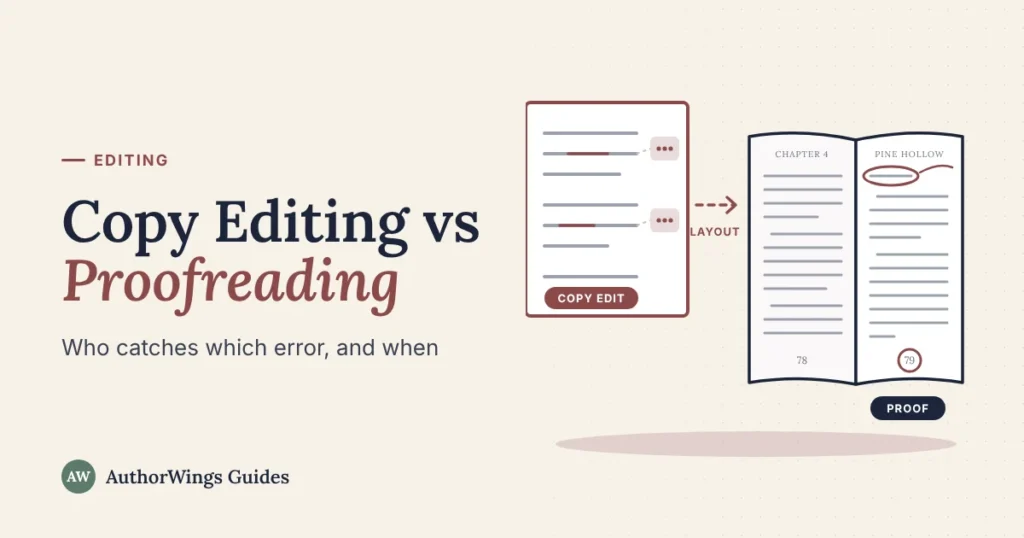
Copy editing fixes grammar, punctuation, spelling and consistency in your manuscript before layout, and records each decision in a style sheet. Proofreading is the final check on the laid-out pages, catching errors that slipped through or were added in layout. Copy editing comes first; proofreading comes last. Many books need both.
Copy editing and proofreading both hunt for errors, so they’re easy to confuse. The difference is when they happen and what they work on: a copy editor works on your Word file and can change anything that’s wrong; a proofreader works on the final pages and checks them against the edited text. This guide shows which errors each one catches, how the work passes from one to the other, and a short quiz to test yourself. Our copy editing and proofreading are priced separately, so you can book one or both.
Copy editing vs proofreading at a glance
Copy editing happens on the manuscript; proofreading happens on the final pages. The table compares them on a 70,000-word novel at AuthorWings fiction rates.
| Copy editing | Proofreading | |
|---|---|---|
| When | After line editing, before layout | After layout, just before publishing |
| Works on | Your Word file | The laid-out pages or final file |
| What it fixes | Grammar, punctuation, spelling, usage, consistency, style | Errors that slipped through, and layout errors |
| How many changes | Many small fixes throughout | Few, and only what’s wrong |
| Queries to you | Yes, where only you know the answer | Rarely, and only on new problems |
| What you get | Tracked changes, queries and a style sheet | Marked corrections on the pages |
| Time (AuthorWings) | 5 to 10 business days | 3 to 7 business days |
| Cost for 70,000 words (fiction) | $1,680 | $1,120 |
Both together cost $2,800 for the same book. If you’re comparing copy editing with the sentence-level edit before it, see line editing vs copy editing.
Which errors each one catches
Copy editors and proofreaders overlap on simple typos, but many errors belong to one stage or the other. The table sorts common errors by who catches them.
Who catches which error
Copy editor (manuscript)BothProofreader (laid-out pages)
- Subject and verb don’t agree“The list of changes were long.”Copy editor
- A name spelled two waysPine Hollow in one chapter, Pinehollow in anotherRecorded in the style sheet.Copy editor
- Numbers styled two ways“7 miles” here, “seven miles” thereCopy editor
- A detail that contradicts an earlier chapterGreen eyes in chapter 3, blue in chapter 9The copy editor queries you.Copy editor
- Wrong word that spell check misses“their” for “there”The proofreader catches any left over.Copy editor
- Doubled or missing word“the the door”Often added in late revisions.Both
- A word split badly at the end of a line“therapist” broken as “the‑rapist”Proofreader
- A single line stranded at the top of a pageA short last line of a paragraph alone at the top of a new pageProofreader
- Wrong running head or page numberChapter 4’s title on a chapter 5 pageProofreader
- A correction that wasn’t madeA change you accepted that’s missing from the pagesFound by checking pages against the edited file.Proofreader
For the full picture of what proofreading does and doesn’t cover, see editing vs proofreading.
The handoff: style sheet, layout, then proofs
The two jobs are linked by the files that pass between them. Here’s the usual order for a self-published book, and what each step hands to the next.
Copy edit
The copy editor works on your manuscript, in standard manuscript format, in tracked changes, and sends queries.
Passes on: Tracked changes, queries, draft style sheet
Your review
You accept or reject each change and answer the queries. The copy editor finalizes the style sheet.
Passes on: Clean edited file, final style sheet
Layout
The edited file is set into book pages through interior formatting.
Passes on: PDF proof of the pages
Proofread
The proofreader reads the proof against the edited file and the style sheet, and marks what’s wrong.
Passes on: Marked corrections
Corrections
The designer makes the corrections, and someone checks that each one went in without causing a new problem.
Passes on: Final print and ebook files
Chicago’s editors sum up the difference: copyeditors read copy before it is in final form, and proofreaders read it after it has been finalized. For the proofreader, “the goal is not to edit,” but to check that the pages match the edited copy. Our guide to what a manuscript is shows where proofs fall in the stages from draft to book.
Copy edit or proofread? Try sorting six errors
Test yourself: for each error, choose who should catch it.
Copy editor or proofreader?
- Chapter 2 calls the dog Biscuit; chapter 11 calls him Biscut. Answer: Copy editor. A name spelled two ways is a consistency error. The copy editor fixes it and adds the spelling to the style sheet.
- A short last line of a paragraph sits alone at the top of page 47. Answer: Proofreader. A short line stranded at a page break only exists once the pages are laid out, so it’s a proofreading catch.
- “Neither of the sisters were ready.” Answer: Copy editor. In formal, edited prose, “neither” takes a singular verb: “Neither of the sisters was ready.” The plural is common in everyday speech, but fixing it is a copy edit job.
- The running head on page 112 shows the wrong chapter title. Answer: Proofreader. Running heads are added in layout, so the copy editor never sees them. Checking them is the proofreader’s job.
- The trip takes two days in chapter 5 and a week in chapter 8. Answer: Copy editor. Consistency across chapters is the copy editor’s job. They’ll query you, because only you know which is right.
- A change you approved in the edit is missing from the proof. Answer: Proofreader. Proofreaders check the pages against the edited file, so they catch changes that never made it into layout.
Can you skip one?
You can, but each one you skip leaves a different set of errors in the book.
- Skip the copy edit and the proofreader will catch typos but won’t fix grammar, inconsistencies or style, because their job is to check, not to edit. Those errors can stay in the book.
- Skip the proofread and nobody checks the pages after layout, so bad line and page breaks, wrong running heads and missed corrections can reach readers.
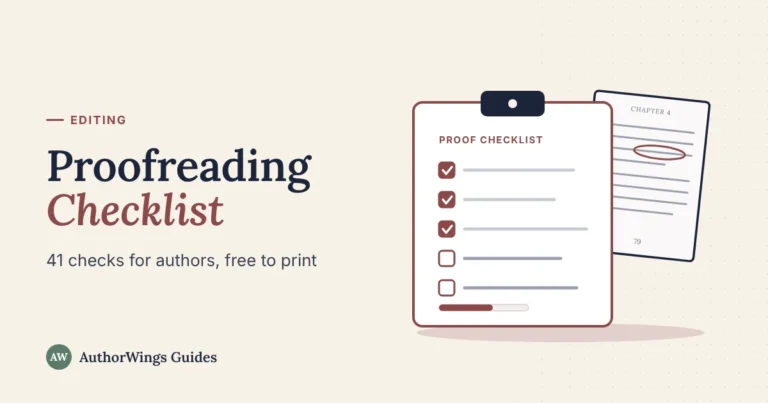
If you’re publishing an ebook only, there are no fixed pages, so page-break checks don’t apply, but a final read of the converted file still catches typos and conversion errors. Our guide to editing vs proofreading covers proofreading a Word file versus a printed proof. To proofread your own pages, use our free proofreading checklist.
When to get help
Book the copy edit once the structure and sentences are settled, and the proofread once the book is laid out. At AuthorWings fiction rates:
- Copy editing: $240 for the first 10,000 words, then $0.024 a word, with a style sheet. 5 to 10 business days.
- Proofreading: $160 for the first 10,000 words, then $0.016 a word. 3 to 7 business days.
- Both for a 70,000-word novel: $2,800.
One lead editor handles the edit, with a fresh proofreader for the final check.
Copy editing and proofreading
Correct, consistent, then checked
A copy edit with a style sheet, then a fresh proofreader on your final pages. Every change comes back in tracked changes, done by a human editor.
- Copy editing from $240
- Proofreading from $160
- $49 sample edit
Frequently asked questions
Does a copy editor proofread too?
A copy editor fixes the typos they find, but they work before layout, so they can’t see line breaks, page breaks or running heads. Revisions after the copy edit can also add new errors. That’s why a separate proofread on the final pages still matters, even after a careful copy edit.
Should the same person copy edit and proofread?
It helps if they don’t. After weeks with a manuscript, an editor knows it so well that their eyes slide over what they expect to see. Fresh eyes catch more, so it’s common to use a different person for the proofread. At AuthorWings, one lead editor handles the edit, with a fresh proofreader for the final check.
What does a proofreader do with the style sheet?
The proofreader uses it as the rulebook. If the style sheet says “okay” and “Pine Hollow,” the proofreader checks that the pages follow it, rather than reopening decisions you and your copy editor already made. Where the style sheet is silent, a good proofreader flags the problem with a query instead of changing the text.
Do ebooks need proofreading?
Yes, though the checks are different. A reflowable ebook has no fixed pages, so there are no page breaks or running heads to check. Converting the file can still introduce formatting errors, such as lost italics or a broken table of contents link, so check the final file in Kindle Previewer or on a device before you publish.
Related reading

AuthorWings editorial team
The AuthorWings editorial team writes and updates our guides for first-time authors. Every post is read and edited by a person on our team before it is published.