Home / Guides / Children's Books
How to Start a Children’s Book: 5 Decisions Before You Write
 By AuthorWings editorial team
8 min read
By AuthorWings editorial team
8 min read
Short answer
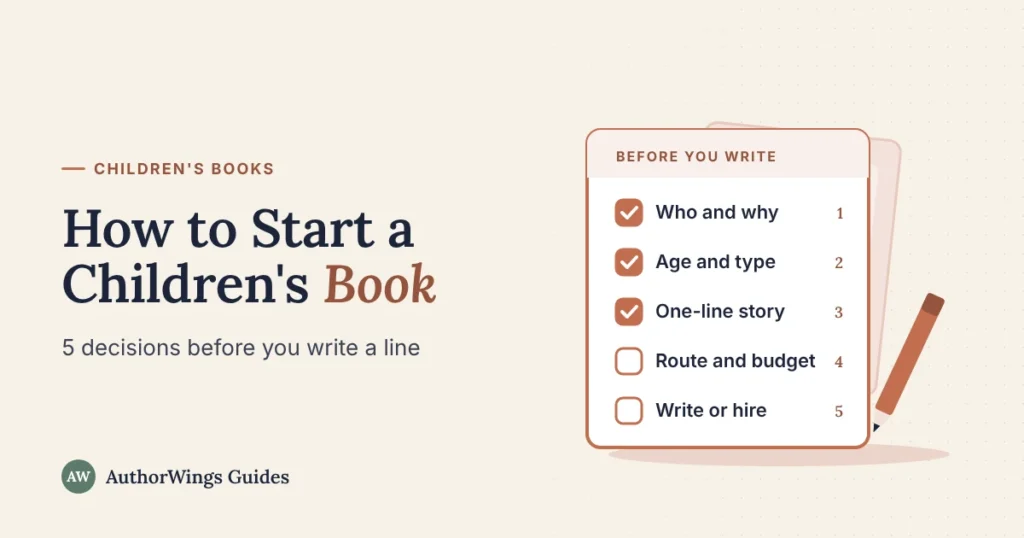
To start a children’s book, make five decisions before you write a line: who the book is for and why, the reader’s age and book type, your story in one sentence, your route and budget, and whether you’ll write it yourself, get help or hire. Each answer changes what you write next and what it costs.
It’s tempting to start by typing the opening line. That works for a journal, but a children’s book has more moving parts: an age group, a page count, an illustrator and a way to reach readers. Decide those first and the draft goes faster, because you know what you’re writing toward. If you decide you’d rather not write it at all, a children’s book ghostwriter can start from your idea.
This guide covers the decisions only. When you’re ready to draft, our guide on how to write a children’s book takes you through the writing, step by step.
Decision 1: Who is the book for, and why?
Start with the goal, because it decides almost everything else. A children’s book usually starts from one of three goals.
- A keepsake for one child or one family. A bedtime story about your grandchild, or a book for a class. You don’t need to sell it, so you don’t need a market or a store listing. You need a few good copies. KDP (Amazon’s publishing platform), for example, lets you order proof copies of a book still in draft, up to 5 per order, once you’ve approved the files; proofs are marked “Not for Resale” (as of October 2026).
- A book to sell yourself. You self-publish on Amazon and other stores, hire the illustrator, keep the rights and earn the royalties. You’re the publisher, so the budget and the decisions are yours.
- A book for a traditional publisher. You usually send the text to literary agents, though a few smaller publishers accept it directly. If a publisher buys it, the publisher pays for and chooses the illustrator, so unless you illustrate too, you don’t need pictures to submit.
Write your goal down in one sentence. You’ll come back to it in Decision 4.
Decision 2: The reader’s age and the type of book
Pick the child before the story. A two-year-old and an eight-year-old need different books: different lengths, sentence sizes and jobs for the pictures. Our guide sets out each age range and category with its word count, so here’s the short version of the choice:
| If your reader is about | The book is usually | Read first |
|---|---|---|
| 0 to 3 | A board book | What a board book is |
| 3 to 7 | A picture book, with or without words | Wordless picture books |
| 5 to 10 | An early reader or a chapter book | Each type of children’s book |
| 8 to 12 | Middle grade | The same section, under middle grade |
Age bands are approximate and vary by publisher. A comic or graphic novel is a format rather than an age, and you’ll find them for every age from early readers up. If you’re unsure, pick the youngest age your story still works for, and read ten recent books written for that age before you decide.
Decision 3: Your story in one sentence
Before you draft, you should be able to say the story in one line: a child, a problem and how it changes. If the line needs “and then” twice, the story isn’t clear yet.
| Child | Problem | Change |
|---|---|---|
| A boy who hates loud noises | has to sit through his sister’s first drum concert | and finds the one quiet beat he likes |
| A girl in charge of the class plant for one weekend | knocks it off the windowsill on Saturday | and has to grow a new one from a cutting by Monday |
| A toddler who won’t wear his rain boots | splashes through every puddle in his socks | and picks the boots himself the next morning |
If you don’t have an idea yet, start with our 50 children’s book ideas by age, then run your favorite through the one-sentence test. In a picture book, the child should solve the problem, not an adult.
Decision 4: Your route, time and budget
Go back to your goal from Decision 1. It tells you who pays for the pictures, how long it takes and what you send.
Decision 4 at a glance
Three routes, three starts
Your goal from Decision 1 sets who pays for the pictures, how long it takes and what you do first.
Goal 1
Keepsake
For one child or one family
- Route
- Self-publish a few copies
- Who pays for the art
- You
- What it costs
- The illustration plus printing. Our Picture Book Package is $2,595 for up to 16 illustrations
- Time
- Weeks to months
- Start with
- Your one-sentence story, then an illustrator’s brief
Goal 2
Sell it yourself
On Amazon and other stores
- Route
- Self-publish in stores
- Who pays for the art
- You
- What it costs
- A 32-page picture book is $1,542 to publish with your own art, or $3,593 with 16 illustrations
- Time
- Months
- Start with
- A finished draft and a critique before you pay for art
Goal 3
Traditional deal
Through an agent
- Route
- Agent, then publisher
- Who pays for the art
- The publisher
- What it costs
- Your time. A $249 critique before you query is optional
- Time
- Usually years
- Start with
- The polished text, with brief art notes only where the words don’t make sense alone
To see each self-publishing cost line by line, look at how to self publish a children’s book with us. For the agent route, our guide on how to get a book published covers query letters and agents, and self-publishing vs traditional publishing compares the money.
Time matters as much as money. Write down how many hours a week you have and when you want the book in a child’s hands. A birthday six weeks away and a book for agents are different projects.
Decision 5: Write it, get help or hire
The last decision is how much of the work you want to do.
- Write it yourself. Follow the 9 writing steps in our guide, then decide who draws it. If you draw too, our guide on how to illustrate a children’s book shows the process. If you’re considering AI art, check what KDP, publishers and copyright allow first.
- Write it, then get a professional read. A picture book critique ($249) or a full picture book edit ($599) from our children’s book editing team can catch problems before you pay for art. Fixing words is cheaper than redrawing a spread.
- Hire it out. With children’s book ghostwriting, a writer turns your idea into the text, and the illustrations are included, from $3,999. Every word written by a human writer. If you have the text and need only the art, a children’s book illustrator draws it from your notes.
There’s no wrong answer. A common approach is to write the first draft yourself and hire the parts you can’t do.
When to get help
If you’ve made the five decisions and one step is stuck, that step is where help pays off. Our team works on all three paths: we write, edit, illustrate and publish children’s books, and you keep the rights.
Children’s book ghostwriting
Have the idea but not the time?
A children’s book writer turns your idea into the text, matched to the age group, with full-color illustrations included. Every word written by a human writer.
- From $3,999 Children’s book ghostwriting with illustrations
- $249 Picture book critique before you pay for art
- $2,595 Picture Book Package, up to 16 illustrations
Frequently asked questions
Do I need an illustrator before I start writing?
No. Write and revise the text first, then find the illustrator, so you don’t pay for art while the story is still changing. If you’re sending the book to agents, you don’t need an illustrator at all: the publisher picks and pays for one. If you self-publish, you’ll hire one once the text is final.
Should I write the words or plan the pictures first?
Start with the words and a rough plan of where the page turns fall. You don’t need to draw, but think in pictures: each spread should have something to show. If the story is told mostly in pictures, plan it as a wordless or nearly wordless book and write notes for each spread instead.
How long should I spend on these decisions before I start drafting?
An afternoon can be enough. Read a stack of recent books for your age group, write your goal and your one-sentence story, and check your budget and time. If one decision stays open, start drafting anyway; the draft may answer it. Just don’t pay for illustrations until the text is done.
What if my idea fits two age groups?
Pick one, because the age group sets the length, the words and the pictures. Ask which child would be most excited by the problem in your story, then write for that age. A book aimed at “ages 3 to 10” spans several categories, so it risks reading too old for the youngest and too young for the oldest. You can always write a second version for the other age later.
Related reading
- How to write a children’s book: the 9 steps, with a free template
- Children’s book ideas: 50 story starters by age
- Wordless picture books: how to plan a story told in pictures
AuthorWings editorial team
The AuthorWings editorial team writes and updates our guides for first-time authors. Every post is read and edited by a person on our team before it is published.