Short answer
To become a beta reader, pick one or two genres you know well, then offer to read for authors through writing communities, beta reader groups, critique-swap sites or authors’ newsletters. Beta reading is often unpaid at first. Finish on time and give specific, honest notes on how the book felt to read. A record of useful reports is what leads to paid work.
A beta reader reads a finished draft before publication and tells the author how it felt as a reader. (If you’re an author looking for readers, see our guide to what a beta reader is.) This guide is for readers: where to find your first reads, how to write notes authors can act on, paid vs free, what to watch out for, and how beta reading can lead to paid work. It includes a free report template.
What you need to start
You don’t need a degree or a certificate. Authors look for four things:
- You read like a reader. You notice where you were hooked, bored or confused, and you can say so. You don’t need to know why.
- You know the genre. Readers of a genre know what its audience expects, from romance beats to fantasy worldbuilding.
- You finish on time. A reader who disappears halfway leaves the author guessing.
- You write clearly and kindly. Honest notes, delivered with care, are the ones authors use.
Start with the one or two genres you read most. You’ll give better notes, and authors will trust you sooner.
Where to find your first beta reads
Authors look for beta readers in many places. Start where authors in your genre already ask.
| Where | How it works | Good for |
|---|---|---|
| Beta reader groups and forums (for example on Reddit or Goodreads) | Authors post requests with genre, length and deadline | Finding reads in your genre quickly |
| Critique-swap sites | You read and critique others’ work to earn feedback on your own | Writers who want notes in return |
| Writing groups, local or online | Members swap chapters or full drafts | Long-term reading relationships |
| Author newsletters and reader teams | Authors you already read invite subscribers to read early | Fans of a series or author |
| Your own network | Writers you know from classes, workshops or conferences | First reads with people you trust |
| Freelance marketplaces | Authors pay for a structured written report | Readers with a track record |
Before you say yes, read the sample and ask: how long is the book, when is it due, what feedback does the author want, and what file format will they send?
Write notes authors can use
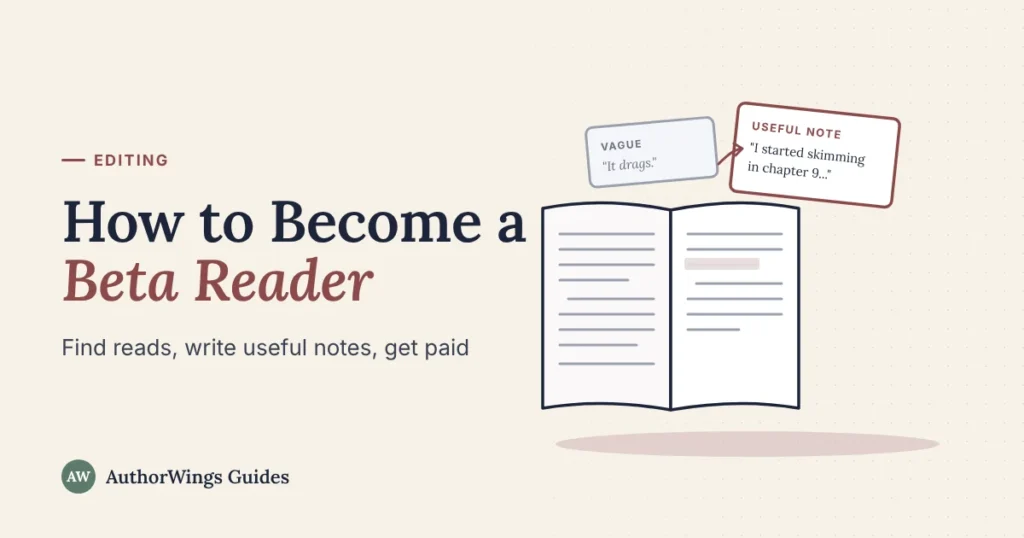
The most useful note says where you reacted and how, in your own words. An author can act on “I was confused on page 40,” but not on “the middle was weird.”
Vague“The middle drags.”
Useful“I started skimming in chapter 9, around the second council meeting, and didn’t feel pulled back in until the fire in chapter 12.”
Vague“I didn’t like Mara.”
Useful“I stopped rooting for Mara when she lied to her sister in chapter 6, because I didn’t understand why she did it.”
Vague“The ending was confusing.”
Useful“I wasn’t sure who sent the letter in the last chapter. I flipped back to chapter 3 to check and still didn’t know.”
Vague“Great book!”
Useful“The first chapter hooked me. I read it in one sitting because I wanted to know what was in the box.”
Vague“Cut the flashbacks.”
Useful“The flashbacks in chapters 4 and 7 pulled me out of the main story. I wanted to get back to the trial.”
Vague“The dialogue is stiff.”
Useful“Sam sounded formal for a 15-year-old to me, for example “I do not wish to go” in chapter 2.”
Five rules make the difference:
- Use “I” statements. You’re reporting your experience, not ruling on the book.
- Say where. Give the chapter, page or scene.
- Describe the reaction, not the fix, unless the author asks for suggestions. The author decides how to change the book.
- Say what worked, so the author knows what to keep.
- Answer the author’s questions first, then add anything else you noticed.
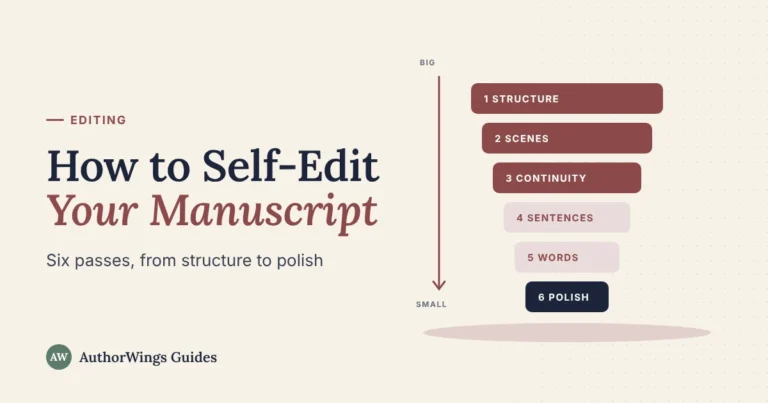
Leave sentence-level fixes to editors. If you write too, the same eye helps with your own drafts: see how to self-edit your manuscript. For the difference, see what a book editor does.
Free beta reader report template
A report template keeps your notes clear and the same shape every time, which authors notice. Ours is a Word file you can fill in for each book.
Beta Reader Report Template (free)
Download the template (US Letter)- Book details: title, genre, dates, how you read it (screen, e-reader or print)
- First impressions: three to five sentences, written before you reread anything
- Reading log: chapter by chapter, where you were hooked, bored or confused
- Characters: who you cared about, and who you didn’t believe
- Pace and plot: where it dragged or rushed, and what you guessed early
- The ending: whether it felt worth the read
- The author’s questions: each one answered in turn
- What worked best: the parts to keep
- In one sentence: what you’d tell a friend this book is about
Grey guidance text in each section tells you what to write; delete it before you send the report. Free to use for any book you read.
Paid vs free beta reading
Beta reading is often unpaid, done for early access to books you love, for practice, or in exchange for feedback on your own writing. Paid beta reading exists too, usually as a structured report from someone with a track record, and freelance marketplaces list beta reading services.
| Free | Paid | |
|---|---|---|
| Who asks | Authors in groups, writer friends, fans of a series | Authors who want a set deadline and a written report |
| What you give | Honest notes, often answers to the author’s questions | A structured report, delivered on an agreed date |
| Agreement | Usually informal, such as an email covering the deadline, not sharing and deleting the file | Written terms: scope, deadline, fee, payment and confidentiality |
| What you get | Early reading, practice, return reads, a thank-you in the acknowledgments | Payment, testimonials, repeat clients |
If you charge, set your fee by the length of the book and the depth of the report, and agree it in writing before you start. In the US, freelance income is taxable, and self-employment tax generally applies once your net self-employment earnings reach $400 in a year, so keep records of what you’re paid.
Red flags and protecting the author’s work
An author is trusting you with unpublished work. Treat it that way:
- Don’t share the manuscript, quote it in public or paste it into AI tools.
- Delete the file when you’re done, or when the author asks.
- Don’t post reviews or spoilers before the book is out, unless the author asks you to.
- Read any NDA before you sign it. Some authors ask for one, so make sure you understand what you’re agreeing to.
And watch for these red flags:
- Anyone who charges you a fee to join a paid reader list or “unlock” reading jobs. The FTC warns that legitimate employers never ask you to pay to get a job.
- Long unpaid trial reads before any paid work is agreed.
- A scope that keeps growing, such as a second full read, without new terms.
Authors can read more about protecting their work in our book-writing guide.
From beta reader to paid work
Read in your genre
Read widely and notice what works for you.
Do free reads
Three to five reads for authors in groups give you practice.
Use one template
A consistent report looks professional.
Collect testimonials
Ask authors for a line about how your notes helped.
Offer paid reports
Set your scope, deadline and fee.
Keep learning
Craft books and courses deepen your notes, and some readers move into editing.
Beta reading builds the reader’s instincts that developmental editing draws on, though editing also takes craft training. If you want to edit professionally, see how to become a book editor and the difference between line editing and copy editing. Once you have three years of professional editing experience, you can join our specialist network.
For experienced editors
Join the AuthorWings specialist network
We work with editors, designers and other publishing specialists who have at least three years of professional experience. Every opportunity is fully remote.
- 3+ years of experience
- Fully remote
- No fees to apply
Frequently asked questions
Do beta readers get paid?
Often not. Beta reading is frequently unpaid, done for early access to books, for practice or as a swap for feedback on your own writing. Some experienced readers charge for a structured written report. If you’re paid, agree the scope, deadline and fee in writing before you start reading.
Do you need qualifications to be a beta reader?
No. Authors want readers who know the genre, finish on time and can explain their reactions clearly. A writing or literature background can help, but it isn’t required. What matters most is a track record: a few authors who found your notes useful and will say so.
How long should a beta read take?
Timeframes vary, so agree the deadline with the author before you start. For a full-length novel, plan on a few weeks of reading and note-taking; a short book takes less. If you fall behind, tell the author early. Where you stopped reading is useful feedback too, so share it.
What should a beta reader not do?
Don’t line edit, rewrite scenes or mark every comma; that’s an editor’s job, and it buries the reactions the author needs. Don’t share the manuscript or post about it without permission. And don’t tell the author how to fix the book unless they ask. Describe what you felt and where.
Related reading
AuthorWings editorial team
The AuthorWings editorial team writes and updates our guides for first-time authors. Every post is read and edited by a person on our team before it is published.