Home / Guides / Children's Books
What Is a Picture Book? Length, Ages and Format
 By AuthorWings editorial team
8 min read
By AuthorWings editorial team
8 min read
Short answer
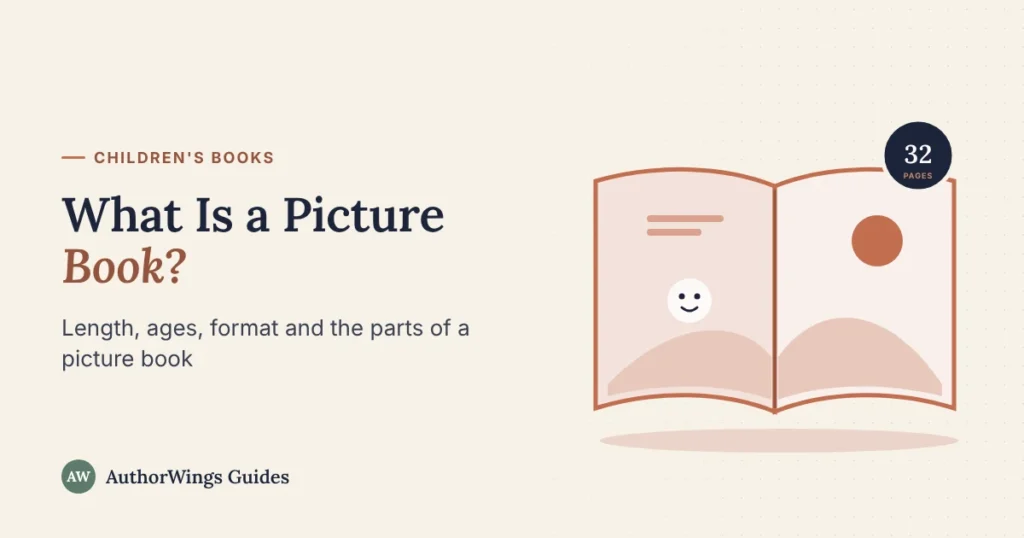
A picture book is a children’s book in which the pictures and the words tell the story together. It’s usually 32 pages long, made for children of about 3 to 7, and meant to be read aloud by an adult. It usually has a few hundred words and art on nearly every spread.
Picture books are often a child’s first stories, and the format has conventions of its own: a usual page count, art on nearly every spread and words written to be heard. This guide explains what makes a book a picture book, its usual ages, length and format, the parts of a picture book and the main types, with examples. If you’re making one, our picture book publishing page shows what each route costs.
What makes a book a picture book
In a picture book, the pictures do part of the telling. Take them away and the story loses much or all of its meaning. The Caldecott Medal rules, set by the Association for Library Service to Children (a division of the American Library Association), describe a picture book as one that essentially provides the child with a visual experience, with a story, theme or concept developed through its series of pictures.
Three things usually mark the form:
- The art carries the story. It shows what the words leave out: a character’s face, a joke in the background, the thing hiding behind the door. That’s why the picture book illustration matters as much as the text.
- It’s read aloud. An adult reads the words while the child reads the pictures, so the text is written to be heard.
- One idea per spread. Each pair of facing pages moves the story one step, and the page turn holds back the next surprise.
Picture book vs illustrated book
Not every children’s book with pictures is a picture book. In his book Writing with Pictures, author and illustrator Uri Shulevitz drew the line this way: a story book (what many now call an illustrated book) can be understood without its pictures, while a true picture book tells its story mainly or entirely through them.
A collection of fairy tales with a painting every few pages is an illustrated book. Rosie’s Walk by Pat Hutchins, in which the text never mentions the fox chasing the hen, is a picture book: without the art, there’s no story.
Picture book ages, length and format
| Feature | Typical picture book | More detail |
|---|---|---|
| Reader age | About 3 to 7; some non-fiction and older picture books reach 8 and up | The adult reads aloud; the child follows the pictures |
| Length in words | Usually a few hundred, often under 600 for fiction; non-fiction runs longer | Word counts by age are in our main guide |
| Page count | 32 pages, sometimes 24, 40 or 48 | Why 32: see how many pages a children’s book should be |
| Shape | Portrait, square or landscape, usually larger than a novel | The shape is chosen to suit the art |
| Binding | Usually hardcover from US trade publishers; self-published books often add a paperback | Some popular titles also come out as board books |
| Ebook | A fixed-layout ebook, so each page stays as designed | Needs picture book formatting, not a reflowable layout |
Parts of a picture book
Picture book anatomy
Parts of a picture book, front to back
- 1
Jacket and cover
The first picture a child sees, with the title and the main character.
- 2
Endpapers
The folded sheets that join the inside covers to the pages, often patterned or used for a small scene.
- 3
Title page
Title, author and illustrator, often with a small picture that starts the story.
- 4
Copyright and dedication
The legal page and the author’s dedication, often on one spread.
- 5
Spread
Two facing pages that work as one picture. The story happens here, about 14 times.
- 6
Gutter
The fold down the middle of a spread. Faces and words are kept out of it.
- 7
Page turn
The moment between spreads, where the next surprise waits.
- 8
Back cover
The blurb, barcode and often one last picture.
Planning what goes on each spread is a step of its own. Our main guide shows how to plan the 32 pages, spread by spread.
Types of picture books, with examples
Picture books share a format, but not a purpose. These are the main kinds.
| Type | What it does | Example to study |
|---|---|---|
| Story picture book | Tells a story with a beginning, a problem and an ending | Knuffle Bunny, Mo Willems |
| Concept book | Teaches an idea such as colors, numbers or the alphabet | Freight Train, Donald Crews |
| Rhyming picture book | Tells the story in verse with a steady beat | The Gruffalo, Julia Donaldson and Axel Scheffler |
| Wordless picture book | Tells the whole story in pictures. See wordless picture books | Flotsam, David Wiesner |
| Non-fiction picture book | Explains real things: nature, science, history, lives | Over and Under the Snow, Kate Messner and Christopher Silas Neal (narrative non-fiction) |
Rhyme is often the hardest of these to get right, because one forced rhyme or wobbly beat stands out when read aloud. A picture book editor checks the meter beat by beat. Board books are a separate format, often sturdier, shorter editions of picture books; see what a board book is.
How picture books compare with other children’s books
A picture book sits between the board book and the first books a child reads alone.
| Board book | Picture book | Early reader | Chapter book | |
|---|---|---|---|---|
| Reader age (about) | 0 to 3 | 3 to 7 | 5 to 8 | 7 to 10 |
| Who reads it | An adult, with the child pointing | An adult, aloud | The child, learning to read | The child, alone |
| Pictures | On every page | On every spread, carrying the story | On most pages, helping with the words | Every few pages |
| Typical length | 12 to 24 thick pages | 32 pages | About 32 to 64 pages | About 48 to 128 pages |
For a closer look at the next step up, see what a chapter book is.
A short history of the picture book
The picture book as we know it took shape over roughly the last 150 years.
- 1878: Randolph Caldecott’s first picture books appear. The Caldecott Medal is later named after him.
- 1902: Frederick Warne publishes Beatrix Potter’s The Tale of Peter Rabbit, a small book with a picture on every opening, after Potter printed it privately in December 1901.
- 1928: Wanda Gág’s Millions of Cats comes out, often called the oldest American picture book still in print.
- 1938: The first Caldecott Medal for the most distinguished American picture book goes to illustrator Dorothy P. Lathrop for Animals of the Bible, with text selected by Helen Dean Fish.
- 1963: Maurice Sendak’s Where the Wild Things Are is published. It wins the Caldecott Medal the next year.
When to get help
A picture book needs a manuscript, 14 or more illustrations, a cover, layout for print and ebook, and an upload to each store. At AuthorWings, publishing a 32-page picture book costs $1,542 with your own art, $3,593 with 16 illustrations, or $4,947 with the words and pictures done for you by a children’s book ghostwriter and illustrator, at our published prices (as of October 2026).
Picture book publishing
Turn your picture book into a finished book
Copy edit, cover, picture book formatting for print and ebook, and publishing to the stores, run by one project manager.
- $1,542 With your art
- $3,593 With 16 illustrations
- $4,947 Written and illustrated for you
Frequently asked questions
What age are picture books for?
Usually about 3 to 7, read aloud by an adult. Babies and toddlers are better served by board books, and some picture books, especially non-fiction, are written for children of 8 and up. The Caldecott Medal defines children as anyone up to and including age 14, and picture books for that whole range are eligible, so a picture book isn’t only for the very young.
Is a picture book fiction or non-fiction?
Either. Many picture books tell a story, but non-fiction picture books explain real things, from how snow shelters animals to the life of a scientist. Non-fiction picture books often have more words than story picture books and may add extra facts at the back.
Can adults read picture books?
Yes, and the best ones are written with the adult in mind too, since they’re the one reading aloud. Some picture books handle grief, history or big ideas in a way older readers value as well. A good one holds up on the 50th reading; see what makes a good children’s book.
What’s the difference between a picture book and a storybook?
“Storybook” is a looser term. An illustrated storybook usually has more text per page, and the story still makes sense without the pictures. Shulevitz calls this a story book. In a picture book, the pictures carry part of the story, the text is shorter, and the book is planned spread by spread.
Related reading
- How to write a children’s book: the 9 steps, with a free template
- What is a board book?: ages, size and format
- What makes a good children’s book?: 9 things kids and parents love
AuthorWings editorial team
The AuthorWings editorial team writes and updates our guides for first-time authors. Every post is read and edited by a person on our team before it is published.