Short answer
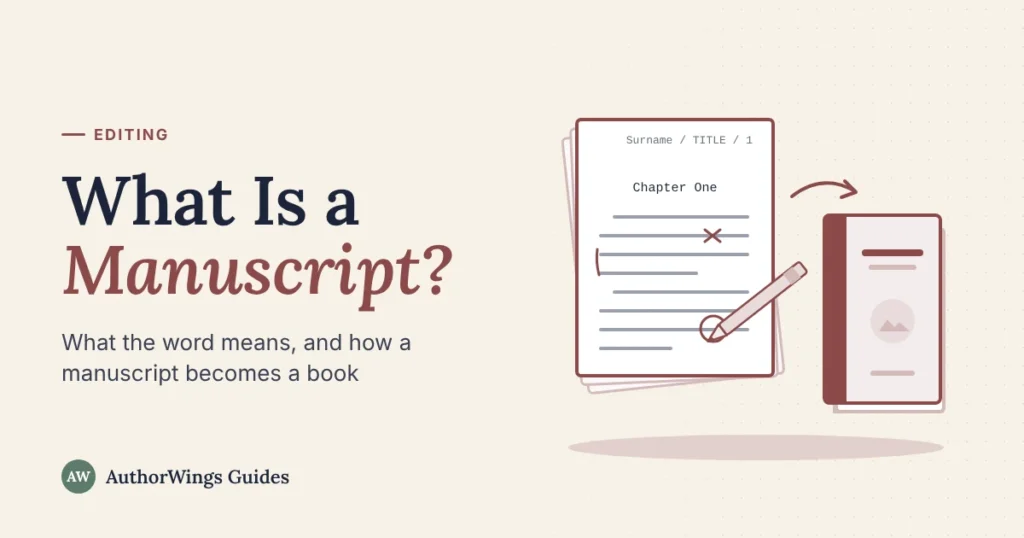
A manuscript is the author’s text of a book, article or other work before it is published. Today it is usually a Word file or Google Doc, not handwriting. It stays a manuscript through drafting, revising and editing. Once it is typeset, printed or released to readers, it becomes a book.
Whether you’re writing your first novel, a memoir or a business book, “manuscript” is the word editors, agents and publishers will use for your file until the day it goes on sale. This guide explains what the word means, how a manuscript differs from a book, what a finished one contains, and what happens to it on the way to print. If yours is ready for an editor, our book editing services start with a $49 sample edit.
What a manuscript means in publishing
In publishing, a manuscript is the unpublished version of a work: the copy an author writes, revises and sends to editors, agents or a publisher. The Oxford Learner’s Dictionary gives two senses: a copy of a book or piece of music before it has been printed, and a very old book or document written by hand before printing was invented.
The word comes from the Latin manu scriptus, “written by hand.” Until movable type printing spread through Europe from around 1450, books there were mostly copied by hand, as manuscripts. Writers kept the word when they moved to typewriters and then computers, so a 90,000-word Word file is a manuscript today.
The short forms are MS for one manuscript and MSS for more than one. You’ll still see them in submission guidelines and library catalogs.
Manuscript vs book: the differences
A manuscript is the text before publication; a book is the finished, published product built from it. The table shows what changes between the two.
| Manuscript | Book | |
|---|---|---|
| Status | Unpublished | Published |
| Who reads it | You, beta readers, editors, agents, a publisher | Anyone who buys or borrows it |
| File | A Word document or Google Doc | A print-ready PDF and cover file, an ebook file |
| Layout | Plain: one column, simple font, no design | Typeset: trim size, fonts, headers, page numbers |
| Editing | Any stage, from rough draft to fully edited | Edited and proofread |
| ISBN | None | One per format (what an ISBN is) |
| Copyright | Protected from the moment you write it down (US Copyright Office) | Same, plus a copyright page and the option to register |
| Changes | Edit freely | Changes mean a new upload or a new edition |
The same opening: manuscript page vs book page
Manuscript page
Plain, double-spaced, one simple font, for editing (see standard manuscript format)
Book page
Typeset at trim size, with designed headings and page numbers
Your manuscript is protected by copyright as soon as it’s written down, published or not. The pillar guide explains protecting your work before you share it.
From draft to book: what your file is called at each stage
Your text has a different name at each step on the way to print, and the names tell you who is working on it. The diagram follows one book from first draft to finished copy.
Manuscript
- 1
First draft
The first complete version, start to finish. Rough on purpose. Stuck halfway? See how to finish a stalled draft.Who: you
- 2
Revised manuscript
You rewrite after a rest, often with notes from beta readers.Who: you and test readers
- 3
Edited manuscript
An editor works on the file in tracked changes: developmental, then line, then copy editing. See the editing levels and prices.Who: an editor
Book in production
- 4
Proofs (galleys)
The text is laid out in the book’s final pages through interior formatting, then a proofreader checks those pages.Who: a designer and a proofreader
- 5
Advance reader copy
An optional early copy, or ARC, sent to reviewers before release. It may still contain typos.Who: reviewers
- 6
Published book
Printed, uploaded and on sale, with an ISBN for each format.Who: readers
The words overlap in everyday use. Some authors call any draft a manuscript, ARCs are often printed with “uncorrected proof” on the cover, and people use galley, ARC and proof loosely. What matters is the order: edit the manuscript first, then lay it out, then proofread the pages.
What a finished manuscript contains
A finished manuscript holds every word that will appear in the book, in three parts. Anything missing at this stage has to be edited and laid out later, which costs time twice.
Front matter
Title page, copyright page, dedication, table of contents, and an epigraph or foreword if the book has one.
Body
The chapters or sections, in order and complete. For guidance on length, see chapter length.
Back matter
Acknowledgments, an author’s note, and for non-fiction any notes, bibliography or appendix. An index is usually made later from the page proofs.
A picture book manuscript is different: it is the text alone, with short art notes where the words don’t tell the illustrator what to draw. Our guide shows a picture book manuscript page by page.
How long a manuscript should be depends on the kind of book. The pillar guide gives word-count targets by type, and memoirs have their own range in our guide to memoir length.
Non-fiction authors who want a traditional publisher often sell the book before the manuscript is finished, using a book proposal. Novelists usually need the complete manuscript first. Our publishing guide explains manuscript or proposal for agents.
Other meanings of manuscript
Outside book publishing, “manuscript” can mean three other things, and the context tells you which.
- Academic papers. In journals, the manuscript is the paper a researcher submits for peer review. The US National Institutes of Health defines the author accepted manuscript as the author’s final version accepted for journal publication, with all peer-review revisions, tables, graphics and supplemental material. For papers accepted on or after July 1, 2025, NIH-funded authors must submit it to PubMed Central, where it goes public with no embargo on the official publication date.
- Historical documents. Libraries and museums use “manuscript” for handwritten books and papers, such as medieval illuminated manuscripts. The study of old handwriting is called paleography (palaeography in British English).
- Music. A composer’s handwritten score is a manuscript, and the blank staff paper it’s written on is sold as manuscript paper.
Famous manuscripts that became books
Three well-known manuscripts show how much can change between the author’s pages and the published book.
- Frankenstein (Mary Shelley). Shelley wrote the novel in 1816 and 1817 in notebooks that her husband, the poet Percy Bysshe Shelley, annotated and corrected. The notebooks came to Oxford’s Bodleian Library on loan from 1974, the library bought them in 2004, and scans are online through the Shelley-Godwin Archive. The book came out anonymously on January 1, 1818.
- The Great Gatsby (F. Scott Fitzgerald). Fitzgerald wrote his draft in pencil, over 250 pages by September 1924, and a secretary typed it up. The publisher’s galleys carried the working title Trimalchio, and Fitzgerald rewrote heavily on those galleys in January and February 1925. Princeton University Library has the manuscript and galleys online.
- On the Road (Jack Kerouac). In three weeks in April 1951, Kerouac typed a single-spaced draft on long sheets of tracing paper and taped them into a scroll about 120 feet long. The novel was published in 1957 after years of revision. The scroll version itself was published in 2007.
All three were edited after the first full draft. Even a celebrated manuscript went through the same stages yours will.
When to get help with your manuscript
Get an editor when your manuscript is complete and you’ve revised it yourself at least once; the right edit depends on what the draft needs. See what a book editor does at each level.
- Not sure what it needs? An editorial assessment gives you written notes on the whole manuscript, with no edits in the file: $180, then $0.018 a word ($1,260 for 70,000 words). The fee is credited toward a full edit booked within 60 days.
- Ready for edits in the file? Book the levels in order: developmental, line, copy, then proofreading on the final pages. One lead editor handles the edit, with a fresh proofreader for the final check.
- Want to see an editor’s work first? A $49 sample edit covers up to 1,000 words in tracked changes, with a short note on which service your draft needs.
Book editing
Your manuscript, edited by people
Send us your manuscript and get a flat price by genre and word count. Every edit is done by a human editor and comes back in tracked changes.
- $49 sample edit
- Proofreading from $160
- Human editors only
Frequently asked questions
Is a manuscript the same as a draft?
Not quite. A draft is one version of the manuscript: your first draft, second draft and so on. The manuscript is the work itself, which goes through several drafts before an editor sees it. People often use the words loosely, but editors usually mean the latest complete version when they ask for your manuscript. A half-finished first draft is better called a work in progress.
What does MS stand for?
MS is the standard short form of “manuscript,” and MSS is the plural. The abbreviation comes from the Latin manu scriptus, “written by hand.” You’ll see it in library catalogs, scholarly notes and some publishers’ submission guidelines. In medical and academic contexts, MS can mean other things, so check the context.
What is an unsolicited manuscript?
An unsolicited manuscript is one sent to an agent or publisher who didn’t ask for it. Unsolicited submissions go into what publishers call the slush pile, read when staff have time. Large publishers such as Random House and Simon & Schuster say they don’t accept unsolicited manuscripts and point authors to literary agents, while some smaller presses take submissions directly. Always follow each publisher’s submission guidelines.
How many pages is a manuscript?
It depends on the word count, not the page count. An old rule of thumb counted a double-spaced manuscript page as about 250 words, so 80,000 words came to roughly 320 pages. Most agents and publishers now ask for the actual word count from your software instead, and a manuscript page count rarely matches the printed book, which fits more words on each page.
Related reading

AuthorWings editorial team
The AuthorWings editorial team writes and updates our guides for first-time authors. Every post is read and edited by a person on our team before it is published.